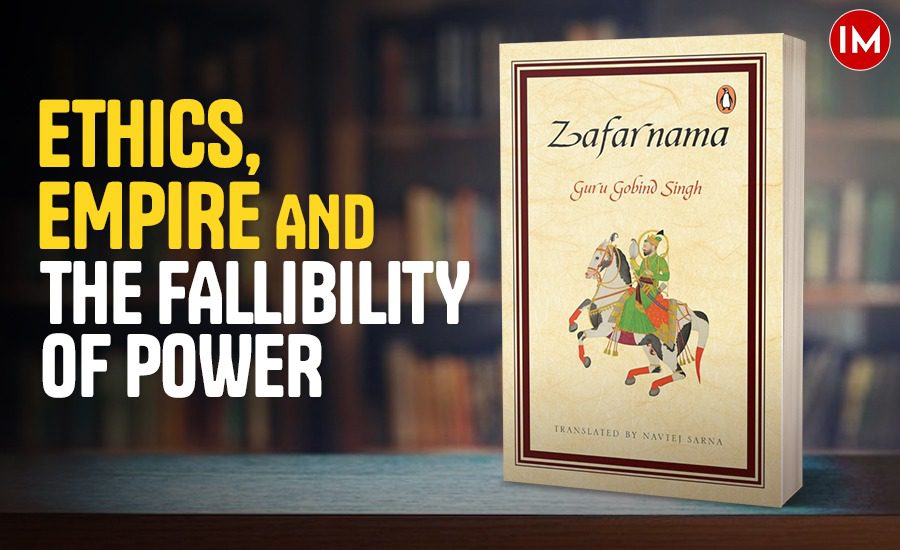
Twenty-two decades ago, in 1705 CE, the founder of the Khalsa and tenth Guru Gobind Singh of the Sikhs sent a Zafarnama (epistle of victory) containing these iconic lines to the Mughal Emperor Aurangzeb:
Chun kar az hameeh heelate dar guzasht
Halal ast burdan bi – shamsher dast
When all has been tried, yet/
Justice is not in sight/
It is then right to pick up the sword,/
It is then right to fight.
The Mughal empire was then at its zenith, and Aurangzeb held sway over all of Hindustan, which included nearly all of current-day India, Pakistan, Bangladesh and Afghanistan. But unlike the principled composer of this verse, the Emperor had violated a sacred oath taken on the Holy Quran. Even as he was facing adversity in war, the Guru wrote 111 stanzas in Persian – the language of the court – to convey to the Emperor the fundamentals of ethics, warfare, the concept of Kal (time) and Akal (timelessness). It indicted Aurangzeb and his commanders against a spiritual frame of judgment pointed at their lack of morality in governance and the conduct of war.
But before we delve into the Zafarnama, we may take a moment to understand the evolution of the Khalsa: a fitting response to the growing fanaticism of the Mughal emperors after the death of Akbar. In many ways the temporal authority of the Mughals ran parallel to the spiritual mission of Guru Nanak (1469-1539), the first Sikh Guru, who was forthright in his condemnation of Babur’s barbarity. In Var Majh, for example, he wrote:
The dark times are like a knife,/
The kings are butchers,/
Dharma has taken wings and flown,/
In the dark night of falsehood,/
The moon of truth/
Cannot be seen.
He was followed by Guru Angad who formalized the Gurumukhi script, Guru Amar Das who institutionalized the langar as integral to the Sikh church, and Guru Ramdas who was the founder of Harmandir Sahib. Guru Arjan Dev, the fifth Guru, started compiling the Bani of his predecessors, and the words of leading contemporary Bhakti poets like Farid, Namdev, Kabir, and Ravi Das. This formed the kernel of the Guru Granth Sahib (Adi Granth), which would be given its final shape the Guru Gobind Singh. Guru Arjan Dev was tortured to death by Jehangir, after which his son and successor, Guru Hargobind Singh decided that it was time to introduce martial vigour in the spiritual faith. He began wearing two swords by the waist – peeri, for spirituality; meeri, for temporality. The Akal Takht was built across the Harmandir Sahib, and heroic balladry was initiated to instill a new sense of confidence in the following. His grandson and successor Guru Har Rai incurred the wrath of Aurangzeb for having supported Dara Shikoh. After the very short Gurudom of his son Har Krishan, Guru Teg Bahadur from the village of Bakala and the father of Guru Gobind Singh, was accepted by the Sangat as their helmsman. Before his death, the tenth Nanak invested all the powers and the authority of Gurudom in the Adi Granth Sri Guru Granth Sahib which is why it is also called the living Guru.
Guru Teg Bahadur was martyred just across the Red Fort, the seat of Mughal power, at the spot on which Gurudwara Sis Ganj has been built, and his body was cremated at Gurudwara Rakabganj. All this had left a deep impact on the mind of the nine-year old Gobind, who, as JD Cunningham wrote in The History of Sikhs, ‘resolved upon awakening his followers to a new life, and upon giving precision and aim to the broad and general institutions of Nanak. In the heart of a powerful empire, he set himself to the task of subverting it, and from the midst of social degradation and religious corruption, he called up the simplicity of manners, singleness of purpose, and the enthusiasm of desire.’
Guru Gobind Singh was a soldier and a polyglot: in addition to swordsmanship, archery and equestrianism, he became proficient in Persian, Arabic, Sanskrit, Braj and Awadhi. He wrote highly accomplished texts like Chandi di Var (a ballad depicting the eventual victory of gods over demons) and spiritual uplifting psalms like Jaap Sahib, Sudha Sawaiye, Akal Utsat, Shabad Hazare, besides an autobiographical work, Bachitar Natak and narratives like Chaubis Avtar and Chandi Charitra. Finally, this epistle of victory, Zafarnama, which has been immortalised through its multiple translations in so many languages. What we have in our hands is a labour of love by diplomat-scholar Navtej Sarna, who has drawn from multiple sources in recreating this brilliant translation. One acknowledgement he makes is to the existing free translation of Zafarnama as part of the epic poem Chamkaur, done by his father, celebrated Punjabi author Mohinder Singh to whom this book is dedicated (along with his mother Surjit Sarna).
The first twelve verses of Zafarnama are an ode to the Almighty Lord. It is in many ways an elaboration of the mool mantra given by Guru Nanak: Ek Omkar. The Dastaan story begins with the 13th verse, where he clearly tells Aurangzeb: “I have no faith at all/ In the oath that you swear,/ That the God who is One ,/ Your witness does bear.”
In the 45th and 46th verses, he castigates the Emperor :
“Unaware was I that this perjurer,/ Worshipped no God, but gold/ His faith he had flung aside / His rotten soul, he had sold”, and “There is no belief in religion/ And faith is discarded/ The Lord is ignored,/ The prophet disregarded.”
However, he also gives Aurangzeb a chance to repent and relent, for in the 76th verse, the Guru writes: “The burden of your oath/ lies heavy on your head / You have to do the right thing/ and perform what you have said.”
The 107th and 108th verses talk of the transient world, and the wheel of Time:
“Be aware that the world is transient,/ Here today and tomorrow gone,/ The wheel of time is relentless/ It will take us all, one by one,” and “Beware the unrelenting turn/ Of Time’s faithless wheel:/ It turns for each and everyone / and hears no appeal.”
And finally, in the last stanza (111th) he tells the temporal king that he (Guru Gobind) has the protection of the spiritual Lord:
“A thousand plots of the enemy/ Full of treachery and fraud/ They cannot harm a single hair/ Of the one protected by God.”
The Zafarnama is a fine example of Persian verse, but more than that, it is a timeless declaration of independence and true triumph. It reinforces the point that physical victory and the acquisition of riches or territories are not the be-all and end-all of life. There is a life beyond this life which is to be measured not in the numbers of mortal years one has lived, but in the frame of whether or not one has followed the path of Dharma in what that word means as essence.
(Sanjeev Chopra is a distinguished retired Indian Administrative Service officer, former director of the Lal Bahadur Shastri National Academy of Administration, and an author-historian known for his writings on India’s governance and state formation)