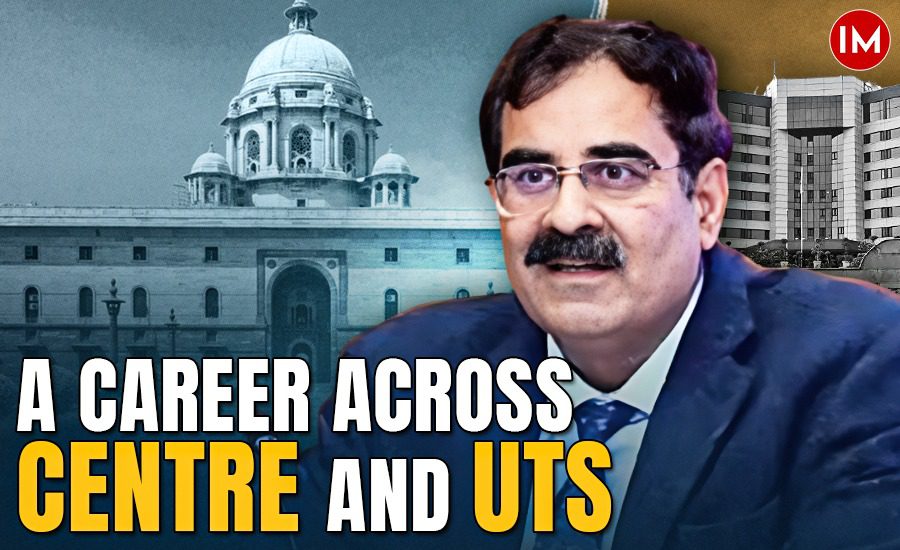
On October 1, 2025, senior IAS officer Rajeev Verma formally took charge as the Chief Secretary of Delhi, assuming one of the most demanding bureaucratic positions in the country. Appointed by the Ministry of Home Affairs, the 1992-batch officer of the AGMUT cadre succeeded Dharmendra (1989 batch), who retired at the end of September.
For Verma, the appointment is both a culmination of over three decades in public service and a return to familiar administrative terrain. With deep experience in Delhi’s governance ecosystem and long stints at the Centre and in Union Territories, he steps into the role at a time when the national capital faces heightened expectations on infrastructure, urban management, and policy delivery.
A STRONG ACADEMIC FOUNDATION
A native of Uttar Pradesh, Rajeev Verma’s journey into governance has been shaped by an unusually diverse academic background. He holds a Bachelor’s degree in Architecture from the Maulana Azad National Institute of Technology (MANIT), followed by a Master’s degree in Urban Design from the Delhi School of Planning and Architecture. He later earned an M.Tech from the Indian Institute of Technology (IIT) and also holds a postgraduate qualification in economics.
This combination of architecture, urban planning, engineering, and economics has given Verma a multidimensional perspective on administration—particularly relevant for a metropolis like Delhi, where infrastructure, finance, and governance intersect on a daily basis.
ENTERING THE IAS AND EARLY YEARS
Rajeev Verma joined the Indian Administrative Service in 1992 and was allotted the Arunachal Pradesh–Goa–Mizoram–Union Territory (AGMUT) cadre. Over the next three decades, he served in a wide range of roles across Delhi, Goa, and other parts of the National Capital Region, steadily building experience in district administration, transport, finance, and urban governance.
These early postings laid the groundwork for a career that would eventually span both state-level governance and senior policy-making roles at the Centre.
A FAMILIAR NAME IN DELHI’S POWER CORRIDOR
Delhi has been a defining chapter in Verma’s career. Long before becoming the city’s top bureaucrat, he handled several key responsibilities in the capital. Between 2018 and 2022, he served as Principal Secretary and Commissioner (Finance and Revenue) in the Delhi government, a role that placed him at the centre of fiscal management and revenue administration during a politically and administratively sensitive period.
Earlier, from 2017 to 2018, Verma was Principal Commissioner (Housing and Urban Affairs) at the Delhi Development Authority (DDA), where his academic grounding in urban design translated directly into administrative decision-making. He also served as Chairman and Managing Director of the Delhi Transport Corporation between 2012 and 2013 and held senior positions in the Transport and Revenue Departments.
Officials who worked closely with him describe him as an officer who balances strict adherence to rules with a practical understanding of ground realities—a trait considered crucial for governance in the capital.
EXPERIENCE AT THE CENTRE
Beyond Delhi, Verma’s career includes significant exposure to central ministries. From 2013 to 2017, he served as Joint Secretary in the Ministry of Defence, a posting that involved coordination across services, policy formulation, and large institutional systems. He also held responsibilities in the Ministries of Power and Health and Family Welfare, expanding his administrative footprint across critical public sectors.
This blend of central and state experience has given Verma a strong grasp of policy execution as well as inter-governmental coordination.
LEADING UNION TERRITORIES
In the years leading up to his appointment as Delhi’s Chief Secretary, Rajeev Verma served in top administrative roles in Union Territories. He was Chief Secretary of Puducherry and later Chief Secretary of Chandigarh. Most recently, from 2022 to 2025, he served as Advisor to the Administrator of Chandigarh.
These roles required navigating the unique governance structures of Union Territories, where administration often involves close coordination with the Centre. His tenure in these postings further strengthened his reputation as a steady and dependable administrator.
CHALLENGES FOR HIM
As Chief Secretary, Verma now heads Delhi’s administrative machinery and oversees coordination across departments. His responsibilities include steering key governance priorities such as infrastructure development, traffic and transport management, urban planning, fiscal administration, and environmental initiatives, including projects related to the rejuvenation of the Yamuna river.
He is also expected to play a critical role in implementing major policy initiatives of the newly formed BJP government in the capital, while managing the complex administrative relationship between the elected government and the Lieutenant Governor’s office.
A REPUTATION FOR BALANCE AND INTEGRITY
Within bureaucratic circles, Rajeev Verma is widely regarded as a calm, methodical, and balanced officer. Fluent in English and Hindi, he is known for combining rule-based governance with a practical approach to implementation.
Having already taken charge as Delhi’s Chief Secretary, Verma now stands at the helm of one of India’s most challenging administrative assignments. With a career shaped by technology, planning, finance, and governance, he is expected to bring steady leadership as the national capital navigates its next phase of administrative and urban transformation.