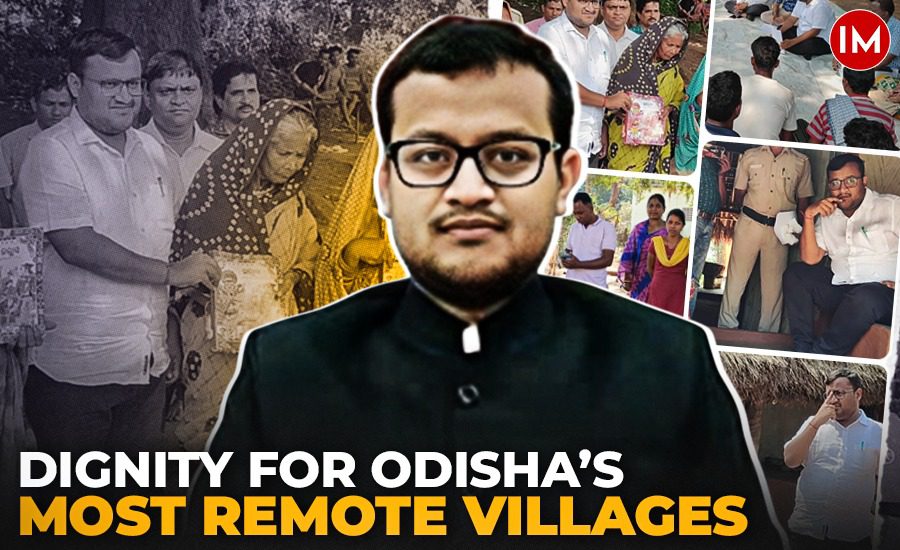
When IAS officer Akshay Sunil Agrawal (2019 batch, Odisha cadre), District Collector of Nayagarh, first began travelling across villages in the district, he noticed something unsettling. Nayagarh is often counted among the more developed districts of Odisha, yet scattered across its landscape were pockets of deprivation—places cut off from even the most basic state services.
“We realised that even in a district known for progress, there are villages that remain completely disconnected from the development story,” Mr. Agrawal said in a conversation with Indian Masterminds.
“These are the places that need focused attention.”
This realisation became the foundation of a district-wide transformation program—Mission Antyodaya. Derived from Sanskrit, Antyodaya means the upliftment of the last person in the line. Mr Agrawal and his team translated this philosophy into action by identifying the villages where development indicators were the weakest. Using data on literacy, housing, SC/ST population, electricity access, water, roads, and livelihoods, the administration mapped 15–16 such villages. Baseline surveys have already been completed in most of them.
One of the earliest and most striking examples of the challenges they encountered was the Nepal village. Deep inside a protected forest, located 10 km from the nearest motorable road, this settlement had long been invisible to the system. No electricity, no school, no drinking water, no Anganwadi center, and no government presence for years. “When I visited the Nepal village, I understood immediately that these families had been waiting for someone to simply show up,” Mr. Agrawal says.
“You cannot understand their situation while sitting in an office. You have to walk the same path they walk every day.”
QUICK WINS THAT CHANGED LIFE
One of the first administrative actions taken was the revival of a stalled Anganwadi centre. Funds were trickling in over years—₹2–5 lakh at a time—leading to delayed construction. Mr Agrawal sanctioned the remaining amount from district reserves, and within two weeks, the building was completed.
Education became another pressing priority. No child in the Nepal village attended school because the nearest one was too far and too unsafe to reach. The administration adopted a dual approach. Teachers from the nearest school now travel twice a week to conduct classes within the village. Uniforms and supplies were distributed to make classes familiar and structured. In the long term, a proposal to establish a primary school within the village has already been sent.
For older children aged 16–19, open schooling through the State Institute of Open Schooling (SIOS) has begun. Several children have also been enrolled in hostels and ashram schools. Initially, parents hesitated to send their children away. “We sat with every family, explained the benefits, and assured them that their children would be cared for,” Mr. Agrawal says.
“Once trust was built, many parents agreed—and today their children are studying with confidence.”
SOLAR POWER, ROADS, AND DRINKING WATER
Electrification was another major challenge. Extending grid power required forest clearances and significant time. Meanwhile, the administration deployed solar energy solutions—a simple yet effective step that households immediately benefited from.
Road connectivity was a more complex problem. Portions of the path fell under the Revenue Department, and others under the Forest Department. Through coordination between departments and funding via MGNREGA and rural connectivity schemes, work began on creating an all-weather road. “A road is not just a road in such areas. It’s access—to health, to markets, to the outside world,” Mr. Agrawal explains.
Drinking water was equally urgent. The existing borewell produced iron-rich, unsafe water. The district ordered installation of a new borewell with a solar-powered pump and filtration unit.
LIVELIHOODS AND HOUSING SUPPORT
Most households in these villages have no farmland and rely on daily-wage labour. Small-scale vegetable farming provides only seasonal support. Recognising the need for dependable income, the administration initiated goat-rearing and dairy-based livelihood projects. Around 20–25 families are being assisted through government schemes.
Housing, too, was a critical gap. Many families lived in fragile mud houses. They have now been included in Pradhan Mantri Awas Yojana and state housing schemes. Forest authorities were instructed to permit use of local material for construction since it is not for commercial use.
Furthermore, all eligible families have been linked to pensions and ration benefits. “People don’t ask for money; they ask for dignity,” Mr. Agrawal reflects.
“Basic comforts like shelter, electricity, water, and education are not luxuries. They are part of the right to live with dignity under Article 21.”
PRESENCE BUILDS TRUST
A significant part of the mission’s progress is rooted in the personal presence of the district administration. Mr. Agrawal himself has spent hours walking through difficult terrain, visiting each home and interacting with every family. He sits on the ground with villagers during meetings. “When you sit among them, not above them, they start to see you as someone who cares,” he says. “That changes everything.”
He often shares his own journey—leaving Maharashtra to study, working away from home—to help parents understand the value of education and the opportunities it can open for their children.
Gradually, villagers began sharing their aspirations. A small kitchen near the temple for community functions. A cremation ground. A multipurpose community space. These may look like minor demands in official records, but they hold immense emotional and cultural significance for the families who live there.
MAKING GOVERNANCE RESPONSIVE
Interestingly, once the administration began visiting regularly, local leaders and elected representatives also started engaging more actively. Even if some visits are politically motivated, IAS Akshay Sunil Agrawal views it positively. More attention leads to quicker solutions.
Perhaps the biggest learning, he says, is that development cannot happen in isolation. “No single government scheme can change a village,” he explains. “You need electricity, water, housing, nutrition, healthcare, roads, and livelihoods to work together. Only then does development last.”
BEYOND INFRASTRUCTURE: A MISSION OF RESPECT
Mission Antyodaya is not a one-year initiative; it is becoming a long-term district transformation framework. It focuses not only on physical infrastructure but also on restoring dignity and agency to families who felt unseen for decades.
“Our goal is simple—the last person should not feel like the last person anymore,” Mr. Agrawal says. “If the administration does not reach them, development loses its meaning.”
The work continues across Nepal, Panabari, Aseda, Tabeda, and other remote villages with similar challenges. Roads are being improved, solar energy is being expanded, livelihood options are increasing, children are entering classrooms for the first time, and trust between communities and government is deepening.
Mission Antyodaya is showing what focused administration, empathy, and coordination can collectively achieve. As IAS officer Akshay Sunil Agrawal puts it, “Development is not about buildings or statistics. It is about restoring dignity. When people feel seen and heard, real progress begins.”