The interview stage of the UPSC Civil Services Examination is often regarded as the most decisive and unpredictable phase of the selection process, where knowledge alone is not enough. It is the stage where personality, clarity of thought, confidence, decision-making ability, and administrative temperament are tested before an expert panel.
This year, with the Union Public Service Commission releasing detailed marks, it has become clear which candidates stood out in the Personality Test, with some securing exceptionally high interview scores that significantly influenced their final rankings.
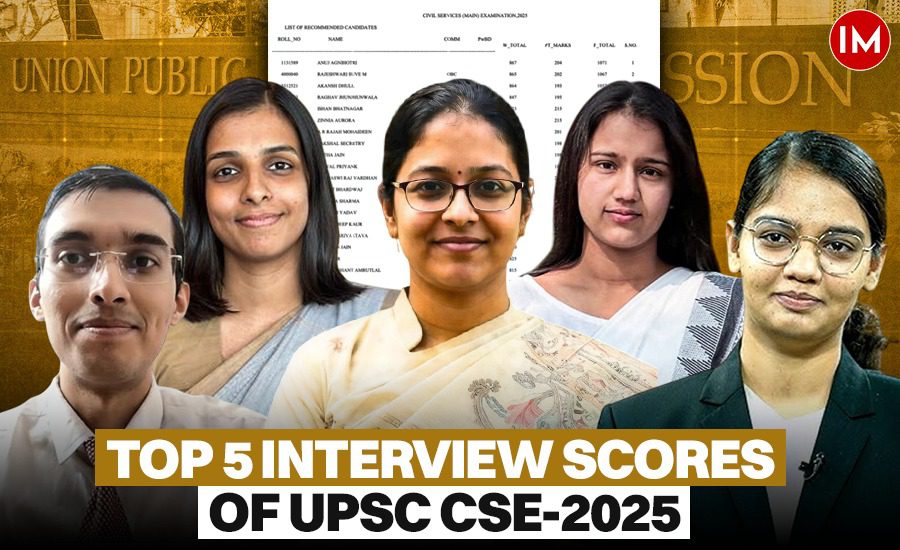
According to the detailed mark sheets, the highest interview scorer this year is Tejaswini Singh, who secured 225 marks, followed by Anjana B and Anita, who scored 220 marks each, Saurabh Sharma with 218 marks, and Komal Mavi with 216 marks. In comparison, AIR 1 Anuj Agnihotri scored 204 marks in the interview, while Deepak Baghel recorded one of the lowest interview scores among recommended candidates with 132 marks.
Profiles of the Top 5 Highest Interview Scorers
From Corporate Career to AIR 62: Tejaswini Singh Scored the Highest Interview Marks This Year
Tejaswini Singh has emerged as one of the most inspiring success stories of the UPSC Civil Services Examination after securing All India Rank 62 in her very first attempt, proving that focused preparation, discipline, and self-belief can produce extraordinary results within a short period.
Born and raised in Bokaro, Tejaswini completed her schooling at Delhi Public School Bokaro before pursuing Mechanical Engineering at Birla Institute of Technology Mesra, graduating in 2022. Her academic excellence was visible early – she not only built a strong engineering foundation but also secured an impressive 99.84 percentile in CAT, reflecting exceptional analytical ability.
After graduation, she joined ZS Associates as a Decision Analyst and worked there for nearly two years. Despite a promising corporate career, she chose to leave her job and dedicate one full year at home in Bokaro to UPSC preparation—a decision that transformed her life.
Coming from an accomplished family, Tejaswini drew strength from a highly supportive environment. Her father, Rajesh Kumar, serves as General Manager at Steel Authority of India Limited’s Bokaro Steel Plant, while her mother, Dr. Pallavi Parveen, is Professor and Head of the Botany Department at BS City College. Alongside academics, she remained active in dance and debating during school, reflecting a balanced and confident personality.
Her journey stands as a powerful example for aspirants: with clarity of purpose, disciplined effort, and courage to take bold decisions, even one year of dedicated preparation can lead to success in one of the country’s toughest examinations.
From Engineering to AIR 222: Anjana B Secures One of India’s Highest Interview Scores
Anjana B has emerged as one of Kerala’s standout UPSC achievers after securing AIR 222, along with an exceptional 220 marks in the Personality Test, making her one of the highest interview scorers in the country.
Hailing from Palakkad, Anjana comes from an engineering background and completed her graduation in Electronics and Communication Engineering. Soon after graduation, she began her civil services preparation with a disciplined and structured approach.
She chose Sociology as her optional subject, driven by her interest in understanding social systems and institutional functioning. Her preparation strategy emphasized conceptual clarity, answer writing, and personality development, supported by coaching guidance and test series.
What makes her journey especially inspiring is her interview score of 220, which reflects confidence, balance, and clarity of thought—qualities central to civil services. Beyond academics, Anjana enjoys journaling and watching sitcoms, helping her maintain mental balance during preparation.
Her success sends a clear message: patience, self-awareness, and consistency often define UPSC success.
From Rajasthan’s Fields to AIR 644: Anita Deora’s Journey Built on Sacrifice and Determination
Anita Deora also secured 220 interview marks, matching Anjana B and emerging as one of this year’s highest scorers in the Personality Test.
Hailing from Bhopalgarh, Anita comes from a modest farming family. Her father, Shyamlal Deora, is a farmer, while her mother worked in the fields to support her education despite financial limitations.
She completed schooling at Saini School Bhopalgarh, where she topped at the block level in Class 12—an achievement that became the turning point in her decision to pursue civil services.
Later, she moved to Delhi for higher education and joined Miranda House, completing both graduation and a Master’s degree in Mathematics.
After initial coaching in Delhi, Anita returned home and relied heavily on self-study and online resources. She cleared UPSC in her second attempt, proving how perseverance often matters more than speed.
Her success is now celebrated across Rajasthan because her story reflects how sacrifice, courage, and discipline can overcome difficult circumstances.
From Chartered Accountant to AIR 146: Saurabh Sharma’s Long Journey of Persistence
Saurabh Sharma secured AIR 146 with an impressive 218 interview marks, emerging as a strong example of sustained effort.
Originally from Bundi, Saurabh comes from an academically accomplished family. His father is a professor, his mother a government school principal, and his grandfather a practicing advocate.
A gold medalist in B.Com, Saurabh later qualified as a Chartered Accountant and worked as an Accounts and Enforcement Officer with Employees’ Provident Fund Organisation in Ahmedabad while preparing for UPSC.
Even after earlier setbacks and clearing Rajasthan Administrative Service, he continued because his ultimate goal remained IAS. Using Commerce and Accountancy as his optional subject, he refined his strategy through mock interviews, test series, and self-correction.
For nearly a decade, he reportedly followed a highly disciplined routine, often beginning at 4 AM with yoga and pranayama before long study hours.
His story reminds aspirants that persistence over time often produces the strongest results.
From Loni to AIR 314: Komal Mavi’s Second-Attempt Success While Studying at IIT Delhi
Komal Mavi secured AIR 314 with 216 interview marks, becoming one of the top interview performers this year.
A resident of Afzalpur village in Loni, Ghaziabad, she studied at Arwachin International School, scoring above 95 percent in both Class 10 and Class 12.
She later graduated from Hansraj College and is currently pursuing post-graduation at Indian Institute of Technology Delhi while preparing for UPSC.
Her optional subject was Chemistry. After not succeeding in her first attempt, she continued with renewed focus and cleared the examination in her second attempt.
According to her family, she often studied 15–16 hours daily, showing exceptional dedication.
Her journey sends a strong message: one failed attempt does not decide the final outcome – consistency and clarity do.
Lowest Interview Marks Among Recommended Candidates
Deepak Baghel stands out as an example of how strong written performance can offset a modest interview score.
He secured 132 marks in the interview, among the lowest among recommended candidates, but scored 814 marks in Mains, taking his total to 946 marks and earning AIR 602.
His result highlights that UPSC rewards overall consistency, and strong written marks can remain decisive.
Topper’s Interview Marks
Anuj Agnihotri, who secured AIR 1, emerged as the overall topper with 1,071 total marks, including 867 in Mainsand 204 in the interview.
Just four marks behind him, Rajeshwari Suve M secured AIR 2 with 1,067 total marks, comprising 865 written marks and 202 interview marks.
The mark sheet clearly shows how even small differences in interview performance can influence final rankings significantly.
How UPSC Final Marks Are Calculated
Before understanding final rank calculations, it is important to know how UPSC stages are structured.
The process begins with the Preliminary Examination, which is only a screening stage. Candidates who clear prelims appear for Mains, and those qualifying in Mains are called for the Personality Test at Union Public Service Commission headquarters in New Delhi.
For final ranking, marks are calculated out of 2,025 total marks –
- Written (Mains): 1,750 marks
- Interview / Personality Test: 275 marks
Only Mains and Interview marks are counted in the final merit list. Preliminary marks are not added.
This is why even a small difference in interview performance can dramatically alter final rank when written scores are closely matched.
Read Also: The rise of ‘Repeat Rankers’ in UPSC CSE 2025