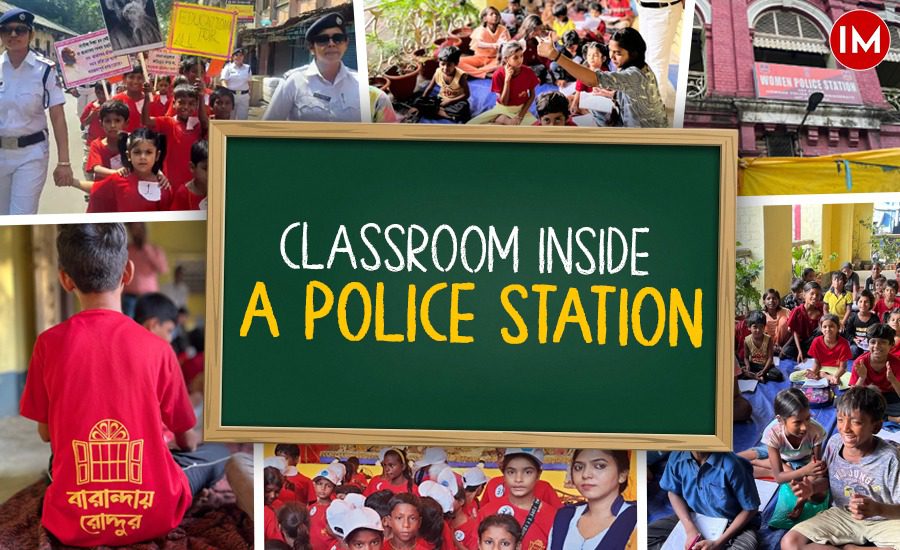
In a city where police stations are usually associated with complaints, investigations and legal procedures, one veranda in Howrah tells a different story every evening. At the Howrah Mahila Thana, the sound of sirens gives way to the rhythm of alphabets and multiplication tables. Here, women police officers have started an education initiative that is changing the lives of underprivileged children.
The programme, titled “Barandaye Roddur” (Sunshine on the Veranda), is run by the women personnel of Howrah City Police. Launched on March 11, 2024, under the guidance of Police Commissioner Praveen Kumar Tripathi, the initiative focuses on children from nearby slum clusters and railway-adjacent neighbourhoods who have either dropped out of school or never had access to formal education.
FROM POLICING TO TEACHING – AFTER DUTY HOURS
Every day around 4:30 pm, once official responsibilities slow down, officers exchange files for notebooks and case discussions for classroom instruction. Sub-inspectors, assistant sub-inspectors, constables and civic volunteers gather on the station’s veranda, ready to teach.
Children between the ages of three and fourteen sit in small groups, learning the Bengali alphabet, basic arithmetic, poems and moral lessons. Some arrived months ago, unable to recognise letters. Today, many can write their names and read simple sentences.
Unlike temporary outreach drives, Barandaye Roddur runs consistently. The officers volunteer their own time without disrupting their official duties. This daily routine has created structure and stability for children who often live in uncertain environments.
REACHING CHILDREN AT RISK
Most of the students come from areas near Ramkrishnapur Ghat and Howrah Station. Many had previously spent their days on the streets, helping families with informal work, begging, or simply wandering. Several were vulnerable to child labour and substance exposure.
Inspector Kakali Ghosh Kundu, who plays a key role in coordinating the classes, says the effort began when officers noticed a few children regularly loitering near the station. Instead of ignoring them, they decided to engage them.
What started with just two children gradually grew as word spread through nearby communities. Parents, initially hesitant, began sending their children after seeing positive changes.
Today, more than 50 children attend regularly.
EDUCATION PLUS ESSENTIAL SUPPORT
Barandaye Roddur goes beyond basic literacy. The programme recognises that education alone is not enough when children face multiple vulnerabilities.
Doctors periodically visit to conduct health check-ups. The children receive lessons on hygiene and personal safety, including awareness about inappropriate touch and self-protection — topics that are often overlooked in marginalised communities.
Each evening, hot meals are distributed to the students. For some, it is their most reliable source of nutrition. During winter, warm clothes are arranged. On festive occasions like Durga Puja, officers organise outings so the children can experience celebrations outside their daily struggles.
Local NGOs and volunteers assist with study materials and nutritional support, strengthening the programme’s reach.
COMMUNITY POLICING IN ACTION
Commissioner Praveen Kumar Tripathi has highlighted that the initiative reflects a broader vision of community-oriented policing. By addressing root causes such as lack of education and vulnerability, police can help prevent future social problems.
The programme has also changed how families perceive law enforcement. For many children, the police uniform once symbolised fear or authority. Now it represents mentorship and guidance.
Regular interaction has built trust between the station and surrounding neighbourhoods. Parents approach officers not only for safety concerns but also for advice regarding school admissions and documentation.
A REPLICABLE MODEL FOR WEST BENGAL
The success of Barandaye Roddur has prompted discussions about expanding the concept to other police stations in Howrah and potentially across West Bengal. Since the programme operates within existing infrastructure and relies on voluntary participation, it offers a cost-effective model.
Experts often emphasise that early education reduces the risk of juvenile crime, early marriage and substance abuse. By engaging children between ages three and fourteen, the initiative addresses this critical stage.
The veranda classroom may appear simple — a blackboard, chalk, floor mats — but the social impact is measurable. Improved attendance, better hygiene awareness and increased confidence among students reflect tangible progress.
The officers, despite demanding schedules, remain committed. Teaching has become part of their routine — not an obligation, but a shared responsibility.