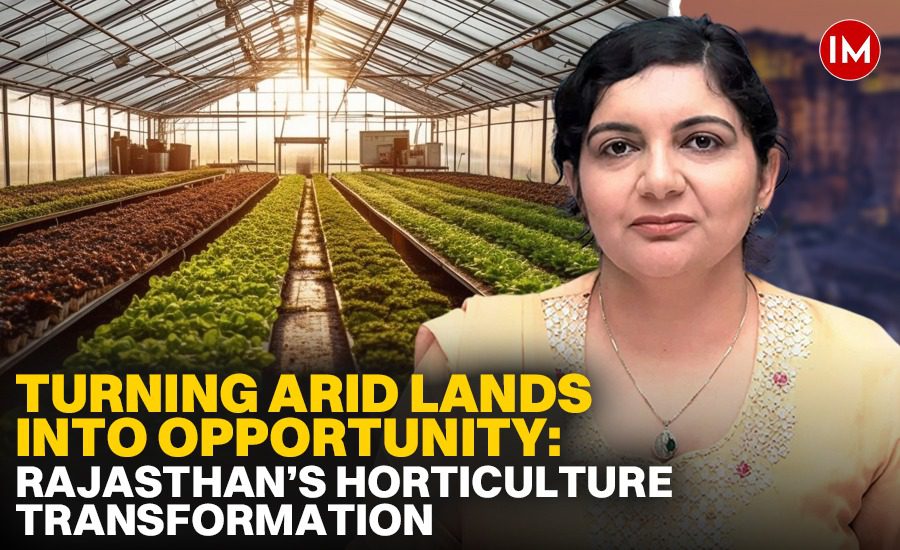
In a state long defined by its arid landscapes and water scarcity, a quiet agricultural transformation is taking root. Across Rajasthan, farmers are gradually shifting from traditional crops to high-value horticulture—redefining not just incomes, but also the future of food and nutrition.
At the heart of this shift is Rajasthan’s push towards climate-resilient agriculture, led by forward-looking policies and administrative leadership. Spearheading this effort is IAS officer Shubham Chaudhary, a 2014-batch officer of the Rajasthan cadre, currently serving as Commissioner, Horticulture Department.
“Horticulture is the future. It offers high-value crops and can significantly increase farmers’ income,” she says.
A STATE AT A CROSSROADS
With a rapidly growing population and shrinking agricultural land, Rajasthan faces a dual challenge—ensuring food and nutritional security while sustaining farmer livelihoods. Over 60% of the state’s population depends on agriculture, making this transition crucial.
Read More : Women Who Lead, Create and Inspire | Women’s Day Special
Changing dietary patterns and rising awareness about nutrition have also increased demand for fruits and vegetables. This shift is encouraging farmers to explore horticulture as a viable alternative to traditional farming.
“We need to make agriculture both sustainable and profitable. Horticulture helps us achieve both,” says Chaudhary.
STRENGTH IN DIVERSITY: RAJASTHAN’S HORTICULTURE POTENTIAL
Despite its harsh climate, Rajasthan has emerged as a leader in several horticulture crops—particularly seed spices. The state contributes significantly to India’s production of cumin, fenugreek, fennel, coriander, and isabgol.
It has also carved a niche in fruit cultivation. From kinnow orchards in Sri Ganganagar to mandarin belts in Jhalawar, and pomegranate cultivation in Barmer and Jalore—the diversity is striking.
Vegetable production too is robust, with onions, tomatoes, peas, and potatoes grown extensively. High-value vegetables like capsicum and cucumber are now being cultivated in controlled environments such as polyhouses.
DRIVING CHANGE THROUGH TECHNOLOGY AND POLICY
The transformation is being powered by targeted government interventions. Schemes like the Mission for Integrated Development of Horticulture (MIDH), solar pump initiatives, and micro-irrigation systems are central to this effort.
“Micro-irrigation, especially drip irrigation, is critical. It ensures precise water delivery and helps conserve resources,”Chaudhary explains.
Rajasthan has set ambitious targets to expand micro-irrigation across lakhs of hectares, with encouraging progress. Farmers are increasingly adopting integrated farming models—combining polyhouses, solar pumps, fertigation, and advanced techniques like plastic mulching.
“These clusters show how modern agriculture can be both sustainable and profitable,” she adds.
EXPLORING NEW FRONTIERS: MAKHANA, FLOWERS AND MORE
Beyond traditional crops, the state is now exploring new opportunities. One such focus area is makhana cultivation—traditionally associated with Bihar but now being tested in select regions of Rajasthan.
“Makhana has emerged as a superfood. Its demand has increased significantly, and we want our farmers to tap into this potential,” says Chaudhary.
Floriculture is another promising sector. Farmers growing flowers like gerbera and roses are not only earning higher incomes but are also exploring export markets.
These shifts signal a move towards diversification—reducing risk while enhancing profitability.
THE HUMAN FACTOR: CHANGING MINDSETS
While policies and technologies are enabling change, the biggest challenge lies in altering long-standing farming practices.
“It’s not about lack of awareness. Farmers are intelligent and well-informed,” Chaudhary clarifies.
The real hurdle is psychological—stepping out of comfort zones built over generations.
“Change requires leaving familiar practices, and that is never easy—for anyone,” she notes.
However, with increasing awareness, visible success stories, and government support, the transition is gaining momentum.
BEYOND INCOME: A PUSH FOR BETTER NUTRITION
The impact of horticulture goes beyond economics. It also holds the key to improving public health.
India’s diets are often heavily skewed towards carbohydrates, with inadequate intake of fruits and vegetables. Expanding horticulture can bridge this gap.
“Greater access to fruits and vegetables can improve nutritional balance by providing essential vitamins and minerals,”Chaudhary emphasizes.
Thus, the sector plays a dual role—boosting farmer income while enhancing dietary quality.
A QUIET TRANSFORMATION UNDERWAY
From spice fields in Jodhpur to fruit orchards in Kota, Rajasthan’s horticulture story is one of resilience and reinvention. It is a shift driven by necessity, enabled by innovation, and sustained by the determination of its farmers.
At the policy level, the vision is clear. At the ground level, change is visible—though gradual.
And as Chaudhary reflects, the journey ahead will depend on a simple yet powerful idea:
“Meaningful change begins when we are willing to step beyond our comfort zones.”
In the deserts of Rajasthan, that change has already begun to bloom.