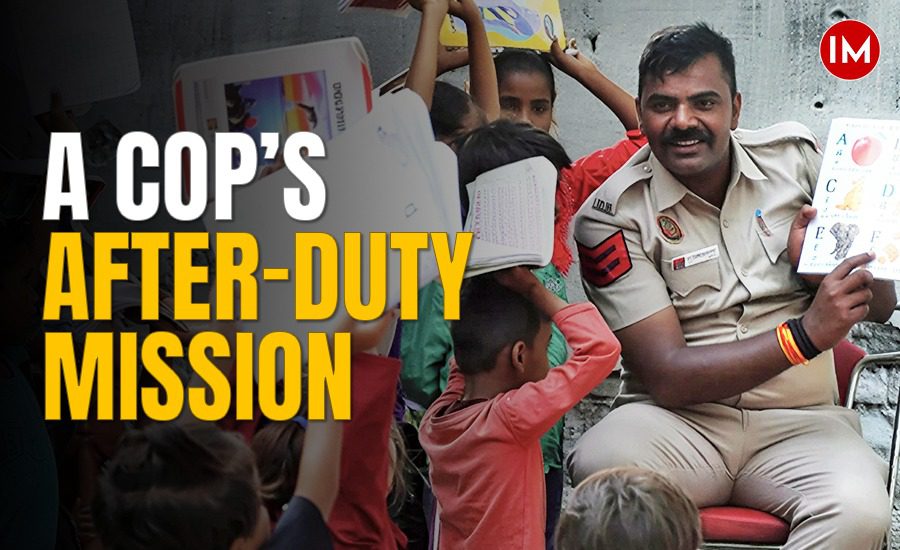
Every afternoon, just steps away from the imposing red sandstone walls of Delhi’s Lal Qila, something quietly extraordinary unfolds. As tourists drift away and traffic hums past, children with worn schoolbags gather near the Sai Baba temple in the Red Fort parking area. There are no gates, no blackboards fixed to walls, and no uniformed staffroom bells.
This is Than Singh Ki Pathshala, an open-air school run by Delhi Police head constable Than Singh, a place where learning happens on mats laid out on concrete, and futures begin to take shape.
A POLICEMAN, A PROMISE, AND NINE YEARS OF TEACHING
For the past nine years, Than Singh has spent his afternoons doing something far beyond the call of duty. After completing his police responsibilities, he turns teacher, not in a government building, but right on the premises of the Red Fort.
What started with just five children has grown into a daily gathering of over 100 students, supported by around 50 volunteers. The classes run every day from 3:00 pm to 5:30 pm, including Sundays, without charging a single rupee.
REACHING CHILDREN THE SYSTEM MISSED
Most of the children who come to the pathshala are from nearby slum areas. Many had once spent their days rag picking or doing odd jobs to support their families. School was not part of their routine or even their imagination.
Today, nearly 80 such children are studying regularly because one policeman decided that access to education should not depend on income or address.
WINNING PARENTS BEFORE TEACHING CHILDREN
The hardest lesson did not involve letters or numbers. It involved trust.
“These children’s parents come from low-income groups. Initially, they were scared about sending their kids to school, so I decided to remove that fear,” Than Singh shared with the media.
He spoke to parents again and again, explaining what education could do and how it could change the direction of their children’s lives. Slowly, hesitation gave way to belief. Conversations turned into consent. And consent turned into attendance.
A COMMUNITY THAT MOVED WITH HIM
The school did not grow alone. Battery rickshaw drivers began helping by transporting children from their homes to the pathshala. Volunteers stepped in to teach. Donations started coming in, in the form of notebooks, pencils, time, and effort.
The school runs entirely on donations, with no formal funding and no fees. Singh’s rule is simple: anyone who wants to help should come, meet the children, and contribute directly.
FROM AN OPEN FLOOR TO SCHOOL TOPPERS
The results are already visible.
Several students from Than Singh Ki Pathshala have been enrolled in formal schools. Nine of them went on to become class toppers.
“These kids proved wrong those who said they wouldn’t be able to achieve anything,” Singh stated.
For children once written off as unlikely to succeed, the classroom near the Red Fort became a launchpad.
A PLACE WHERE CHILDREN LEARN TO DREAM
Beyond textbooks, the pathshala offers something rarer: a permission to dream.
“I want to become an IPS officer, and I think I should prepare for IPS in this school,” says one young girl, sitting cross-legged in the open-air class.
In a space without walls, ambitions are not limited by circumstances.
ONE COP, ONE CLASSROOM, MANY FUTURES
As the sun dips behind the Red Fort and classes wrap up, the parking lot slowly returns to its usual rhythm. But something remains changed.
Through patience, consistency, and community support, Than Singh Ki Pathshala continues to open doors for children who once stood outside the education system altogether, proving that sometimes, the most powerful schools don’t need buildings, only belief.