When Dev Tomar introduces himself, he often begins with geography—and then history. He is from Gwalior, he says, but his family roots lie in Morena, a district in Madhya Pradesh long associated with rebellion and outlaw culture. In his own family tree, that reputation was not just folklore.
His grandfather, he recounts matter-of-factly, was a rebel dacoit in his time. The shift came with his father, who chose classrooms over conflict and eventually retired as a college principal in the state government system.
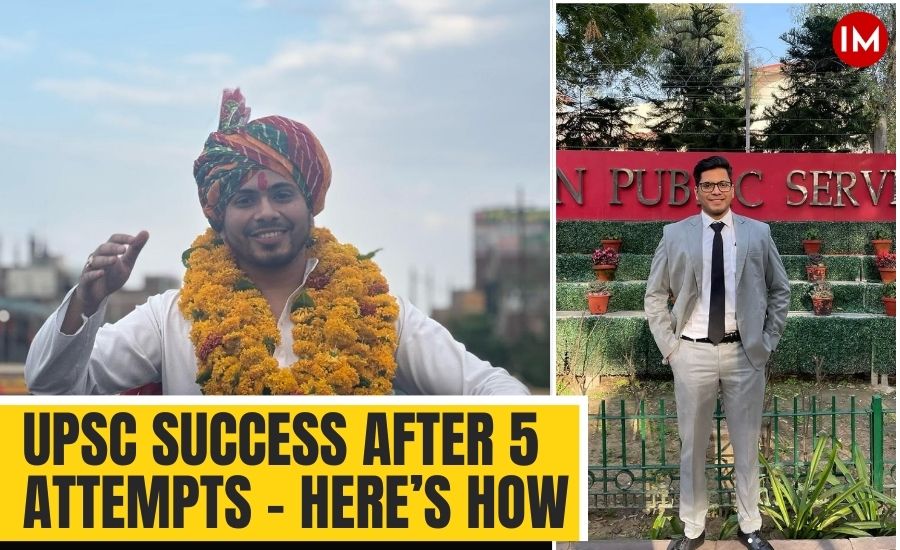
That shift—from rebellion to education—quietly shaped Dev Tomar’s life. In 2024, after five attempts and years of uncertainty, he cleared the UPSC Civil Services Examination with an All India Rank of 629 and was allotted the Indian Railway Management Service (IRMS). His journey, however, is less about dramatic transformation and more about deliberate choices, risk-taking, and learning the hard way.
“In our family, there was a history of rebellion, but my father entered academics. Seeing him, I naturally developed an interest in studies,” Dev shared with Indian Masterminds.
AN IIT GRADUATE IN A GLOBAL CORPORATE ROLE
Academically inclined from school, Dev opted for Physics, Chemistry and Mathematics in Classes 11 and 12 and set his sights on the IITs. He cracked JEE Advanced and joined IIT Roorkee, graduating in 2019. Like many IIT alumni, he moved quickly into the private sector, working as a scientist with Philips, a multinational company headquartered in the Netherlands.
By any conventional metric, his career was on track. The job was technically rewarding and well-paid, and living abroad exposed him to global work culture. Yet, something remained unresolved.
“Government service offers a stability that the private sector doesn’t, but more than that, I felt there was scope to actually take decisions that affect people’s lives.”
The idea of public service was not sudden. Growing up, Dev had seen district officials visit his area to implement schemes. Programmes like Ladli Behna Yojana and the Accessible India Campaign left a mark on him—not as slogans, but as visible interventions. With his father in government service and several uncles serving in the armed forces, the administrative ecosystem was not alien to him.
After spending some time in the Netherlands, he made a decision many questioned: to return to India and prepare for the UPSC examination.
FIVE ATTEMPTS, ONE LONG LEARNING CURVE
Dev’s UPSC journey stretched across five attempts. The first was while he was still working at Philips; the others were full-time preparation. He does not romanticise this phase. The pressure, he admits, was intense—not because of family expectations, but because of societal commentary.
“People kept asking why I left a high-paying job. There was no family pressure to do UPSC; in fact, they were satisfied with my private-sector career.”
Friends and acquaintances often told him he was already successful and should move on. Even well-meaning advice carried its own weight: too much time has passed, you have better options. The psychological impact, he says, was real.
What changed over the years was not just his knowledge base, but his understanding of the exam itself. His early mistake, according to him, was staying overly focused on prelims.
“I remained prelims-oriented for too long. Once prelims is cleared, if you don’t upgrade your preparation, your performance actually drops in later attempts.”
The turning point came when he adopted an integrated strategy—treating prelims, mains and interview as parts of a single continuum rather than separate battles.
MAINS FIRST, ALWAYS
Dev’s preparation philosophy is clear and unapologetic: prepare for mains first. He completed the GS syllabus early, wrote regular tests, and focused on answer writing even when prelims were months away. Current affairs, he argues, become easier to retain for prelims once you have written about them analytically for mains.
“If your content is ready for mains, prelims facts automatically stick better because you’ve already processed them deeply.”
He also stresses the importance of consistency in test series—two to three full-length tests a month at a minimum—and early inclusion of the optional subject. During this phase, he supplemented his income by mentoring JEE aspirants, which helped him stay academically engaged and financially stable.
Contrary to popular belief, Dev did not rely heavily on coaching. He favoured self-study, structured schedules, and selective mentorship over classroom programmes.
“Don’t follow every topper video. Choose one strategy, make it your own, and stick to it without changing direction every few months.”
THE INTERVIEW ROOM: EXPERIENCE OVER FACTS
By the time Dev appeared for his third consecutive interview, his scores had steadily improved—from 179 to 185, and finally 193 in 2024. For him, the interview is less about encyclopaedic knowledge and more about clarity, composure and articulation.
Some panels, he notes, are more factual and situational, leaving little room for discussion. Others deliberately probe opinions. In one earlier interview, he was confronted with a controversial assertion about women drivers being less efficient. He countered it calmly, pointing out that training, not gender, determines competence.
Another question challenged his very choice of career, citing examples of civil servants leaving the service for private pursuits. His response was simple: the administrative system still offers unmatched scope for action.
LIFE BEYOND THE SYLLABUS
To cope with the long years of preparation, Tomar leaned on his hobbies. Music—guitar and drums—offered release, while regular workouts kept him grounded. An interest in automobiles, which he openly mentioned in his Detailed Application Form, gave interviewers an insight into his personality beyond textbooks.
Notably, he had no elaborate Plan B.
“It was a no–Plan B situation. If it happens, good. If not, I would decide instantly what to do next.”
That mindset, he says, reduced hesitation. Once the decision to attempt UPSC was made, he committed fully.
A MESSAGE SHAPED BY EXPERIENCE
Now part of the Indian Railway Management Service, Dev Tomar looks back without bitterness or exaggeration. His advice to aspirants is practical, born of trial and error rather than theory: manage time ruthlessly, build discipline, and avoid postponing targets.
Above all, he emphasises clarity—about why you are preparing and how you plan to get there. UPSC, in his view, is not about extraordinary talent but about sustained execution over years.
His story—from Morena’s complicated past to a central service in India’s largest public-sector organisation—stands as an account of steady resolve, informed strategy and the willingness to stay the course even when the odds felt uncertain.