The 2024 General Election of India has concluded, with the BJP-led NDA forming the government and Narendra Modi becoming Prime Minister for the third consecutive term. However, this election brought some surprises. For the first time since 2014, the BJP fell short of a majority, winning only 240 seats. Meanwhile, the opposition alliance, I.N.D.I.A, saw significant growth, securing 234 seats in total.
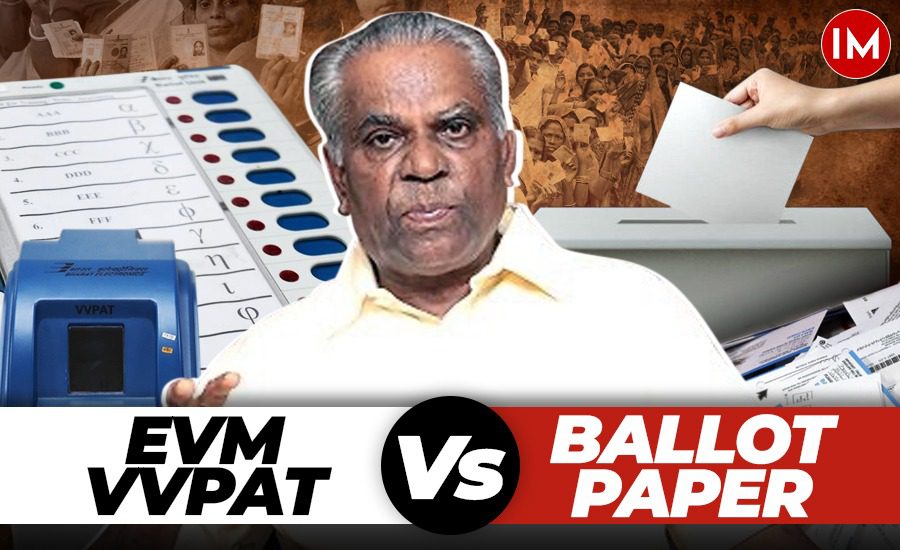
Unlike previous elections, there was less talk or criticism about the efficiency of Electronic Voting Machines (EVMs). However, the debate is far from over. Retired IAS officer Mr. MG Devasahayam, who is also the coordinator for the Citizen Commission on Elections (CCE), asserts that political parties criticize the EVM-VVPAT system based on their convenience rather than scientific evidence. The CCE, formed after the 2019 general elections, conducted a scientific study with experts from around the world and concluded that EVMs do not comply with the basic principles of democracy.
This finding suggests that the debate over the reliability of EVMs is ongoing and remains a critical issue for ensuring democratic integrity in India.
In an exclusive interview with Indian Masterminds, retired officer and columnist Mr. Devasahayam shared his concerns. He said, “As a civil servant, I’ve conducted many elections, from local to general. To the public, voting might seem straightforward, but we know what happens behind the scenes. In our commission, we studied different voting methods and found that EVMs lack complete verifiability. There are serious concerns that can’t be ignored. We have submitted our report to the Election Commission of India, but they are not open to any debate or discussion.”
END TO END VERIFIABILTY
In any democracy, citizens should be able to confirm that their vote was cast as intended, recorded correctly, and counted accurately. The EVM-VVPAT system fails to ensure this. VVPAT only verifies that the vote was cast as intended. Mr. Devasahayam claims there have been reports of discrepancies where something different is recorded than what was shown. Additionally, the VVPAT slips are not counted. “Many senior citizens and those unfamiliar with the system may not be able to verify the slips. They count what voters haven’t seen; they don’t actually count the slips,” says the retired officer.
In a democracy, voting is not merely a routine exercise to elect a leader. “Every eligible citizen has the right to vote, and through their votes, they transfer their sovereignty. Therefore, they have the right to ensure their vote is counted accurately and without any manipulation,” adds the officer.
ONLY HUMAN ERROR IS POSSIBLE
Mr. Devasahayam argues that the time taken to count votes using ballot papers and EVMs is almost the same, so efficiency is not a concern. “All advanced democracies with advanced technology still use ballot papers because they are the gold standard,” he says.
Addressing concerns about vote manipulation and human error, he explains that with ballot papers, errors are limited to tens or hundreds and are only human mistakes. However, with EVMs, there is room for both human and mechanical errors, potentially affecting millions of votes. “With ballot papers, we can trace where an error happened, but EVMs increase the scope for manipulation. We can’t determine who tampered with the system or from where,” he explains.
He also mentions that the issue of booth capturing is outdated. “In the past, we lacked good transportation, communication, or security, but now we have ultra-modern technology. Communication is instantaneous, and any mishap can be investigated. This isn’t possible with the EVM-VVPAT system,” Mr. Devasahayam points out.
In essence, he believes that the traditional ballot paper system is more transparent and reliable. Despite technological advancements, the potential for manipulation and error in EVMs remains a significant concern, making ballot papers the preferred choice in many advanced democracies.