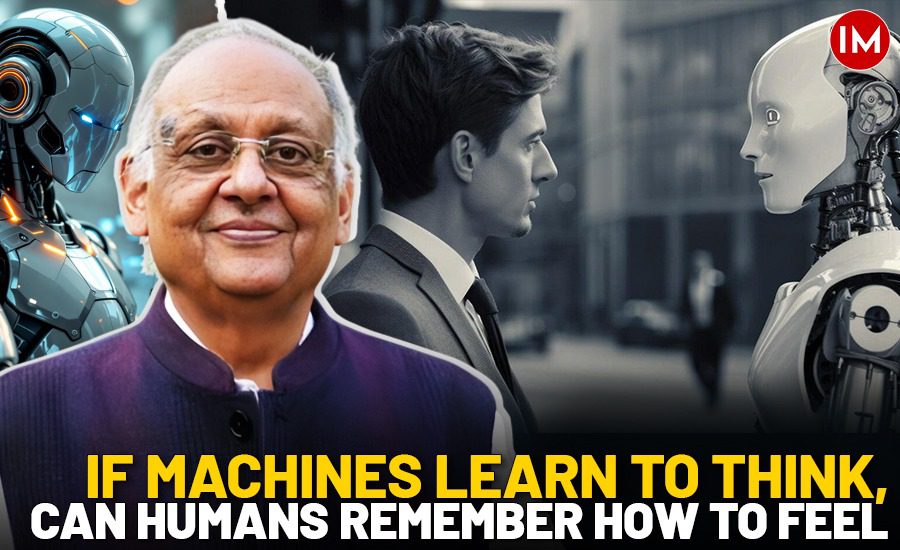
“The greatest danger of the future is not that machines will think like humans – but that humans will start thinking like machines.” – Sydney J. Harris
In 2035, society will not merely be a collection of technologies, cities, and economies – it will be a living reflection of our collective choices, emotions, and values. The next decade will determine whether humanity builds a world of connection and compassion – or drifts into loneliness, surrounded by intelligent machines.
Human civilization is crossing one of its greatest thresholds. Artificial intelligence, biotechnology, quantum computing, and immersive digital realities are rewriting every script — from work and health to relationships and governance. The village square has become virtual, the classroom global, and the workplace intelligent.
Yet, beneath this progress lies a quieter transformation — one shaping what it means to be human. We are no longer just users of technology; we are becoming partners, creators, and sometimes prisoners of it. Society@2035 will be defined not by the gadgets it owns, but by the quality of human life it enables — our sense of belonging, purpose, and shared destiny.
In 2035, loneliness may still be one of society’s greatest diseases. As virtual reality blurs the line between real and digital relationships, emotional authenticity will become precious. Many will live surrounded by digital assistants who understand their moods — but not their souls.
At the same time, others will thrive in hybrid communities — circles of purpose that use technology to strengthen connection, not weaken it.
Waking Up in 2035
Your home senses your mood before you speak. The walls change color to calm your mind. Your health data — heart rate, stress, sleep — syncs instantly with your AI wellness companion. You don’t visit a doctor for routine issues; your wearable detects illness days before symptoms appear and prescribes nutrition or therapy.
Work has changed, too. Many professions have merged with AI collaboration — lawyers use cognitive agents, teachers use emotion-aware tutors, and farmers rely on climate-predictive algorithms. The 9-to-5 office is history; people work flexibly, focusing on creativity and problem-solving rather than routine tasks.
Education is lifelong. Learning pods, powered by AI mentors, adapt to each person’s curiosity. Children learn empathy, ethics, and systems thinking as seriously as coding or math. The goal of education is no longer employment — it is enlightenment.
Governments have evolved into digital democracies. Policies are simulated on national AI platforms before implementation. Citizens interact through transparent civic dashboards, seeing where taxes go and how their inputs shape governance. Corruption is reduced not by policing but by data visibility.
And yet, amid all this intelligence, humanity’s deepest challenge remains — how to stay human in a world run by machines.
The Emotional Landscape
In 2035, loneliness may engulf humanity. As virtual reality blurs the line between real and digital relationships, emotional authenticity will become precious. Many will live surrounded by digital assistants who understand their moods — but not their souls.
At the same time, others will thrive in hybrid communities — circles of purpose that use technology to deepen empathy. Festivals, rituals, and storytelling traditions will find new digital forms, connecting generations and cultures. The elderly will find companionship in intergenerational virtual families; children will grow up learning from global mentors, not just local teachers.
Society@2035 will be a mirror — reflecting both the human yearning for connection and temptation of isolation. The question will not be, “What can technology do for us?” but “What will we allow it to do to us?”
The Architecture of Society
By 2035, societal systems — health, education, economy, governance — will be interconnected ecosystems rather than isolated sectors:
i) Healthcare will shift from treating illness to preserving wellness. AI-driven prediction, genetic mapping, and personalized care will make hospitals less central, while home-based health hubs become common.
ii) Education will blend physical and virtual spaces. AI tutors will track emotional engagement, not just test scores, nurturing curiosity and empathy.
iii) Economy will be data-driven and decentralized. Blockchain-like systems will enable citizens to own and trade their personal data safely.
iv) Governance will become anticipatory. AI will detect social unrest, environmental threats, or economic shocks early — allowing governments to act before crises strike.
But this “smart society” must also be a wise society — one where ethics, inclusion, and sustainability anchor every decision. Otherwise, efficiency will triumph over empathy, and progress will hollow out meaning.
The Human Question
As technology amplifies intelligence, humans must amplify wisdom. Machines will predict, optimize, and decide — but only humans can care, forgive, and dream. The defining skill of 2035 will not be coding or data analytics — it will be emotional literacy: the ability to understand, manage, and nurture human feelings in a digital world. Families, communities, and workplaces will have to consciously cultivate this. Schools will teach not just AI ethics, but digital empathy. Workplaces will measure not only productivity, but also well-being. Success will shift from individual achievement to collective flourishing.
In such a world, spirituality may quietly return — not as religion, but as a search for connectedness beyond algorithms. People will crave meaning, silence, and authentic human touch — luxuries that no technology can simulate.
But the same forces that can uplift humanity can also undo it.
If power remains concentrated — in corporations that control data, or states that monitor citizens — society may slide into a technological feudalism. Privacy could vanish, truth could fragment, and human free will could fade into algorithmic manipulation. AI could create digital hierarchies — the “data-rich” and the “data-poor.” Biotech enhancements might widen the gap between those who can afford genetic optimization and those who cannot. Even love and trust could become programmable, traded as experiences rather than emotions.
In such a world, we might achieve convenience but lose conscience.
Principles of a Humane Future
To prevent that outcome, we must anchor Society@2035 in timeless human values:
i) Compassion must guide innovation — designing for inclusion, not exclusion.
ii) Trust and transparency must shape governance — making data a public good, not private weapon.
iii) Responsibility must govern AI — every algorithm should be auditable, explainable, and accountable.
iv) Equity must define opportunity — ensuring no one is left behind by the digital divide.
v) Sustainability must guide consumption — because no intelligent society can exist on a dying planet.
These values are not optional — they are the foundation stones of a civilization worth inheriting.
Way Forward
The path to Society@2035 begins now — in small, everyday choices. Every parent who teaches empathy alongside screen skills, every teacher who inspires curiosity instead of conformity, every entrepreneur who designs for humanity, every policymaker who places ethics before efficiency — all are building the architecture of tomorrow’s world.
We must learn Future Literacy — the ability to imagine, understand, and shape change consciously. For the future is not something that happens to us; it is something we create, moment by moment.
We reimagine the world@2035, not as the triumph of machines, but the renaissance of humanity. A world where technology is invisible, and human connection is visible again. Where AI augments empathy, not replaces it. Where every innovation deepens dignity. Where progress is measured not by GDP, but by Gross Human Well-Being.
In such a society, people will look back at the early 21st century — not as the age when machines rose, but when humans redefined themselves.
If we nurture empathy as fiercely as we build technology, 2035 will not divide us — it will finally unite us.