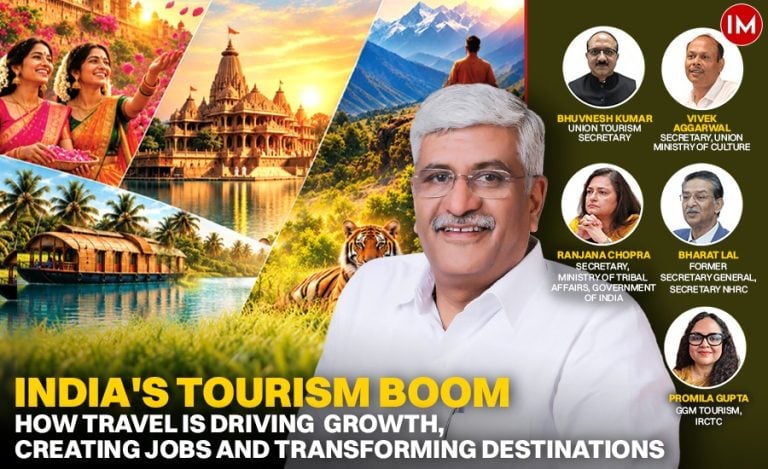
The number of domestic tourist visits in India has more than doubled over the past twelve years, while foreign tourist arrivals have also witnessed an increase of over 50 per cent.
And why not? India has everything that makes it an attractive tourist destination — magnificent rivers, mountains and lakes, a rich cultural heritage, lush forests and diverse wildlife.
But how can India unlock its vast tourism potential? What steps is the government taking to improve tourism infrastructure, attract more foreign visitors, generate employment and enhance the overall tourist experience? And what is the vision for making India a leading global tourism destination by 2047?
To explore these questions, Mr. Sharad Gupta spoke with Mr. Gajendra Singh Shekhawat, Union Minister of Culture and Tourism, about India’s tourism growth, emerging opportunities and the government’s roadmap for the sector. Here is the interview:
First of all, what do you think is the biggest reason for this increase in the last 12 years?
In the last few years, the way India has worked on infrastructure, new expressways were built, new highways were built, new airports were built in India, the number of airports in India has increased by more than double, the railways of the new generation have started in India, the time for commutation has been reduced. This has made commutation easier in India. India has progressed economically. And the size of India’s economy has increased by more than double in the last 12 years.
This has created opportunities for tourism. Third, the way the government has made policies, and because of these policies, on one hand, per capita income has increased, and on the other hand, people have dispensable money due to tax reduction. Because people had money to spend, domestic travel has increased due to these policies.
Watch here :
The way the government has developed tourism spots, the way the government has developed tourism spots, the way they have developed tourism spots in a focused manner, the way the states have incentivised policy planning, the result of which has been that the overall tourist experience has been elevated on tourist spots. The work that has been done from this perspective, has given the tourists a better experience. India has progressed and the world has changed its view of India.
So, definitely it has also worked to increase tourism in India. India’s image has also changed. The way the Prime Minister has started showcasing India all over the world through various schemes, he has also worked to increase tourism in India.
Apart from destination-based tourism, there is a new vertical of wellness tourism, a new vertical of medical value tourism, a new vertical of mice tourism, which has registered the highest growth in the world in India in the last year. In this new generation of tourism, India has changed its position and has also helped to increase tourism in India. So, because of all these reasons, tourism has increased today.
And as you said, the total number of domestic tourism trips has registered more than 400 crores in the last year. And the increase of foreign tourists in the world is also one of those countries who have been able to recover the pre-Covid situation in a V-shape. But foreign tourists did not come in the proportion that was domestic. So, what is the reason for this?
See, when domestic tourism increased, our travel infrastructure, which takes a gestation period, came under pressure. As demand increased, the supply-demand gap increased. The cost too increased. So, competitiveness decreased comparatively. Our air travel became expensive, our hotels became expensive. And because of that, foreign tourists, especially budget-class travellers, who used to be maximum, found our peer competitors, be it the Middle East countries, Sri Lanka, Maldives, Dubai, Singapore as cheaper alternatives.
Because our domestic purchasing power capacity increased. So, with the domestic growth, the international travel numbers did not grow. The government started working on it. Policy initiatives, states started giving incentives. We will definitely see its impact in the future.
At national level, infrastructure like roads, trains, flights, everything is very good. But at the local level, civic infrastructure has not increased in that proportion. So, the wholesome experience that tourists get, isn’t good.
You are right. For a tourist, overall experience counts. After getting down from the airport, going to their destination, staying there, how was the travel experience? How were the roads? How was the cleanliness? What was the level of cleanliness? How trained and professional were the guides? How comfortable was the hotel? Were the signages good? Was there seamless travel? How were the local craftsmen behaving with them? How did the taxi driver work with them? All these things matter. We started working on this from two perspectives.
First, in Ekta Nagar, we learned from the Prime Minister’s initiative. We made destination management authorities We started working in that direction. So that people can see all these things holistically.
We also trained Human Resources Capital, the frontliners who come in direct contact with tourists. We trained our stakeholders about their sanitation, their behaviour. We started working on that too. I think this will have a positive impact.
Religious Tourism is the sector that has seen the maximum growth in the last 12 years. Was this strategically done?
Yes, the corridors that have been built, as I said, the investments that the government has made on them, be it in Ujjain’s Mahakaal Lok, on the Kashi Vishwanath Corridor, in Kedarnath, in Jagannath Dham, in Somnath, their infrastructure development will not only increase the number of touristswhose paying capacity has increased. The person who had dispensable money, will be the first to leave the house.
With Prime Minister’s efforts, 25 crore people left the poverty line. And they are leaving the house to go on a pilgrimage with wife, parents and family?
Many things matter in tourism. Not just the number of tourists, but also how many days they are staying in one place, how much money they are spending. How are we faring on these counts?
First of all, no matter who the tourist is, his experience should be elevated. Secondly, focusing on high-value tourists is a part of our policy.
From marketing strategies, and to make their travel seamless, and to give them a high-end experience, authentic experience, we are working in this direction. Definitely, in terms of tourism, on one hand, for foreign currency.
In the last year, we have earned more than Rs 2,30,000 crores, about 35 billion US dollars in foreign currency. It is the driver of the economy. Today, if in Ayodhya, after building a temple, we take 10 crores every year, then the economy of Ayodhya depends on it.
If 7-8 crores people go to Ujjain every year, then the economy of Ujjain gets a big boost because of it. Because a traveller goes, the hotel owner gets revenue, the restaurant owner gets revenue, the street food owner gets revenue, the priest gets revenue, the taxi driver gets revenue, the petrol pump owner gets business. Every stakeholder, the craftsman gets employment, the guide gets employment.
So, on one hand, there is revenue generation, and on the other hand, there is employment generation. Today, tourism contributes about 5.5-6% to GDP. The Prime Minister has planned to take it to 7% by 2030 and reach the benchmark of 10% by 2047. The day we reach 10%, apart from being a big standalone vertical of India’s economy, we will be the second largest vertical generating employment
So, what are the 4-5 big steps that you have thought for this? What will the government do to generate employment?
The biggest challenge is to decongest the established destinations. We have worked on two policies. First, we have developed our greenfield destinations. We have started working on developing iconic destinations of global standards in 50 new places. Second, to decongest our existing destinations, how can we create new experiences? Everyone who goes to Goa goes to the beach. We have started working on Goa beyond beaches.
How many rooms will the government be able to create in the next 10 years?
The government has taken a few decisions. First, a destination with a population of less than 10 lakhs has been given the status of infrastructure so that the bankability of the investor improves. He will get a loan for a period of 20-25 years. Secondly, we have studied the policies of all states and created the best draft policy for the states.
All the states have a competition to give more incentives to the tourism sector. Madhya Pradesh gives 30% capital subsidy. Uttar Pradesh gives 30% capital subsidy. Andhra Pradesh is giving capital subsidy over investment. If you are building a hotel of 200 crores, the government is giving you 60 crores. Apart from this competition, everyone has extended industry status to tourism. Rajasthan has capped electricity prices. We have also made a single window system.
Tourism is a state subject, most decisions are taken by state governments. But, we have aligned the funding of the Centre with that. If you do reforms, we will incentivise you. The way we are working, will definitely increase the infrastructure in hospitality.
The concept of home stays is the most popular in the world. Tourists experience local culture too. But why home stays are not working out well in India?
Every state has its own home stay policy. Our draft policy was a part of the home stay policy. To give an authentic tribal experience, we have made home stays in the tribal areas. We have incentivised it with the Ministry of Tribal Affairs. We are contributing to making 5000 home stays. Along with that, under the Mudra loan scheme, under the PMEGP scheme, the government helps to develop home stays in all these schemes.
Along with that, of home stay owners. Through various programmes, the ministry is also working to build their capacity. How to market digitally, how to address safety and sanitation issues, how to maintain cleanliness to ensure good food.
In such tribal hamlets, in remote places, the residents can live without fear and can have an authentic experience of the culture. For this, we have used various mediums.
Sir, these days, artificial intelligence is used everywhere. How is the tourism ministry leveraging it?
I believe that AI is an enabler for tourism. Firstly, there are millions of trips. To analyse those trips, to analyse the data, and to plan policies based on it, AI is a big tool for us. Secondly, to market India we need AI-based tools.
To make our tourism inventory more climate sensitive, we are using AI and technology. How can we make our tourism sector resilient for the environment? For this also, we are using AI.
We are also using AI our cultural heritage, intangible heritage. In Gyanabharata Mission, we are digitising manuscripts. We have already digitised 5.5 crore pages through AI. How can it be read? How can it be analysed? In other languages of the country, in other languages of the world, how can it be changed? As an enabler, as a technology partner, technology support, we have started using it everywhere.
Today we have more than 400 crores tourists, of whom 2 crores are foreign travellers. We want to take this number to more than 10 crores by 2047.
You talked of building 50 greenfield tourist destinations. Can you please give an example?
Shimla is a well-known and well-established destination. But it is overcrowded. So, at same altitude , can we make a new destination with a new road and access from a different direction? Will it be successful or not? Will Shimla benefit from it or not?
There is no scope in Shimla for Greenfield development, but we can create a new experience at a higher level. We can give a stay of 2 or 3 nights to the tourists. If we do this, tourism will automatically increase in the direction you mentioned. Not only Indians, but foreign tourists will also come to India and they will spread that experience here to the world.