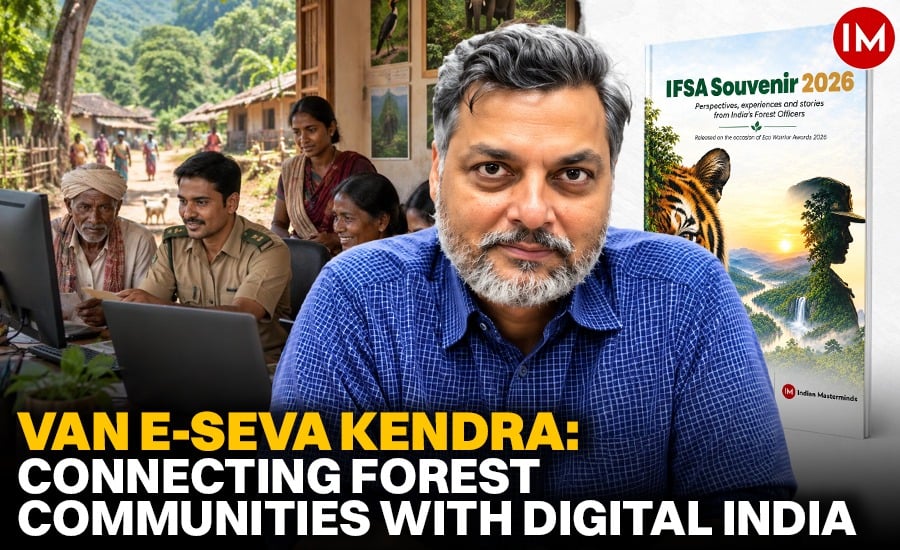
Digital governance has transformed the way public services are delivered across India. However, for thousands of people living in remote forest villages, access to these services continues to remain a challenge due to poor connectivity, digital illiteracy, and the absence of service centres. Recognizing this gap, Pench Tiger Reserve, Maharashtra, introduced the innovative concept of Van e-Seva Kendra—a village-level, one-stop digital service centre dedicated to providing forest department services and other essential government services directly to forest-dependent communities. The project was started during 2023-24.
The initiative represents a unique blend of technology, community participation, and decentralized governance. It not only delivers digital services at the doorstep of villagers but also generates local employment, strengthens community participation in conservation, and improves trust between the Forest Department and local communities.
The Challenge
Pench Tiger Reserve comprises 39 buffer villages, many of which are inhabited predominantly by tribal communities living in remote locations. Before the introduction of the Van e-Seva Kendras, villagers had to travel long distances to taluka headquarters or forest range offices to access online services. Limited internet connectivity, low smartphone penetration, and inadequate digital literacy further compounded the problem.
Even for small compensation claims related to human-wildlife conflict or crop damage, villagers were required to physically visit government offices with documents. This process was time-consuming, expensive, and often discouraged people from applying for legitimate benefits. Simultaneously, forest range offices experienced increasing administrative workload as officials had to assist citizens with online applications that were intended to simplify service delivery.
Also Read – Returning to Work After Childbirth: Why One Mother’s Choice Cannot Become Every Woman’s Standard
The Innovative Solution
To overcome these challenges, Pench Tiger Reserve conceptualized Van e-Seva Kendra as a decentralized digital service delivery platform at the village level. Selected village residents provided space within their homes or community premises where the centres were established. They were trained by the Forest Department to operate digital systems and deliver various online services.
Each centre was equipped with computers, printers, scanners, UPS systems, and internet connectivity through CSR support. Besides online applications, physical records and forest-related information not available on digital platforms were also made accessible at these centres. Plans were also initiated to integrate the centres with the Aaple Sarkar Portal, thereby expanding the range of citizen services available under one roof.
A One-Stop Digital Service Centre
The Van e-Seva Kendras function as integrated service centres providing both forest department and other government services. Citizens can access:
- Online applications for forest department services such as compensation claims, solar fencing assistance, and Malaki cases.
- Revenue department services including e-7/12 extracts and Form 8A.
- Forest boundary maps.
- Forest land records and related information.
By bringing these services to the village itself, the initiative has significantly reduced travel time, transaction costs, and dependency on distant government offices.
Empowering Communities through Livelihood and Inclusion
One of the most remarkable features of the initiative is its emphasis on community empowerment. Operators were selected through transparent criteria that included educational qualification (MSCIT), residence within the village, recommendations from the Gram Panchayat and Eco-Development Committee, possession of a BPL card, and preference for women.
The initiative also promoted social inclusion. According to the project documentation, all operational centres are managed by individuals belonging to backward communities, while women own a significant proportion of the centres. Besides creating sustainable livelihood opportunities, these operators have emerged as trusted digital facilitators and ambassadors of the Forest Department within their communities.
Building Digital Capacity
The success of the initiative rests on continuous capacity building. Every operator receives specialized training in handling forest-related digital services, maintaining digital records, and assisting villagers in accessing government schemes. A dedicated coordinator acts as a bridge between the Forest Department and village operators, while a dedicated WhatsApp group enables rapid communication and problem-solving.
Regular refresher training and feedback mechanisms ensure continuous improvement in service quality and operational efficiency. This approach has helped create a digitally empowered network capable of providing responsive and transparent public services even in remote forest landscapes.
Transforming Governance at the Grassroots
The impact of Van e-Seva Kendra extends far beyond digital service delivery. The initiative has fundamentally transformed the relationship between government institutions and forest communities.
Villagers now receive services closer to home, reducing bureaucratic delays and financial burden. Range offices experience significantly reduced workload, allowing field staff to focus more effectively on conservation and protection activities. Improved transparency and accessibility have strengthened public confidence in the Forest Department, leading to enhanced cooperation between communities and conservation authorities.
The centres have also promoted digital literacy and encouraged greater use of technology among rural populations, helping bridge the longstanding digital divide in forest villages.
Community Awareness and Transparent Governance
Extensive awareness campaigns were conducted through print media, digital platforms, village meetings, and public announcements to ensure that every eligible beneficiary was informed about the services available.
Transparency remains a central pillar of the initiative. Citizens can provide feedback through the official website, suggestion boxes placed at the centres, and periodic review mechanisms. Feedback is regularly analysed, and appropriate improvements are incorporated into the system, ensuring that the centres continue to evolve based on community needs.
A Replicable Model for India
In Pench currently 10 centres are working. Tadoba Andhari Tiger Reserve replicated the model and established 20 centres during 2025-26.
Recognizing its wider applicability, Pench Tiger Reserve has developed a comprehensive toolkit for replication. The model is particularly relevant for protected areas and remote forest fringe villages where access to digital governance remains limited.
The initiative aligns closely with India’s vision of building a digitally empowered society by ensuring that even the most remote communities benefit from e-governance. With appropriate institutional support and community participation, the Van e-Seva Kendra model has the potential to transform public service delivery across protected areas and rural landscapes throughout the country. Considering the relevance and potential for the kendras in mitigating conflict situation.
Conclusion
Van e-Seva Kendra demonstrates how a simple yet innovative idea can simultaneously improve governance, promote livelihoods, strengthen conservation partnerships, and bridge the digital divide. By bringing technology closer to people rather than expecting people to travel to technology, Pench Tiger Reserve has created a citizen-centric governance model that is inclusive, transparent, and sustainable.
The initiative stands as a compelling example of how digital innovation can be adapted to local realities, empowering forest-dependent communities while strengthening institutional efficiency. As India advances toward universal digital governance, the Van e-Seva Kendra offers an inspiring roadmap for delivering public services to the last mile, ensuring that no citizen is left behind.