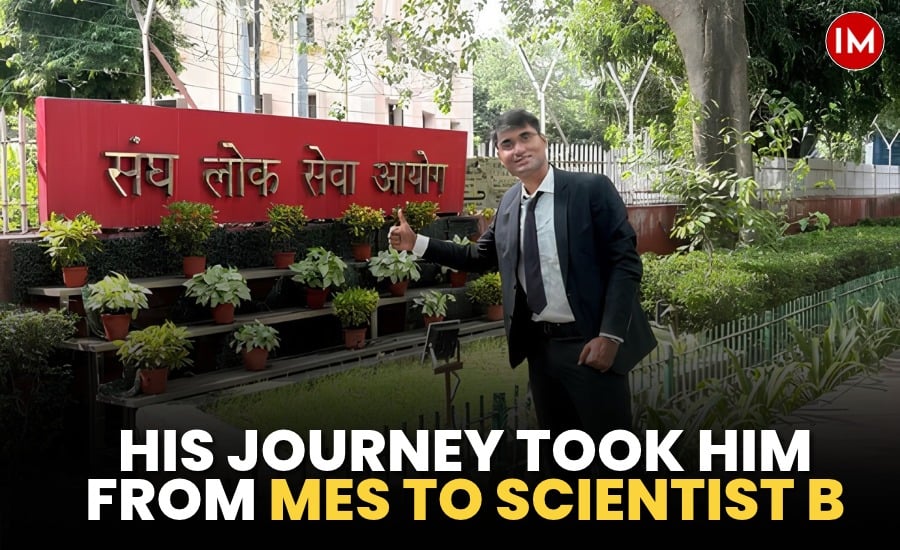
Coming from a Hindi-medium background and a financially modest family in Madhya Pradesh, Sachin Bhadouria overcame educational and financial challenges to build a career in engineering and scientific research. Today, he serves as Scientist ‘B’ at the Central Water and Power Research Station (CWPRS), Pune, after securing All India Rank 2 in a UPSC examination for a scientific post.
For Sachin Bhadouria, success has been a journey of making difficult choices, learning from setbacks and continuing to work towards a goal even when the path ahead was uncertain.
Born on 4 November 1994 in Jamhora, a small village in Bhind district of Madhya Pradesh, Sachin grew up in a family with modest financial means. He completed his schooling up to Class 7 at the primary and middle schools in his village. At that stage, access to resources was limited, and pursuing ambitious academic goals was not easy.
However, he continued his education, eventually entering the field of civil engineering. His journey from a village school to the Indian Institute of Technology (IIT) Madras and, later, a scientific position under the Ministry of Jal Shakti reflects the many stages of his professional and personal growth.
Also read: A Photograph of His Mother Accompanied Vishwas Jhargad to the UPSC Interview, Where His Dream Came Closer
From a Hindi-medium school to IIT Madras
Moving from a Hindi-medium educational background into civil engineering presented Sachin with several challenges. The language barrier, limited resources and financial constraints often made higher education difficult.
To manage his monthly expenses, he also began teaching students through private tuition. Balancing his studies with the need to earn money required considerable effort, but the experience helped him understand the value of education and the importance of making the best use of available opportunities.
His academic journey took a major step forward when he secured admission to IIT Madras for a master’s programme in Structural Engineering. Around the same time, he was selected for the post of Assistant Executive Engineer (AEE) in Telangana, as well as for SSC Junior Engineer (JE) and NBCC.
Having several opportunities before him was a significant achievement, but choosing between them was difficult. Financial and practical circumstances eventually compelled him to leave IIT Madras after completing his coursework.
Although he could not continue the programme, his education and professional ambitions did not end there. He went on to appear for the SSC JE 2017 examination, securing All India Rank 231. The final result was declared in October 2018.
On 21 May 2019, Sachin joined the Military Engineer Services (MES), beginning his government service at Diamond Harbour in Kolkata.
Facing Allegations After Government Job Selection
Getting a government job brought happiness and pride to Sachin and his family. However, it also exposed him to an experience he had not anticipated.
In his village, some people questioned his selection and alleged that he had secured the job using a fraudulent SC/ST caste certificate. Sachin belongs to the General Category, and his selection was based on his examination performance and merit.
The allegations were painful, particularly because they cast doubt on an achievement he had worked hard to earn. Over time, however, he chose to focus on his responsibilities and future goals instead of allowing such criticism to dictate his decisions.
“I realised that not everyone would understand the hard work behind another person’s success. I decided that rather than engaging in arguments, I would let my work, competence and achievements speak for themselves,” he shared with Indian Masterminds.
Meanwhile, continuing his preparation for further examinations alongside a demanding government job was far from easy. Professional responsibilities left him with limited time to study, and managing his career alongside his academic ambitions required careful planning.
What helped him maintain direction was his growing interest in hydraulic structures, particularly dams, spillways and energy dissipators. These areas of engineering gradually shaped his interest in scientific research and encouraged him to pursue opportunities where he could apply his technical knowledge to larger public needs.
How He Secured AIR 2 in a UPSC Examination
While working at MES, Sachin decided to pursue a career in scientific research. His interest in hydraulic engineering provided a clear academic direction, and he began working towards a scientific post through the Union Public Service Commission (UPSC).
He appeared for the written examination on 10 August 2024. The process required patience, as the final stage came after a considerable wait. He appeared for the interview on 3 July 2025.
The result was declared on 15 July 2025, bringing news that marked a major milestone in his career: Sachin had secured All India Rank 2.
For someone who had started his education in a village school, navigated financial difficulties and balanced government service with examination preparation, the result represented years of learning and sustained effort.
“Never mistake your present circumstances for the limits of your potential,” he says, summing up the lesson he hopes young aspirants will take from his journey.
From Military Engineer Services to CWPRS, Pune
Sachin currently serves as Scientist ‘B’ at the Central Water and Power Research Station (CWPRS), Khadakwasla, Pune, under the Ministry of Jal Shakti, Government of India.
The institution provides him with an opportunity to work in scientific research related to water resources and hydraulic engineering, areas that had captured his interest during his engineering journey.
His professional transition from Military Engineer Services to a scientific role reflects his decision to continue developing his technical expertise rather than limit himself to his first government appointment.
For Sachin, education has been more than a means of securing employment. It has also provided a way to identify his interests, develop specialised knowledge and pursue work that can contribute to the country.
Message to Young Aspirants
Drawing from his own experiences, Sachin believes that young people should not allow their family background, financial circumstances or language to determine how far they can go.
Students from small villages and economically modest families often have to navigate challenges that extend beyond their examination syllabuses. Limited access to resources, financial responsibilities and doubts from people around them can make the journey more difficult.
His advice is to keep learning, remain patient and continue working towards a clear goal, even when the results take time to arrive.
“Not every struggle leads to immediate success, but every sincere effort teaches us something valuable,” he says.
He particularly hopes his story reaches students who are pursuing their ambitions with limited resources. He wants them to understand that a difficult beginning does not have to determine the outcome of their lives.
“If my journey encourages even one student to believe in themselves and take another step towards their goal, I would consider that a meaningful extension of my achievement,” he concluded.
Also read: ‘Dreams Don’t Change Lives, Daily Habits Do’: IA&AS Officer Lokesh Datal on UPSC and Discipline