On June 12, 2026, Cabinet Secretary T.V. Somanathan, a 1987-batch IAS officer of the Tamil Nadu cadre, highlighted in a D.O. letter how civil servants often overlook routine skills such as conducting meetings, despite their significant impact on administrative efficiency. Prepared in collaboration with the National Centre for Good Governance (NCGG), the Guide on Conducting Effective Meetings was introduced as the first in a planned series of practical guides aimed at improving everyday governance.
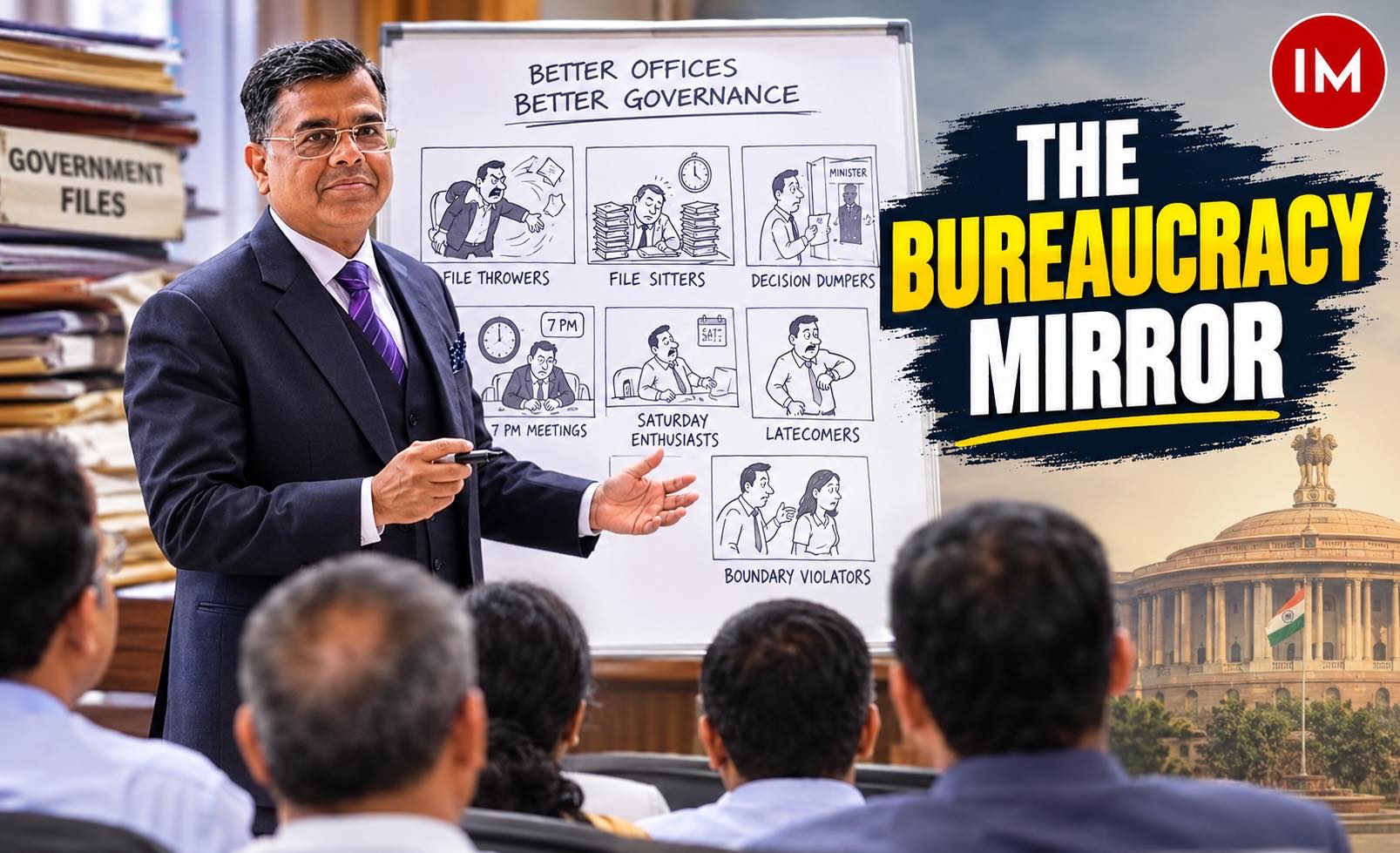
But now, Mr Somanathan has once again drawn attention to an issue that bureaucrats cannot afford to ignore. During a performance review meeting of Union government secretaries in New Delhi on October 27, 2026, he reportedly presented a list of 12 types of bureaucrats, taking a pointed dig at workplace habits that delay decisions, waste official time and undermine professional conduct.
From officers who throw files and sit on them to those who arrive late, schedule meetings after 7 pm or pass decisions upwards unnecessarily, the presentation reportedly used humour and cartoons to highlight familiar administrative shortcomings. Some illustrations were attributed to legendary cartoonist R.K. Laxman, whose work often exposed the contradictions of officialdom.
The presentation reportedly left several senior officials uncomfortable, but its underlying message was serious: improving governance requires not only better policies and procedures but also a change in the everyday behaviour of those responsible for implementing them.
While the presentation covered 12 categories, the complete list has not been publicly disclosed in the available reports. Seven prominent types have been identified, offering an insight into the working practices Somanathan sought to challenge.
12 Types of Bureaucrats: Seven Profiles Identified
1. The File Throwers
These are officers who express authority through aggression, throw files and speak rudely to their subordinates. Such behaviour creates an unhealthy workplace atmosphere and discourages cooperation. The message is that leadership must be firm but respectful, and authority should never become an excuse for intimidation.
Read Also: Trust No One, Said His Instinct in Pakistan
2. The File Sitters
These bureaucrats allow important files and documents to remain pending on their desks without taking timely action. Their indecision can delay approvals, clearances and public services, creating unnecessary administrative bottlenecks. Officials must ensure that files move forward and that delays are justified rather than habitual.
3. The Decision Dumpers
These are officers who refer matters to ministers even when the decisions fall within their own delegated powers. By avoiding responsibility, they increase the workload of senior leadership and slow down routine administration. The emphasis is on taking decisions at the appropriate level while remaining accountable for them.
4. The 7 PM Meeting Mafia
This category targets officers who routinely schedule meetings late in the evening, even when the matters could be addressed during regular working hours. Such practices disrupt employees’ personal lives and can make long working hours a substitute for effective planning. Meetings should be purposeful, properly scheduled and respectful of colleagues’ time.
5. The Saturday Meeting Enthusiasts
These are managers who summon staff to work on Saturdays but themselves arrive late for the meetings they have called. The behaviour reflects poor time management and a disregard for the time of subordinates. Seniority should come with greater responsibility to set an example, not an exemption from punctuality.
6. The Perpetual Latecomers
These officials repeatedly arrive late for meetings and other administrative commitments. Their lack of punctuality wastes colleagues’ time, disrupts schedules and weakens workplace discipline. Timeliness is a basic professional responsibility, particularly for officers expected to ensure that entire departments function efficiently.
7. The Proximity Exploiters or Boundary Violators
This particularly sensitive category concerns officers who behave inappropriately towards women colleagues under the pretext of showing or examining a document. Asking a colleague to stand unnecessarily close crosses professional boundaries and raises concerns about workplace safety and dignity. The message is that every officer must maintain respectful conduct and appropriate physical boundaries.
What about the remaining five types? Although the presentation reportedly covered 12 distinct profiles, the five other categories have not been individually identified in the available accounts. They should not be assigned invented names or characteristics without further confirmation.
Together, the seven reported profiles highlight concerns that extend beyond paperwork. They touch upon accountability, time management, workplace etiquette, professional boundaries and the responsible exercise of administrative authority.
R.K. Laxman’s Cartoons Add a Satirical Edge
The reported use of cartoons gave the presentation a distinctive character. R.K. Laxman, celebrated for his observations of everyday Indian life, frequently used satire to expose the gap between official claims and ground realities.
By using illustrations to depict bureaucratic behaviour, Somanathan reportedly encouraged senior officials to recognise habits that may have become normalised within government offices. Humour can make uncomfortable observations memorable, particularly when the examples reflect familiar experiences.
The larger point was not simply to criticise individual officers. It was to draw attention to how routine behaviour affects institutional performance. A file left unattended, an unnecessary meeting or a decision repeatedly passed upwards may appear insignificant in isolation, but such practices can collectively slow down the government machinery.
Performance Rankings: Why Scores Must Be Meaningful
Beyond the presentation, the performance review meeting also examined the functioning of secretaries across Union government departments. Officials were reportedly assessed and ranked against various performance parameters.
Somanathan highlighted a concern about the scoring system: assessments frequently clustered close to 10 on a scale of one to 10. When almost every officer receives a similarly high score, it becomes difficult to distinguish exceptional performance from satisfactory work or identify areas requiring improvement.
A meaningful assessment system must recognise outstanding contributions while also identifying shortcomings. Proper differentiation can help departments understand where they are performing well and where improvements are necessary.
The objective is not to encourage arbitrary rankings but to make performance reviews useful instruments for accountability, institutional learning and better governance.
Faster Coordination Between Ministries
Inter-ministerial coordination was another important issue discussed during the meeting. Somanathan reportedly urged the Union Ministries of Finance and Commerce to provide their inputs promptly on matters requiring consultation.
Delays in obtaining comments or clearances from other ministries can hold up decisions, prolong administrative processes and affect the implementation of government programmes. Timely communication is therefore essential, particularly when a proposal involves multiple departments.
This concern is closely connected to the behaviours highlighted in the presentation. Just as files should not remain unattended on an officer’s desk, inter-ministerial consultations should not become another source of avoidable delay.
Clear responsibilities, prompt responses and decisions taken at the appropriate level can help ensure that government machinery works in a coordinated and predictable manner.
Deregulation 3.0: The Next Phase of Reforms
The meeting also addressed the Union government’s next phase of regulatory reform, Deregulation 3.0, which is scheduled to begin in January 2027, according to the supplied account.
The initiative is expected to focus on reducing red tape, simplifying regulatory compliance and improving the ease of doing business. Its broader objective is to remove unnecessary procedural burdens and make interactions with government departments more efficient.
However, simplifying rules alone may not eliminate delays if officials continue to sit on files, seek unnecessary approvals or avoid decisions within their authority. Regulatory reform must therefore be accompanied by changes in administrative practices.
For businesses and citizens, the real test of deregulation will be whether approvals become simpler, decisions arrive faster and compliance requirements become easier to navigate. This requires government departments to translate reform objectives into practical improvements in their everyday functioning.
Railway Employees’ Ration Cards Also Figure in the Review
Another issue reportedly brought to Somanathan’s attention concerned approximately one lakh railway employees who were said to hold ration cards enabling them to receive free foodgrains under the Pradhan Mantri Garib Kalyan Anna Yojana (PMGKAY).
According to the supplied account, the Department of Food and Public Distribution raised the matter, following which Somanathan described it as a disciplinary concern and directed Railway Board Chairman Satish Kumar to ensure that the employees concerned surrendered their ration cards.
The reported figure and the eligibility circumstances require verification by the relevant authorities. Nevertheless, the issue highlights the importance of ensuring that welfare benefits reach eligible beneficiaries and that the rules governing their distribution are properly implemented.
The account also refers to earlier concerns about ration cards being used to establish family identity under the Ayushman Bharat Pradhan Mantri Jan Arogya Yojana (PM-JAY), even though ration cards were reportedly not a formal eligibility requirement for the scheme. The distinction between identity documents and eligibility conditions is important for accurate and transparent delivery of public benefits.
A Message Beyond Files and Meetings
Somanathan’s presentation brought together several concerns affecting the functioning of government departments, from discourteous behaviour and delayed decisions to performance assessments, inter-ministerial coordination and regulatory reform.
The complete list of 12 bureaucratic types remains undisclosed in the available reports, but the seven identified profiles convey the central message clearly. Administrative efficiency depends not only on formal rules and institutional structures but also on how officials exercise authority, manage their time and treat the people around them.
The June guide on effective meetings and the October presentation on bureaucratic behaviour point towards the same objective: making everyday administration more purposeful, accountable and responsive.
For India’s senior bureaucracy, the challenge is to ensure that files do not become instruments of delay, meetings do not become exercises in formality and delegated powers do not become responsibilities to be passed on. Ultimately, the effectiveness of governance is measured not by how many procedures an office follows, but by how responsibly and efficiently it delivers results.
Read Also: From Kuno to Gandhi Sagar: India Studies How Cheetahs Coexist with Other Predators