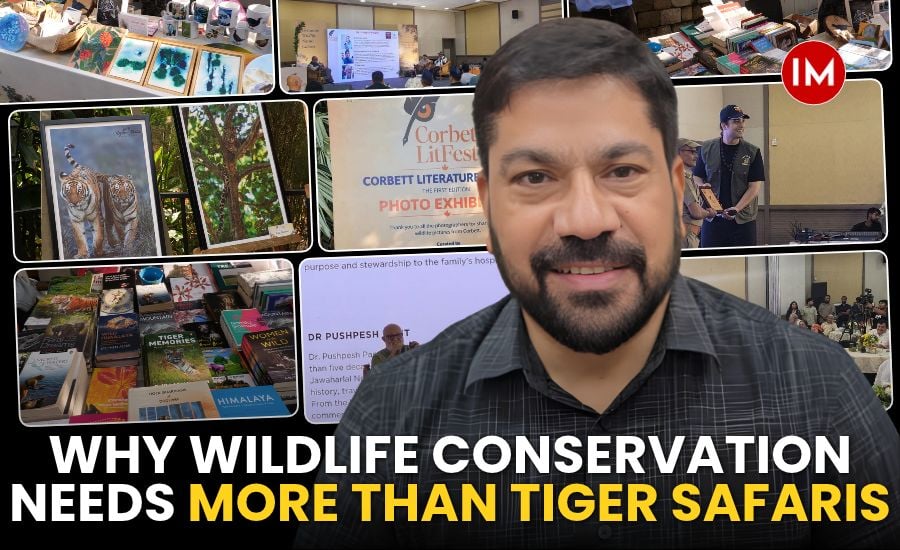
When people think of Corbett Tiger Reserve, tigers and jungle safaris are usually the first things that come to mind. But for Dr Saket Badola, IFS (2008 batch, Uttarakhand cadre), Field Director of Corbett Tiger Reserve, the landscape has many more stories to tell.
Birds, elephants, diverse flora and fauna, the traditions of communities living around the forest and the wider Himalayan ecosystem are all part of Corbett’s identity. Bringing these stories into public conversation was one of the ideas behind the first Corbett Literature Festival, held from October 6 to 8, 2026.
Conceptualised by Dr Badola, the festival seeks to create a space where nature writers, conservationists, filmmakers, academicians, storytellers and people connected with the landscape can come together to discuss issues that extend beyond wildlife sightings.
Speaking to Indian Masterminds, Dr Badola explained that the idea emerged from a desire to attract visitors who would engage more deeply with the landscape and its conservation challenges.
“We need to have some more serious kinds of tourists who do not just come and observe wildlife but also have serious conversations around wildlife conservation and related issues,” he said.
The festival is an attempt to make those conversations an integral part of the Corbett experience.
Watch the full interview here:
A Literature Festival Rooted in the Landscape
Corbett holds a special place in India’s conservation history. Established in 1936 as Hailey National Park, it was the country’s first national park and was later renamed after naturalist and author Jim Corbett. It also became one of the first areas associated with Project Tiger when the initiative was launched in 1973.
For Dr Badola, introducing a literature festival to this landscape was a natural extension of its legacy.
He said the idea had been on his mind for more than two years before the team, institutional support and participating stakeholders came together to make it possible.
The festival’s programme was organised around four broad themes: nature and wildlife, the Himalayas, Uttarakhand’s rich heritage, and the writings of Jim Corbett.
Each theme connects with a different aspect of the region. While nature and wildlife remain central to the reserve’s identity, the Himalayan landscape faces its own environmental pressures. Uttarakhand’s cultural traditions and heritage offer another perspective on the relationship between people and their surroundings.
Jim Corbett’s writings add a literary dimension to these conversations, drawing attention to the ways in which nature, wildlife and human experiences have been documented and understood over time.
According to Dr Badola, the festival is among the first initiatives of its kind to bring a literature festival to the setting of a tiger reserve or national park. He sees Corbett’s history as an appropriate starting point for such an initiative.
“Corbett is the first national park of the country. It is the very place from where Project Tiger started,” he said, explaining why he wanted the first edition to take place here.
Looking Beyond the Tiger
Tigers may be Corbett’s most recognisable inhabitants, but they represent only one part of its ecological richness.
The reserve is also an important bird area, with more than 500 recorded bird species, according to Dr Badola. Elephants are another iconic species associated with the landscape. Its biodiversity also includes gharials, otters and a wide range of plant species.
The festival aims to bring these lesser-discussed aspects of Corbett into greater focus.
For Dr Badola, however, understanding a landscape requires looking beyond its forests and wildlife. The people who live in and around it are equally important.
“When we talk about a landscape, it’s not just a forest patch or animals. The communities which are living there are also part and parcel of that,” he said.
Their culture, traditions and relationship with the natural environment form an essential part of the region’s story. By bringing these perspectives into the festival, the organisers hope to present Corbett as a living landscape shaped by both nature and people.
This approach also raises a larger question: how can conservation efforts protect wildlife while ensuring that the communities living alongside it have opportunities to benefit from a healthy, thriving landscape?
From Conservation Success to Difficult Questions
India has made significant progress in wildlife conservation, and Dr Badola pointed to the country’s work on tiger and elephant conservation, cheetah reintroduction and the return of other species to suitable habitats.
But he believes the next stage of conservation requires sustained discussions about what comes after these achievements.
How can communities participate more meaningfully in conservation? Do existing habitats need additional protection? How can local livelihoods improve without placing greater pressure on natural ecosystems? And how can tourism become more sustainable?
These are among the questions he wants the Corbett Literature Festival to help bring into the mainstream.
For a destination that attracts large numbers of tourists, sustainable tourism is particularly relevant. Visitors can contribute to local economies, but tourism also needs to be managed in ways that respect the landscape and its ecological limits.
Dr Badola wants Corbett to become a platform from which such discussions on conservation, nature and the Himalayas can emerge and continue.
The emphasis is not simply on celebrating wildlife but on examining the choices, policies and community partnerships needed to protect it over the long term.
Bringing Local Communities Into the Conversation
Although the first edition featured prominent personalities, academicians, filmmakers and storytellers, the organisers also involved people whose everyday work is closely connected to Corbett.
Naturalists, nature guides, gypsy drivers, members of the hotel association, resort owners, children and residents of Ramnagar were among those engaged in the festival.
A separate programme for children was also organised, reflecting Dr Badola’s belief that conservation education must reach younger generations.
“No matter what kind of conversation we do, no matter what kind of conservation we do, unless it is passed on to the future generation, it’s not going to sustain for long,” he said.
The participation of children is therefore not merely an additional activity. It is part of a broader effort to build a lasting connection between people and the natural world.
Dr Badola also acknowledged that community participation needs to expand further. While local stakeholders were involved in the inaugural edition, he hopes future editions will reach more people across Uttarakhand, other parts of India and potentially beyond.
The intention is to ensure that the festival becomes a continuing forum for discussion rather than a one-time event.
A Beginning, Not a One-Time Event
The first Corbett Literature Festival coincided with the 90th anniversary of the establishment of India’s first national park. For Dr Badola, it was another addition to Corbett’s long list of firsts.
But the significance of the initiative will ultimately depend on whether the conversations it creates continue after the festival ends.
He is confident that the event will return and hopes it will become a regular feature. The involvement of local stakeholders, he believes, gives the initiative a broader foundation than a programme driven by the government alone.
The larger ambition is to make Corbett known not only for its tigers and safaris but also as a place where people come together to think, write, learn and debate the future of conservation.
If that vision takes root, the festival could give visitors a different way to experience the landscape: not just by spotting wildlife, but by understanding the ecological, cultural and human stories that make the region what it is.
For Dr Badola, that is the conversation Corbett needs to lead — one in which the forest, the people who live alongside it and the generations that will inherit it are all part of the story.