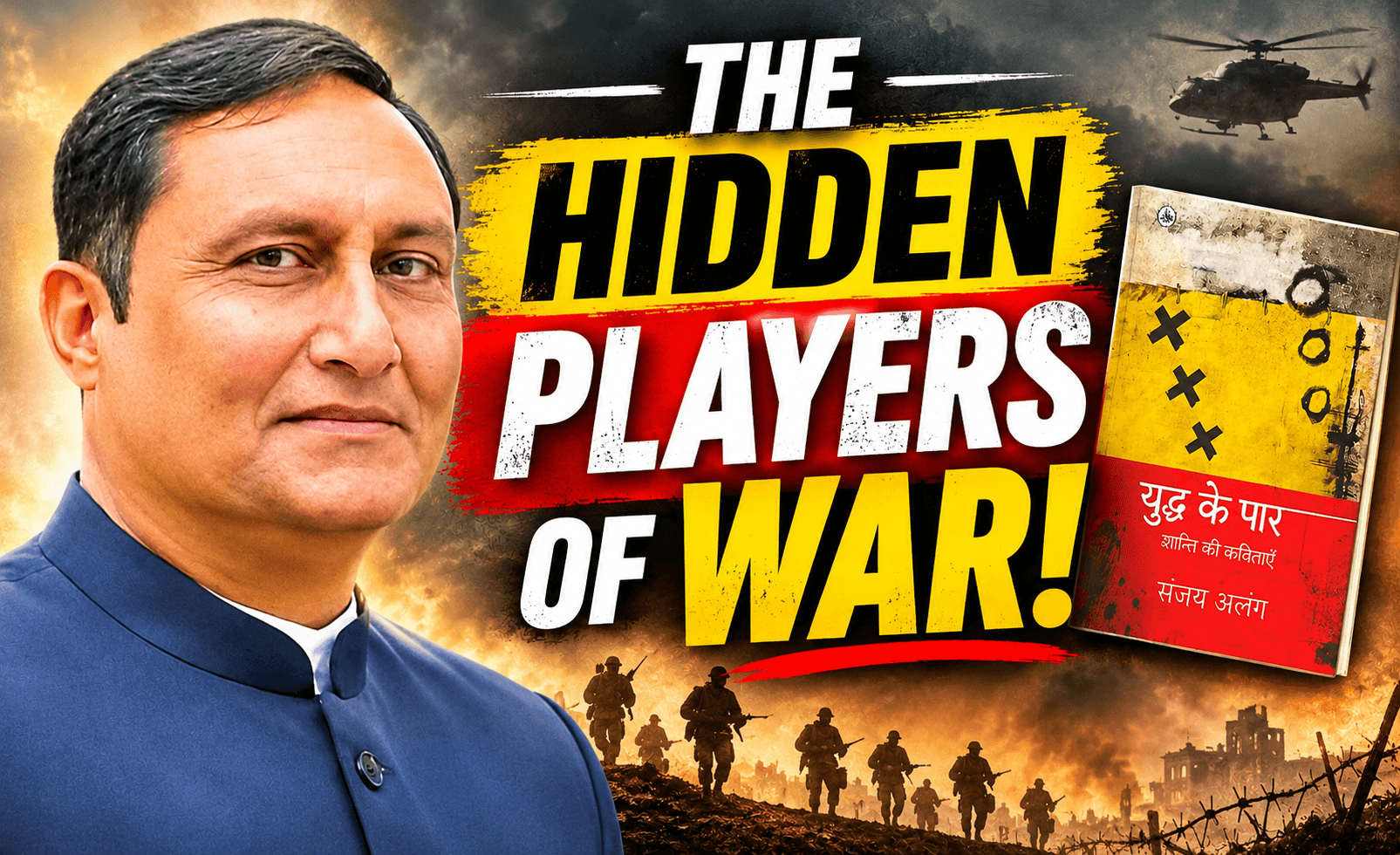
War is usually remembered through its winners, its losers and the territories it changes. History records the generals who command it, the leaders who declare it and the soldiers who fight it. But what about those who finance it? Those who profit regardless of who wins? And those who quietly ensure that one war ends only for another to begin?
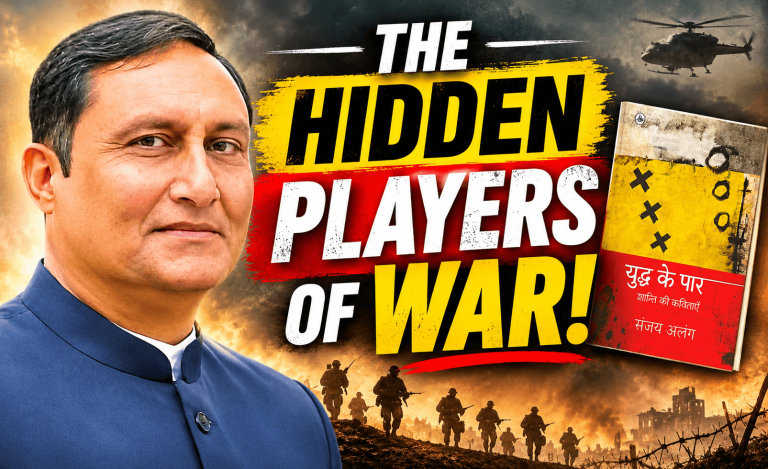
Retired IAS officer Dr. Sanjay Alung, a 2004-batch Chhattisgarh cadre officer, wants readers to look beyond the familiar narrative. His latest Hindi poetry collection, ‘Yudh Ke Paar: Shanti Ki Kavitayein’ (Beyond War: Poems of Peace), published by Rajkamal Prakashan, examines the hidden psychology, economics and politics that keep conflicts alive.
With nearly 70 poems, the collection is not simply an expression of grief over violence. It is an attempt to understand how societies become accustomed to war, how conflict is manufactured and why humanity repeatedly finds itself preparing for the next confrontation.
Also read: IAS Rishav Gupta’s 3.5-Crore Aquapark Model Is Transforming Tribal Women’s Lives in MP
Looking Beyond the Battlefield
For Dr. Alung, the starting point was a simple but uncomfortable question: Why does humanity remain perpetually prepared for war?
Rather than writing only about destruction, he chose to examine what happens before a war begins. What creates the atmosphere for conflict? Why does a society gradually accept violence as inevitable? Who benefits from keeping the machinery of war running?
“I wanted to write poetry that brings the real problems of our times to the forefront. And, at this moment, one of the biggest problems facing humanity is war. I wanted to explore its background, the psychology that creates it, and why we are always preparing ourselves for another war,” he shared in an exclusive conversation with Indian Masterminds.
This approach gives the collection its distinctive character. The poems question not just the visible violence but also the invisible interests that sustain it.
One particularly striking poem, ‘Jise Aap Kabhi Nahin Jaante’ (The One You Never Know), challenges the way history remembers conflict. It points towards a third, largely invisible player: the one who provides money to both sides and remains unconcerned about who eventually wins.
The poem suggests that while victors receive recognition and the defeated disappear into history, those financing the conflict quietly secure its continuation. It is an unsettling observation about the economics of war, where human suffering can become somebody else’s business.
The Ordinary Person in the Machinery of Conflict
Alung’s criticism does not stop at governments, financiers or military establishments. He also turns his attention towards ordinary people and the systems that condition their thinking.
In one poem, he uses the metaphor of running as a form of training. People are taught that running continuously is success, but are rarely encouraged to ask who they are running for or why they must keep running.
It is a reflection that extends beyond war into the pressures and expectations of contemporary society.
The collection also refuses to surrender entirely to despair. In another evocative passage, Alung imagines humanity picking up a white handkerchief, clearing blood from the streets and planting saplings along the roadside. The plants carry small nameplates bearing the words: faith, peace and hope.
It is perhaps here that the collection reveals its deepest intention. To oppose war is not enough; one must also imagine what a peaceful world could look like.
An Administrative Career, A Different Perspective
Alung’s years in the Indian Administrative Service gave him an unusually close view of institutions, authority and the workings of society. He believes the experience helped sharpen his understanding of what lies behind the visible functioning of systems.
“Administrative experience does not necessarily translate directly into poetry, but it does clarify your vision. You begin to understand what is happening behind the scenes, beyond what is immediately visible,” he says.
That distinction is important to understanding his writing. His poems do not read like administrative observations converted into verse. Instead, they bring together a researcher’s curiosity, an observer’s understanding and a poet’s discomfort with the realities of the present.
Gagan Gill Calls the Collection ‘Wise and Wisening’
The collection has also received appreciation from acclaimed Hindi poet and Sahitya Akademi Award winner Gagan Gill.
Describing the poems as “wise and wisening”, Gill observes that Alung has captured the subtle and invisible mechanisms of war with remarkable understanding. She notes that his long experience in public service may have given him an ability to recognise the strategic calculations of power, but what makes the poems particularly striking is their ability to identify the futility of violence spreading beyond the visible battlefield.
She considers the collection an essential intervention for peace in contemporary Hindi poetry.
A Scholar With Many Stories to Tell
War and peace are only one part of Alung’s literary and intellectual journey. A historian and researcher with a PhD in history and culture, he has authored around ten books on Chhattisgarh’s history and culture.
His research work, Chhattisgarh: Itihas Aur Sanskriti, received a national-level award from the Ministry of Human Resource Development in 2016, recognising it as outstanding research in the field of education. The work earned a prize of Rs 1 lakh.
He has also undertaken research into the ancient history of Kashmir, with two substantial research projects, including further work on Chhattisgarh’s history and culture, expected to reach readers in the coming year.
His literary catalogue includes four Hindi poetry collections: Yudh Ke Paar, Nadi Usi Tarah Sundar Thi Jaise Koi Baag, Pagdandi Chhip Gayi Thi and Shav. He has also written the novel Chalo Saath Chale, which explores Down syndrome, and a Chhattisgarhi poetry collection.
His poem Bante Rang has been included in the curriculum of Amravati University, while his recent story Katkona has attracted attention in literary circles.
His contributions have earned him honours including the Sutra Samman, Dinkar Samman and Saraswati Samman. He has also received the President of India’s national-level awards twice for his work in the welfare of persons with disabilities and senior citizens.
Beyond War, Towards Humanity
Now based in Raipur after retiring from the IAS, Alung continues to devote himself to independent writing and research. Yet, in Yudh Ke Paar, his concern is larger than literary recognition or intellectual debate.
The collection asks readers to reconsider what they celebrate, what they accept as inevitable and what they choose to overlook. It challenges the familiar glorification of victory by drawing attention to the human cost that rarely finds a place in official accounts of war.
Perhaps the most important question his poems leave behind is not who wins a war, but who makes sure that wars never really end. And, more importantly, whether humanity can still find the courage to imagine a world in which peace is more than a temporary pause between two conflicts.
Click on the link given to buy his book: https://www.rajkamalprakashan.com/products/yuddh-ke-paar
Also read: How IAS Rishav Gupta Turned a Cracked Riverbed Into a Water Lifeline