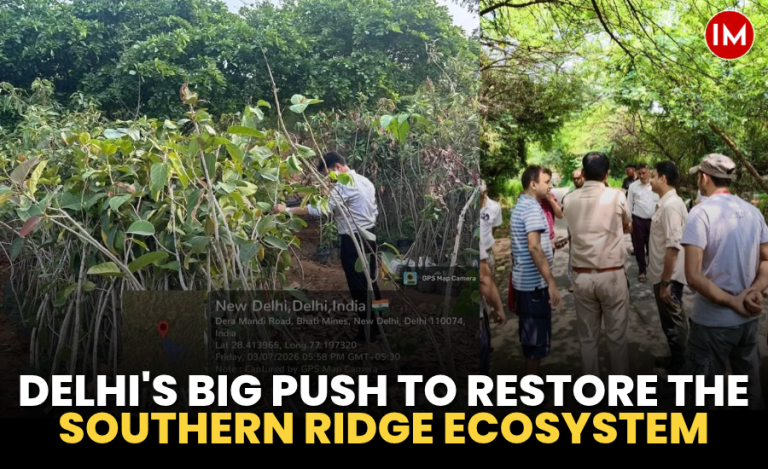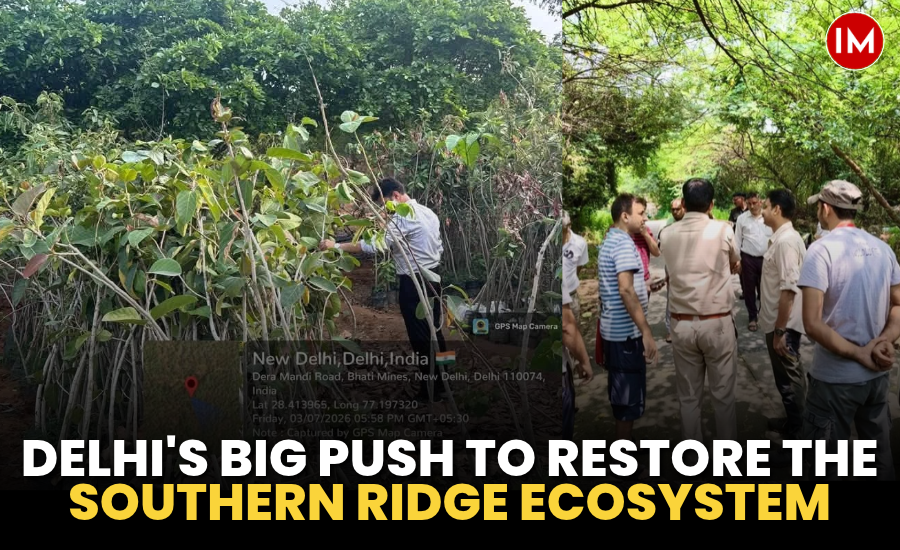
More than 10 lakh native trees and an equal number of shrubs have been planted across Delhi’s Southern Ridge as part of an ambitious ecological restoration initiative. Moving beyond conventional plantation drives, the project focuses on establishing a multi-layered forest ecosystem through tall native saplings, scientific plantation planning and long-term monitoring.
Delhi’s Southern Ridge, often described as the ‘Lungs of Delhi’, has witnessed a major step towards ecological restoration with the plantation of over 10 lakh native trees and an equal number of shrubs this year.
The initiative is significant not merely because of the number of saplings planted, but because of the ecological approach adopted to restore the ridge’s natural character. Instead of concentrating only on increasing green cover, the plantation drive aims to recreate a functioning forest ecosystem that supports native biodiversity, improves habitat conditions and strengthens the ecological health of the Aravalli landscape.
The plantation was carried out during the pre-monsoon season to allow the newly planted saplings to benefit from seasonal rainfall. Planning for the exercise had begun the previous year, with an emphasis on species selection, plantation design and the long-term establishment of vegetation.
The initiative forms part of the Delhi Government’s broader ecological restoration efforts and the Department’s planned eco-restoration programme for 2026–2030.
Beyond Numbers: A Scientific Approach to Plantation
One of the defining features of the Southern Ridge plantation drive is its departure from conventional plantation practices.
Large-scale plantation campaigns are often assessed by the number of saplings planted. However, the ecological value of such initiatives depends on several other factors, including species suitability, survival rates, canopy development and the ability of the vegetation to support local biodiversity.
This project addresses these aspects through a carefully planned plantation model that prioritises native species and the development of a multi-layered forest structure.
A particularly important decision was to plant taller saplings, with a minimum height of 6–8 feet. The objective is to accelerate vegetation establishment and provide an early foundation for canopy development.
The plantation layout has also been designed to ensure that large trees have sufficient space to develop their canopies while allowing mid-canopy trees and shrubs to grow alongside them.
This approach is expected to create a more natural forest structure rather than a uniform plantation of trees. It also recognises that restoring an ecosystem requires different layers of vegetation working together.
Native Species to Revive the Aravalli Ecosystem
Species selection has been central to the initiative. The focus has remained on native trees and shrubs suited to the ecological conditions of the Ridge and the larger Aravalli landscape.
The tree species include Neem, Peepal, Bargad, Arjun, Jamun and Amaltas, along with ridge-specific species such as Hingot, Bistendu and Ber.
These species have been selected for their ecological suitability and their ability to contribute to the restoration of the region’s native vegetation.
Large trees such as Peepal, Bargad and Neem will contribute to the upper canopy, while smaller trees and shrubs will help establish intermediate and lower vegetation layers.
The presence of different species also creates opportunities for a wider range of birds, insects, pollinators and other wildlife to find food and shelter.
Fruit-bearing trees, in particular, can provide an important food source for birds and local fauna. Meanwhile, roots help bind the soil, vegetation cover reduces soil exposure, and leaves and organic matter contribute to the natural nutrient cycle.
Together, these ecological functions can improve soil health, support biodiversity and help restore the natural character of the Southern Ridge.
Creating a Multi-Layered Forest, Not Just Green Cover
A forest is not simply a collection of trees. Its ecological strength comes from the interaction of different vegetation layers, wildlife, soil organisms and natural processes.
Keeping this in mind, the Southern Ridge initiative follows a multi-layered plantation model comprising upper-canopy trees, mid-canopy trees and shrubs.
The larger native trees are expected to form the upper canopy over time. Mid-canopy species will occupy the intermediate layer, while shrubs and other locally suitable vegetation will provide ground-level cover.
This arrangement is important for several reasons.
A diverse canopy structure creates different habitats for birds, insects and other wildlife. It also helps improve soil protection, supports moisture retention and contributes to a more balanced local microclimate.
The presence of multiple vegetation layers can further strengthen habitat availability and ecological connectivity across the ridge.
For an urban landscape such as Delhi, where green spaces face pressure from pollution, rising temperatures and changing land-use patterns, restoring such natural ecosystems has considerable environmental importance.
Technology and Monitoring to Track Plantation Growth
Planting over 10 lakh trees is a major undertaking, but ensuring their survival and growth is an equally important responsibility.
Recognising this, the initiative includes a monitoring framework that goes beyond the plantation exercise itself.
The department has incorporated unique identification tags for saplings, regular field inspections and drone-based aerial photography to monitor plantation areas.
These mechanisms are intended to strengthen accountability and help assess the condition of planted saplings, identify gaps and track vegetation development.
A verified post-monsoon survival figure, however, will depend on the completion of field assessments and consolidation of monitoring records.
The long-term focus will also need to include timely replacement of dead saplings wherever appropriate, protection against grazing and other damage, soil-moisture conservation and regular aftercare.
The emphasis is therefore on ensuring that the plantation gradually develops into an established forest ecosystem rather than remaining a one-time achievement measured only by the number of saplings planted.
Public Participation in Restoring Delhi’s Green Heritage
Another important aspect of the initiative is Jan Bhagidari, or public participation.
People from different backgrounds participated in the plantation exercise, bringing a community dimension to the ecological restoration programme.
“Public participation can play an important role in protecting urban green spaces. When citizens become involved in environmental initiatives, they also become more aware of the importance of biodiversity, native vegetation and the conservation of natural landscapes,” a senior IFS officer told Indian Masterminds.
The initiative reflects the importance of combining administrative planning, ecological expertise and community participation in addressing environmental challenges.
What Could 10 Lakh Trees Mean for Delhi in the Next Decade?
The real impact of the Southern Ridge plantation drive will become clearer over the next five to ten years as the trees establish themselves and the different vegetation layers begin to develop.
If successfully established and maintained, the plantation could contribute to improved native vegetation cover, stronger habitat connectivity, better soil stability and increased availability of food and shelter for local wildlife.
A well-developed forest ecosystem can also help regulate local temperatures, retain moisture, reduce the urban heat island effect and contribute to the interception of airborne pollutants.
These benefits are particularly relevant for Delhi, which faces persistent challenges related to air pollution, rising temperatures and the loss of natural green spaces.
However, ecological restoration is a long-term process. The success of the initiative will ultimately depend on the survival and growth of the planted species, natural regeneration, canopy development and the return of native biodiversity.
With more than 10 lakh native trees and an equal number of shrubs already planted, the Southern Ridge has taken an important step towards restoring its ecological character.
The larger ambition is to transform this plantation into a thriving forest landscape that supports biodiversity, strengthens Delhi’s environmental resilience and preserves an important part of the Aravalli ecosystem for future generations.