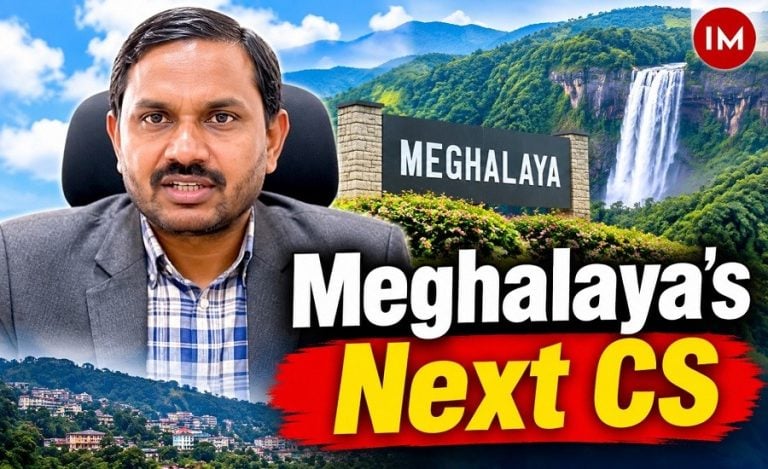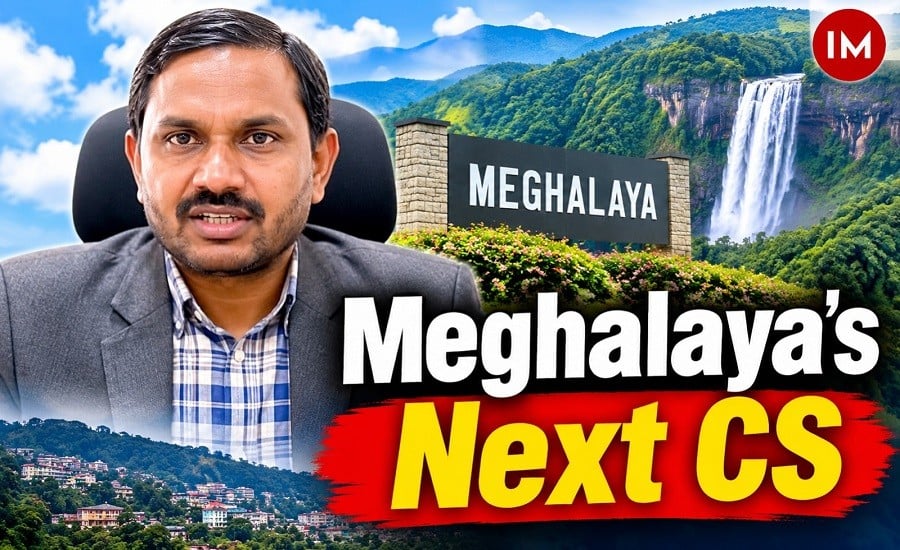
Shillong: Senior IAS officer Sampath Kumar (IAS:1997:AM) is likely to be appointed as the next Chief Secretary of Meghalaya following the scheduled retirement of incumbent Shakil P Ahammed (IAS:1995:AM) on November 30, 2026.
Kumar is currently serving as Additional Chief Secretary in the Meghalaya government, handling several important portfolios, including Community and Rural Development, Social Welfare, and Health and Family Welfare. Over the years, he has been associated with several administrative reforms and community-led development initiatives in the northeastern state, particularly in public health, women’s empowerment, rural development and institutional capacity building.
An engineering graduate from Osmania University, Kumar also studied at the prestigious Harvard Kennedy School as an Edward S. Mason Fellow, where he earned a Master in Public Administration (MPA). He later completed a PhD in Public Health and Policy in India.
His likely elevation comes at a time when Meghalaya is preparing for a change at the state’s highest administrative position.
Shakil P Ahammed to Retire on November 30
The present Chief Secretary, Shakil P Ahammed, has been serving in the position since September 30, 2025. His tenure is scheduled to end on November 30, 2026, upon his retirement.
Meanwhile, on November 19, 2026, the Meghalaya government appointed Ahammed to a post-retirement assignment as Chief Commissioner of the Meghalaya State Public Service Delivery Commission.
With his retirement approaching, Sampath Kumar has emerged as the likely successor. His experience across multiple departments and his involvement in several flagship governance and development initiatives make his possible appointment an important administrative development for the state.
Who Is Sampath Kumar?
Sampath Kumar is a 1997-batch IAS officer of the Assam-Meghalaya cadre, known for his work in community-led governance, public health reforms, rural development and state capability building.
Born on May 20, 1970, he hails from undivided Andhra Pradesh. He is fluent in English, Hindi and Telugu.
His administrative career has involved both field-level development initiatives and senior policymaking responsibilities. Over the years, he has worked on strengthening grassroots institutions, improving public service delivery and developing innovative governance models in Meghalaya.
His professional approach has focused on building institutional capacity and involving local communities in the implementation of government programmes.
Education: From Osmania University to Harvard Kennedy School
Kumar began his academic journey with engineering. He completed a Bachelor of Engineering (B.E.) in Electronics and Communications Engineering from Osmania University.
Later, his interest in public administration and governance took him to the Harvard Kennedy School in the United States. He attended the institution as an Edward S. Mason Fellow, earning a Master in Public Administration (MPA).
He subsequently completed a PhD in Public Health and Policy in India, adding an academic dimension to his experience in administration and development policymaking.
His educational background combines technical knowledge, public administration and public health, areas that have also shaped several of his initiatives in Meghalaya.
Administrative Career: From Rural Development in Uttar Pradesh to Senior Roles in Meghalaya
Before taking up senior responsibilities in Meghalaya, Sampath Kumar served as the Chief Executive Officer (CEO) of the Rajiv Gandhi Mahila Vikas Pariyojana (RGMVP) in Uttar Pradesh.
In this role, he was associated with large-scale rural poverty reduction programmes and women’s self-help group initiatives. The programme focused on strengthening women’s collectives and improving their participation in economic and community development.
His subsequent assignments in Meghalaya brought him into several important areas of governance, including health, rural development, social welfare and institutional reforms.
Over the years, he served as Principal Secretary and Development Commissioner before rising to the rank of Additional Chief Secretary.
As of 2026, his responsibilities in the Meghalaya government span several important departments and policy areas.
These include Community and Rural Development, Social Welfare, Health and Family Welfare, Women and Child Development, and Programme Implementation and Evaluation.
His involvement across these portfolios has placed him at the centre of several development initiatives aimed at improving public services and strengthening community institutions.
State Capability Enhancement Project and Government Innovation Lab
One of Sampath Kumar’s significant contributions in Meghalaya has been his work on strengthening the state’s administrative capacity.
Drawing on governance frameworks and concepts studied at Harvard, he conceptualised the State Capability Enhancement Project (SCEP) to improve the government’s ability to address complex administrative challenges.
The initiative focused on developing institutional capabilities, improving coordination between departments and finding practical solutions to persistent governance bottlenecks.
The project was subsequently institutionalised as the Government Innovation Lab (GIL).
The lab was envisioned as a platform to encourage innovation within the government and develop solutions to complex public administration problems. Rather than relying only on conventional administrative processes, the approach emphasised experimentation, collaboration and problem-solving.
The initiative reflects Kumar’s focus on strengthening the government’s internal capacity to deliver public services and implement development programmes more effectively.
Meghalaya Early Childhood Development Mission and Public Health Reforms
Public health and early childhood development have been among the major areas of Kumar’s administrative work in Meghalaya.
He spearheaded the Meghalaya Early Childhood Development (ECD) Mission, which focused on improving outcomes for young children through coordinated interventions in health, nutrition, education and early childhood care.
The initiative recognised the importance of the early years of a child’s life and sought to strengthen the delivery of essential services through community participation and institutional coordination.
Another important aspect of his work was the establishment of more than 6,600 Village Health Councils across the state.
These councils were intended to strengthen grassroots participation in preventive healthcare and improve the delivery of health services at the village level.
The initiative focused on areas such as child immunisation, maternal healthcare and reducing maternal and infant mortality. By involving local communities in health-related planning and monitoring, the councils aimed to make public health interventions more accessible and responsive to local needs.
Women’s Empowerment Through Village Employment Councils
Women’s participation in grassroots governance and development has also been a key focus of Kumar’s work.
He championed 50 per cent reservation for women in Village Employment Councils, an initiative aimed at increasing women’s representation in local decision-making and strengthening their role in community development.
The approach sought to ensure that women were not merely beneficiaries of government programmes but also active participants in planning, implementation and monitoring.
His earlier experience with women’s self-help groups through the Rajiv Gandhi Mahila Vikas Pariyojana in Uttar Pradesh also provided an important foundation for his work on community-based development in Meghalaya.
Climate Action and Payment for Ecosystem Services
Apart from public health and rural development, Kumar has also been associated with initiatives linking community participation with environmental conservation.
One such initiative is the Climate Corp programme, through which more than 13,000 community facilitators were trained.
The programme focused on developing grassroots capacity for climate-related activities and encouraging communities to participate in environmental protection and climate action.
He also helped implement Meghalaya’s Payment for Ecosystem Services (PES) scheme, described in the supplied information as India’s first such initiative.
The PES model seeks to recognise and incentivise communities for protecting ecosystems and maintaining environmental services. It creates a link between conservation efforts and community-level economic benefits.
In a state such as Meghalaya, where forests, water resources and biodiversity are closely connected with local livelihoods, such initiatives are significant for promoting sustainable development and community-led conservation.
Academic and Advisory Contributions
Alongside his administrative responsibilities, Sampath Kumar has maintained an association with academic and policy institutions.
He has served as visiting faculty at the Lal Bahadur Shastri National Academy of Administration (LBSNAA), IIM Shillong and the Indian Institute of Public Health (IIPH), Shillong.
These engagements have allowed him to contribute to discussions on public administration, governance, public health and development policy.
He was also a member of the Lancet COVID-19 Commission India Taskforce, which brought together experts to examine India’s response to the COVID-19 pandemic and related public health challenges.
Additionally, he served as a jury member for the Creative Bureaucracy Festival, an international platform that recognises innovative approaches to public administration and governance.
His academic and advisory engagements complement his administrative experience, particularly in areas involving institutional innovation and evidence-based policymaking.
Sampath Kumar’s Likely Elevation as Meghalaya Chief Secretary
If appointed, Sampath Kumar will take over as Meghalaya’s top bureaucrat after Shakil P Ahammed’s retirement on November 30, 2026.
His possible elevation would bring an officer with experience across rural development, health administration, social welfare, climate action and institutional reforms to the state’s highest administrative office.
His career in Meghalaya has been marked by initiatives that emphasise community participation, stronger public institutions and innovative approaches to governance.
As the state prepares for the administrative transition, his likely appointment is being closely watched within bureaucratic circles.
Read also: Who Is Ripnar Lyngdoh? Meghalaya Appoints Former IAS Officer as Chief Information Commissioner