Imagine a police officer being posted to a new police station. He has to patrol unfamiliar streets, identify known criminals, understand local trouble spots and respond to emergencies. He may not even know where important installations, hospitals or the residences of history-sheeters are located.
Traditionally, gathering this information would take time and considerable effort. Now, imagine having all these details available on a mobile phone, along with navigation support and alerts about places that need attention.
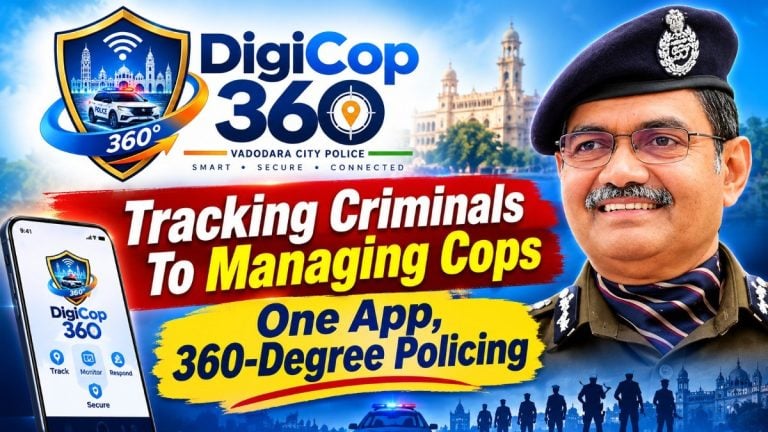
This is the idea behind DIGICOP 360, an application developed to make policing more efficient, informed and responsive.
Introduced in Vadodara, Gujarat, the platform brings several policing functions together. It helps officers mark attendance, allocate duties, monitor performance, access information about their jurisdiction and carry out day and night patrolling more effectively.
Narasimha Komar, IPS (Gujarat cadre, 1996 batch), is currently serving as the Commissioner of Police, Vadodara City. He believes technology should not simply monitor police personnel. It should make their work easier and help them perform better.
Speaking to Indian Masterminds, Komar explains the purpose behind the initiative: “DIGICOP 360 is an application that empowers field Police Officers. It contains all information about vital installations, known criminals, and makes it easy for police officers to discharge their duties efficiently and effectively. It also serves as a force multiplier and enhances efficiency. We want to add more features and add value to make it more comprehensive.”
Also Read – IAS Rishav Gupta’s 3.5-Crore Aquapark Model Is Transforming Tribal Women’s Lives in MP
MAKING ATTENDANCE AND DUTY ALLOCATION EASIER
One of the biggest challenges in policing is managing personnel and their responsibilities. Police officers often have to work outside their police stations. They may have to attend court proceedings, visit forensic laboratories or travel to another city for investigations.
Earlier, attendance was generally recorded in a physical register at the police station. This could become inconvenient for officers who were already on official assignments elsewhere. DIGICOP 360 provides two options. Personnel can mark their attendance digitally at the police station. Alternatively, they can mark it remotely by uploading their photograph and geographical location.
This allows officers to begin their official assignments directly from their location without having to visit the police station first. The application also makes duty allocation more organised. In a police station with around 100 personnel, different officers and staff members have different responsibilities. Some handle crime-related work, while others manage accounts or perform specialised duties.
These fixed responsibilities can be recorded in the system. For duties that change according to requirements, officers can use a dropdown menu to allocate personnel. A VIP visit, religious procession or special security operation can therefore be managed through dynamic duty allocation.
WHEN AN EMERGENCY CHANGES EVERYTHING
The real value of such a system becomes clear during emergencies. Consider a building collapse in a busy area. Several people may be trapped, and the police may suddenly need 25 to 50 personnel to manage crowds, secure the site and assist rescue operations.
In a conventional system, mobilising personnel from different assignments could take valuable time. DIGICOP 360 offers a push-to-talk communication facility. Officers can create groups and communicate with one person, a few people, several teams or the entire group. They can also share the location and broadcast instructions. Personnel can be informed about the emergency and asked to reach the site within a specified time.
Their earlier duties can be revised, and they can be assigned new responsibilities according to the situation.
This gives police officers greater flexibility. It also helps senior officers mobilise available manpower quickly when circumstances change.
AI THAT MAKES PATROLLING MORE INFORMED
Patrolling is among the most regular responsibilities of police personnel. Officers move through their jurisdictions on foot, motorcycles and patrol vehicles. However, a newly posted officer may not know the area well. He may be unaware of the locations of known criminals, bootleggers, history-sheeters or important public installations.
DIGICOP 360 attempts to address this gap through AI-supported day and night patrolling. The application uses approximately 45 layers of information integrated with Google Maps. These layers provide details about the surroundings of an officer.
For example, when an officer is patrolling at night, the application can show what is located within a 100-metre radius. It may include a hospital, a vital installation, the residence of a history-sheeter or another person of interest. The system also helps officers keep track of their visits to important locations. Certain monitoring requirements have been programmed into the application. For instance, if a person of interest has not been checked for a week or two, the system can generate a reminder for the patrolling officer.
There are also designated halting points. If an officer is expected to stop at a particular location for five minutes but does not do so, the application sends a reminder. Navigation support allows personnel to locate specific places, including the residences of known criminals.
This makes patrolling more than just moving through assigned streets. Officers can now access relevant information and receive prompts about locations that require attention.
A COMMUNITY REGISTRY FOR EVERY POLICE STATION
Another important feature is the Community Registry. When an officer joins a new police station, understanding the local area takes time. He needs to know the local elected representatives, important public figures, known criminals and other persons of interest.
He must also become familiar with hospitals, vital installations and other important locations. The Community Registry aims to bring this information together in one place. Police personnel can add and update details about their jurisdiction. They can check how many history-sheeters or bootleggers live in the area and locate them on a map.
Information about local MLAs, MPs, corporators, mayors and other important individuals can also be maintained. The database can grow over time as officers continue adding information. The objective is to create a detailed digital record of every police station’s jurisdiction. When a new officer takes charge, he does not have to begin collecting all the basic information from scratch.
He can access the available records and understand the area more quickly.
PERFORMANCE MONITORING THROUGH REPORTS AND DASHBOARDS
DIGICOP 360 is also designed to help senior officers monitor police activities and evaluate performance. Its dashboard provides daily information about activities such as vehicles checked, history-sheeters monitored and individuals verified during night patrolling.
Commissioner Komar can review these reports to understand how effectively the application is being used. The reporting system offers both standard and customised reports. A senior officer can generate a report about the performance of an individual head constable or review activities across a larger jurisdiction.
A police station officer can access reports for his police station. An ACP can review his subdivision, a DCP can monitor his zone, and senior officers can access information for their respective areas. The application also helps assess the performance of personnel involved in specific assignments. For example, the system can record the number of warrants successfully served or the number of arrests made by an officer during a particular period.
This provides senior officers with a more organised picture of field activities and individual performance.
FROM VADODARA TO OTHER POLICE UNITS
DIGICOP 360 was initially developed for Vadodara with the support of a Bengaluru-based startup. According to Komar, the startup initially had a tool primarily designed for patrolling. However, he felt that policing needed something more comprehensive.
A police station officer handles several responsibilities every day. Requiring him to physically visit different locations or depend on multiple sources for basic information adds to his workload. Komar wanted an application that could bring these requirements together and make information readily available.
The platform has also been integrated with the Command and Control Centre. Its hardware, servers, data maintenance and monitoring support are managed through this facility. Vehicle tracking is another feature. If an officer encounters a suspicious vehicle, he can check details about its registered owner and verify whether it has been reported stolen.
The model has also attracted interest from other police units. Following discussions and an examination of policing tools by a committee constituted by the Home Ministry, headed by the Commissioner of Police, Rajkot, the system has started being used in Rajkot as well.
At present, its regular implementation is primarily in Vadodara, with its use extending to Rajkot. The larger objective is to expand it across Gujarat.
TECHNOLOGY AS A FORCE MULTIPLIER
The success of a policing system is not measured only by the technology it uses. It also depends on whether that technology makes life easier for the personnel working on the ground. A police station officer is often burdened with multiple responsibilities. He must manage staff, respond to complaints, supervise investigations and remain prepared for emergencies. If he has to spend valuable time searching for basic information, it takes him away from more important tasks.
DIGICOP 360 attempts to reduce this burden by placing relevant information, communication tools and operational support in one application. Its larger purpose is to help officers make informed decisions, respond faster and use available manpower more effectively.
As Komar told Indian Masterminds, the idea is not to stop with the features already available. More functions will be added to make the application increasingly comprehensive. For Gujarat Police, DIGICOP 360 is an attempt to bring everyday policing closer to technology. The larger ambition is simple: empower the person on the ground so that he can serve the public better.
Also Read – Beyond Artefacts: How Bihar Museum Is Reclaiming Bihar’s Cultural Identity