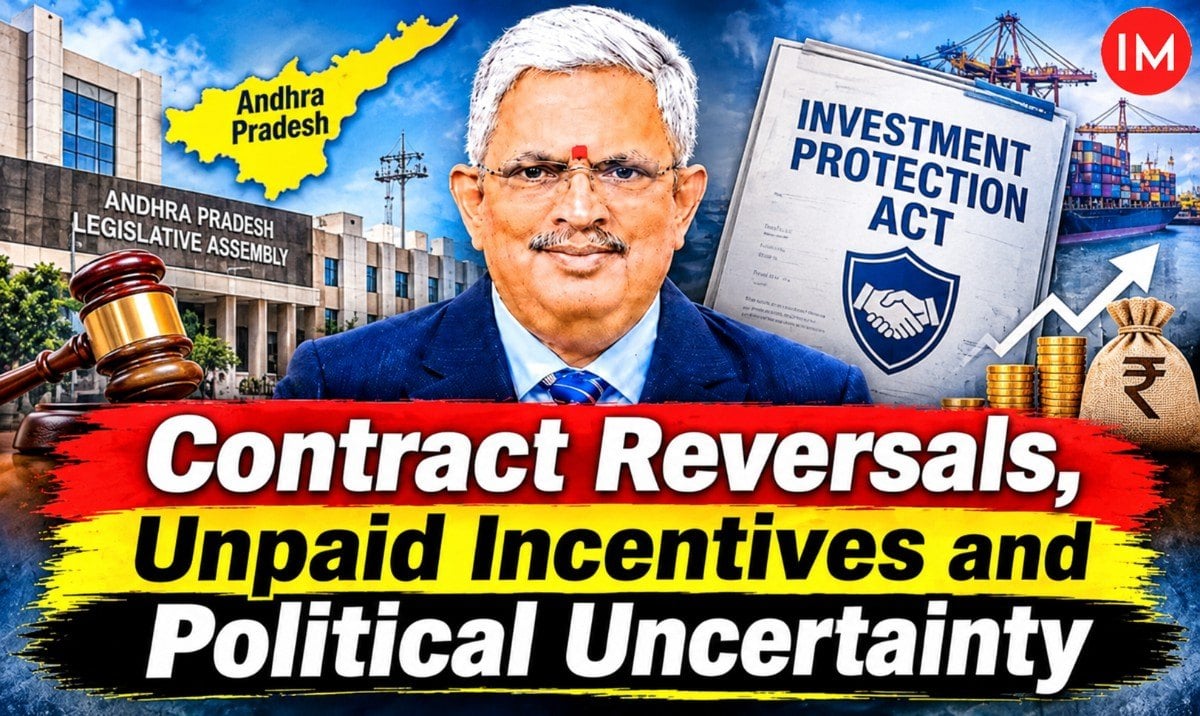
On 12 November 2026, at the CII Partnership Summit in Visakhapatnam, Andhra Pradesh announced that it would enact an Investment Protection Act to shield approvals, incentives and agreements from reversal by a future government, and asked the Union to enact a national law on the same lines. The impulse is understandable: between 2019 and 2024 the state tore up renewable power contracts, closed the Singapore-led Amaravati start-up project, cancelled land given to the Lulu Group and terminated the Polavaram contract, and the courts spent years putting some of it back together. This note seeks to argue that the proposed law is more useful as a signal than as a shield. A legislature cannot bind its successor; the courts already protect investors against arbitrary cancellation; and a law made retrospective to 2024 risks looking like a fence around one party’s deals rather than a promise to all investors. The state’s own record of unpaid incentives, now being answered with an escrow, shows that the investor’s first worry is often the current government’s cheque, not the next government’s pen. The note attempts to set out what the Act should contain if it is to be credible, what the Government of India can do within the Constitution, and why openness at the point of allotment is the best protection at the point of reversal.
The Pitch at the Podium
Investment summits are where Indian states sell their future, and Visakhapatnam’s thirty-first CII Partnership Summit came with an unusual product attached: insurance against the next election. IT Minister Nara Lokesh told the inaugural session that the Telugu Desam-led government would bring an “Investors Protection Act”, and Chief Minister N. Chandrababu Naidu said investors were worried about regime change and had suffered from “vindictive politics”. The Bill, he said, would be passed by the Assembly and then sent to the Centre, and he urged Union Commerce Minister Piyush Goyal to work toward a national law so that the whole country could offer the same assurance. Lokesh was blunter in another account: “We will enact it.” Naidu’s own line was simpler still: “The Centre must support it.”
Also Read – India Is Mapping Climate Risk. Now It Must Enter Planning Earlier
What the Act will actually say is not yet public. No Bill text had been published at the time of writing, and the reports describe intent rather than clauses. The Deccan Chronicle reported that the law would stop a government from arbitrarily cancelling approvals, incentives and agreements given by its predecessor. Swarajya reported that the Act would apply with retrospective effect from 2024, and that an escrow account for industrial incentives became operational on 14 November; so far as I could find, both details appear only in that publication, and they should be read as single-source until the Bill is tabled. The escrow itself is better documented. Business Today reported that a share of state tax collections equal to the incentives owed would be set aside for timely payment, and Swarajya added that accounts would be opened automatically once an MoU is signed, with dedicated escrow accounts offered to industries “backed by sovereign guarantees” (again, a detail I could find only there). The government also announced that it had released about Rs 1,400 crore towards pending incentives.
The numbers came with the pitch, as they always do. The summit produced 303 MoUs worth Rs 9.89 lakh crore; the state said it had attracted proposals worth Rs 32.49 lakh crore since June 2024, and that of 714 proposals worth Rs 22.60 lakh crore received before the summit, about 74 per cent had land and incentive approvals. These are the government’s own figures, and the reports differ a little among themselves (73 per cent in one account, 74 in another). It is worth holding one comparison in mind. The state’s projected GSDP for 2026-27 is Rs 19.75 lakh crore. The commitments claimed since June 2024 come to about one and two-thirds times the size of the state’s entire annual economy. MoUs are promises, and this note is about how much a promise is worth.
The Scar Tissue: Why Andhra Pradesh, and Why Now
No state legislates against a danger it has not felt, and Andhra Pradesh has felt this one in the bone. When the YSR Congress Party took office in May 2019, it ordered a review of almost everything its predecessor had signed, and four episodes from that period still shape how investors read the state.
The first was power. On 1 July 2019 the state constituted a high-level committee to renegotiate wind and solar purchase agreements signed under the TDP, and the distribution companies wrote to generators threatening cancellation if prices were not cut. The Centre wrote at least twice asking the state not to proceed, and the then Union Power Minister R.K. Singh said the move had unnerved global investors looking at India as a whole. A single judge allowed the discoms to pay an interim tariff of about Rs 2.43 to Rs 2.44 a unit, roughly half the contracted rate, against first-year tariffs as high as Rs 5.99 under some agreements. It took until 15 March 2022 for a Division Bench to hold that signed PPAs could not be reopened in this way and to order the arrears cleared within six weeks. By one industry count, more than 7,500 MW of contracts had been in limbo for thirty-two months.
The second was Amaravati. By a Government Order of 11 November 2019 the state closed the 6.84 square kilometre Start-Up Area that a Singapore consortium had been engaged in 2017 to develop. Singapore’s Ministry of Trade and Industry noted the decision with diplomatic coolness, observing that “Companies recognise such risks when venturing into any overseas market.” The World Bank had already pulled out of the capital project that July. Behind the projects lay the farmers who had pooled more than 33,000 acres on the promise of developed plots. In March 2022 the High Court held that the legislature lacked competence to split the capital and directed the state to build Amaravati within six months; the Supreme Court later stayed the time-bound directions, remarking that a High Court cannot act as a “town planner”.
The third was land. In October 2019 the new government cancelled the Visakhapatnam land allotted to the Lulu Group, alleging that land worth Rs 50 crore had been given at Rs 4 lakh an acre. Lulu, which had planned about Rs 2,200 crore of investment, said it would never invest in the state again. The fourth was Polavaram, where the head-works contract with Navayuga was terminated and the work “reverse tendered”. Megha Engineering emerged as the sole bidder at 12.6 per cent below the earlier price, and the state claimed savings of Rs 780 crore, while the TDP called the process favouritism.
All of this was real, and all of it was costly. Yet the record also contains a twist that the summit speeches left out, and an honest note has to tell it.
The Steel Man: Not Every Reversal Is Vendetta
The strongest case against an Investment Protection Act is not made by people who dislike investment. It is made by people who have watched public assets handed over cheaply, on terms nobody could see, and who believe the next government is the only audit that bites in real time.
Consider the cases above from the other side. The YSRCP’s argument on the PPAs was that tariffs locked in during a period of falling solar prices were costing the state about Rs 5,000 crore. The courts rejected the remedy, rightly, but the grievance was not imaginary: long-term contracts signed at the top of a falling price curve are a genuine fiscal burden, and other countries have reopened them. Pakistan has renegotiated its power contracts in 1998, 2012, 2020 and again in 2024, under capacity payments that reached PKR 2.1 trillion in a single year. India’s own history offers Dabhol, where the Shiv Sena-BJP government elected in 1995 cancelled the Enron contract as against the public interest and, by January 1996, accepted a renegotiated version. Reversal by a new government is a feature of Indian democracy across party lines. It happened at Singur, where Tata Motors moved the Nano plant to Gujarat in 2008 and later won an arbitral award of Rs 765.78 crore with 11 per cent interest against the West Bengal Industrial Development Corporation. It happened at Aarey, where the Thackeray government moved the Metro-3 car shed to Kanjurmarg in 2020 and the Shinde-Fadnavis government moved it back in 2022, with the BJP warning of a Rs 4,000 crore escalation from the first move.
Now the twist. The Lulu land was restored by the Naidu government, re-allotted in March 2025 on a 99-year lease, with lease payments waived for three years and then set at Rs 7.08 crore a year, for a promised investment of Rs 1,066 crore and about 500 jobs. A separate allotment of 4.15 acres of APSRTC land in central Vijayawada drew a public interest litigation and objections from the opposition and the Left; former Union Power Secretary E.A.S. Sarma said it “cannot be handed over at such a nominal price”. The present government then told the High Court it would withdraw that allotment, while the Visakhapatnam allotment faces its own PIL on the ground that it was made without bidding. In other words, the very government proposing an Investment Protection Act has itself cancelled an allotment to the very investor whose 2019 exit is the emblem of the problem. It did so because the allotment could not survive scrutiny.
The second twist is sharper. In December 2021 the YSRCP government agreed to buy 7,000 MW of solar power through the Solar Energy Corporation of India for 25 years. In November 2024 a US indictment alleged that most of the bribes in the Adani case, about USD 228 million, were paid to an Andhra Pradesh official to secure that purchase. The Naidu government, under heavy pressure to cancel, said it could not scrap the agreements without solid proof of bribery. That was the correct answer in law, and it was exactly the principle of contract sanctity the new Act wants to make statutory. But it illustrates the problem from the other side: the deal that an investment protection law protects best may be the deal that most deserves a second look.
There is a further, political, irony. In July 2025 the Chief Minister was reported to be ordering a probe into an alleged YSRCP campaign to discourage investors, and the Finance Minister later accused the opposition leader of orchestrating some 200 discouraging emails to bond investors. Whatever the truth of those claims, a climate in which each side calls the other a saboteur of the state is precisely the climate in which a one-party protection law will be read as a weapon rather than a guarantee.
What the Law Can and Cannot Do
The first legal problem is old and fundamental. A legislature cannot bind its successor. Whatever the Andhra Pradesh Assembly enacts in 2026, an Assembly elected in 2029 can amend or repeal by simple majority, and the Supreme Court said as recently as 2025 that even a judgment upholding a statute does not stop the legislature from modifying or repealing it when policy changes. An Act that says “no future government shall cancel” is, in strict law, a promise written in pencil.
The second problem is that promissory estoppel, the doctrine that holds governments to their assurances, yields to the public interest and does not run against the legislature. The Supreme Court in Shrijee Sales Corporation (1997), following Motilal Padampat (1979), held that promissory estoppel cannot be invoked when the public interest requires otherwise. A future government will always say that it is acting in the public interest. The question will then go to court, and the court will weigh it, as it would have done anyway.
The third problem is the mirror of the second, and it is good news. Courts already protect investors against arbitrary cancellation. The PPA judgment of 2022 and the Amaravati judgment of the same year were won without any investment protection statute, on the Electricity Act, the CRDA Act, Article 14 and the doctrine of legitimate expectation. What investors lost in Andhra Pradesh was not the law but time: thirty-two months of halved tariffs is a long time for a project financed on borrowed money. A statute that adds nothing to the substance but shortens the time, by creating a dedicated forum, fixed timelines and an automatic stay on unilateral cancellation pending review, would do more good than one that proclaims inviolability.
The fourth problem is constitutional placement. “Contracts” is Entry 7 of the Concurrent List. A state law that alters the rights of parties to a contract may collide with central laws such as the Indian Contract Act, the Specific Relief Act or the Arbitration and Conciliation Act, and to survive that collision it must be reserved for and receive the President’s assent under Article 254(2). That is the likely reason the Chief Minister speaks of sending the Bill to the Centre. It also means the Union government, an ally today, will have a direct hand in what the state law becomes, which a future opposition will not forget.
The fifth problem is the reported retrospective date of 2024. If that report is accurate, the law would protect commitments made since this government took office and would not protect those made between 2019 and 2024. Retrospectivity is not unconstitutional in itself, but in this context it reads badly. A law that shields “our” approvals and leaves “theirs” open to review is not an assurance to investors; it is a fence around one party’s portfolio. The SECI agreement, signed in 2021, would fall outside it. So would every approval of the YSRCP years that an investor relied on in good faith.
The Escrow: A Confession in the Form of a Remedy
The most practical part of the package is not the Act at all, and it deserves the most scrutiny. An escrow for incentives is an admission, a candid one, that the biggest risk investors face in Andhra Pradesh has not been a future government cancelling their approvals. It has been every government failing to pay what it promised.
The record is plain. In the 2025-26 budget the Finance Minister said the previous government had left more than Rs 11,000 crore of incentives unpaid to industries, MSMEs and SC and ST entrepreneurs, a claim made by a political rival and to be read as such. The present government released a first Rs 1,500 crore at Diwali 2025. Yet on 29 October 2026, a fortnight before the summit, the AP Chambers of Commerce was still asking the Chief Minister to intervene personally over about Rs 5,000 crore of pending incentives to MSMEs and food processing units. The Rs 1,400 crore released at the summit was welcome. It was also a payment of arrears the current government had itself allowed to accumulate. The vendetta of the next government is a hypothetical; the delay of this one is a ledger entry.
Here an auditor must add something the summit could not. Under Article 266 every rupee of revenue the state receives goes into its Consolidated Fund, and under Article 204 nothing comes out except under an Appropriation Act passed by the Assembly. An escrow fed from “a share of state tax collections” can lawfully exist only if the money is first appropriated and transferred, much like a reserve fund in the Public Account. Its protection therefore extends only to sums already moved. A future government that wishes to starve the scheme need not repeal anything; it need only appropriate less next year. If the escrow is designed instead to divert collections before they reach the Consolidated Fund, it will raise serious questions of legislative control that the CAG and the Public Accounts Committee will be bound to ask. And if escrow accounts are to be “backed by sovereign guarantees”, every guarantee is a contingent liability that belongs in the budget’s disclosures and in any fiscal responsibility limit. Andhra Pradesh’s public debt is budgeted at Rs 7.11 lakh crore for 2026-27, up from Rs 4.91 lakh crore in 2023-24, about 45 per cent higher in three years, with the fiscal deficit targeted at 3.84 per cent of GSDP after 4.6 per cent in 2025-26. An incentive promise that is ring-fenced in law but not funded in the budget is simply a liability that has moved to a different line.
The escrow is still a good idea, and the notion of releasing money through the bank rather than through the officer’s desk is a genuine reform. It will be credible to the extent that every rupee is appropriated in the open, reported to the Assembly each year, and audited, so that investors can see the balance and so can taxpayers.
(Note : This is the first part of a two-part article. The second part, examining the way forward and the safeguards needed to make investment protection credible, will follow soon.)
About The Author– Mr. P Sesh Kumar is a retired 1982-batch officer of the Indian Audit and Accounts Service (IA&AS) who served as Director General of Audit at the Comptroller & Auditor General of India.
Disclaimer—(The views and opinions expressed in this article are solely those of the author and do not necessarily reflect the views of Indian Masterminds. For feedback or queries, please write to [email protected].)
Also Read – India’s Per-Capita Emissions Argument: A Case for Climate Justice or an Excuse for Inaction?