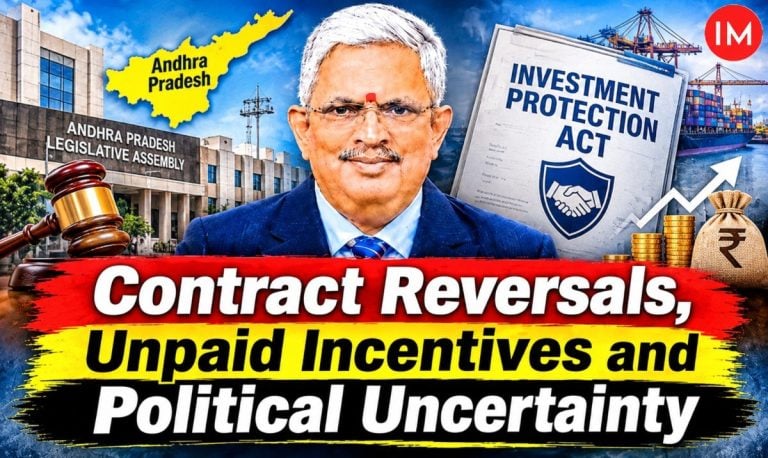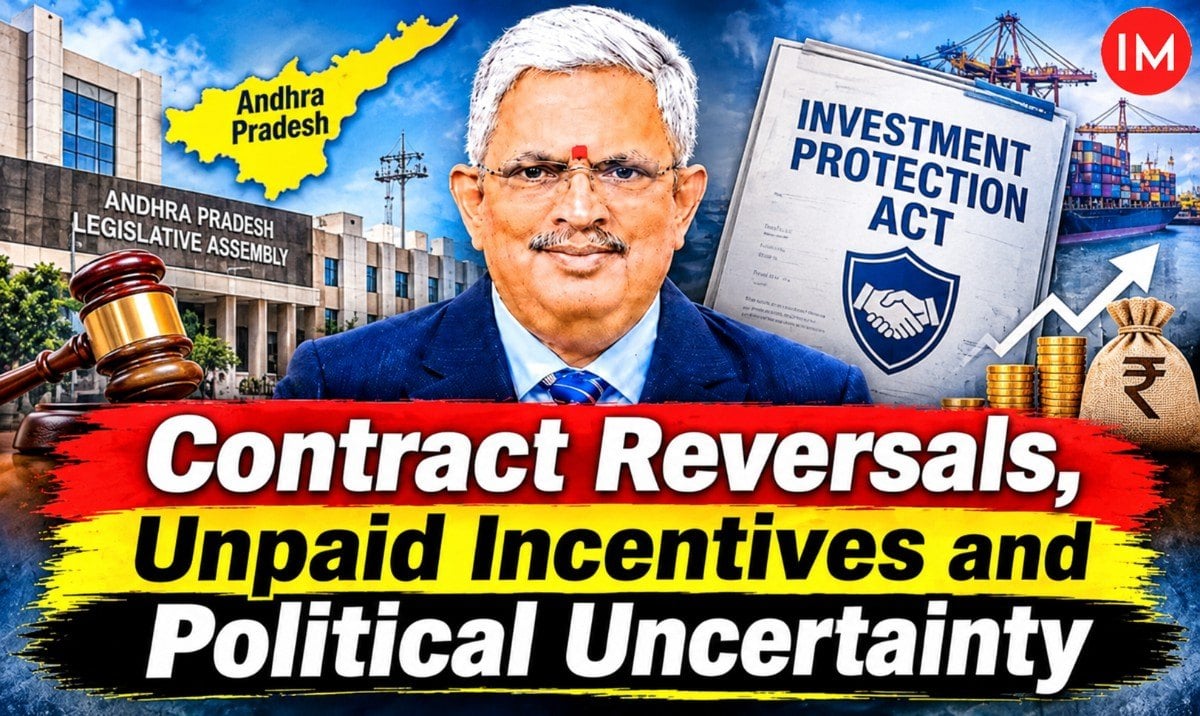
When a new government comes to power, can it undo the promises made by its predecessor to investors? Andhra Pradesh is attempting to answer this question through a proposed Investment Protection Act, announced at the CII Partnership Summit in Visakhapatnam on November 12, 2026. The state wants to protect investment approvals, incentives and agreements from arbitrary reversals by future governments. It has also urged the Centre to consider a similar law at the national level.
The proposal comes against the backdrop of Andhra Pradesh’s own experience between 2019 and 2024, when renewable power purchase agreements were reopened, the Singapore-led Amaravati start-up project was scrapped, land allotted to the Lulu Group was cancelled and the Polavaram contract was terminated. Several of these decisions triggered legal battles, leaving investors uncertain and projects caught in prolonged disputes.
The intention behind the proposed law is understandable. Investors need policy stability and confidence that agreements will be honoured even when governments change. But can one legislature legally bind its successor? And can a new law offer protection when investors are still waiting for incentives promised by the present government?
The proposed Act may be more effective as a signal of intent than as an absolute shield against political reversals. Courts already offer protection against arbitrary government action, while a law that protects only selected past commitments could raise questions about fairness and political motivation. The more pressing challenge is to ensure transparent allotments, enforceable contracts and timely payments.
In this two-part analysis, P. Sesh Kumar examines the legal and constitutional limits of investment protection, the role the Union government can play, and the safeguards Andhra Pradesh must build into its proposed law. The larger argument is that investor confidence cannot rest on legislation alone. It must begin with transparency when projects are allotted and continue with accountability when governments change.
Also Read – Investment Protection or Political Insurance? What Andhra Pradesh’s Proposed Law Must Deliver
Practicality: What Investors Actually Fear
Ask an infrastructure financier what keeps them awake and the answer is rarely a dramatic cancellation. It is the slow bleed: payments that arrive late, approvals that lapse, land that turns out to be disputed, a PIL that freezes a site, an inspector who will not sign. The state’s announcement of approvals within five days through thirteen licences and self-certification speaks to the right worry. But speed and protection pull in opposite directions when allotments are discretionary. Every concession granted quickly and quietly becomes a target for the next government, and a law that protects it will be read as a law protecting the quiet.
There is also the question of what exactly would be protected. An MoU is not a contract and should not be treated as one. Andhra Pradesh’s own history is a warning. A minister of the YSRCP government told the Assembly in 2019 that MoUs worth Rs 12.32 lakh crore signed at the 2016-18 summits had produced actual investment of only Rs 1.39 lakh crore, a figure from a political adversary that I have not been able to verify independently. The YSRCP’s own Global Investors Summit of March 2023 announced MoUs worth Rs 13.05 lakh crore. MoU inflation is a bipartisan sport in Andhra Pradesh, as it is everywhere else in India. A protection law that covers MoUs would be protecting press releases; one that covers concluded contracts, allotments under published rules and notified incentive entitlements would be protecting something an investor can price.
What the Government of India Can Do
The Chief Minister’s request for a Central Investment Protection Act deserves a serious answer rather than a polite one, and the serious answer is that the Centre can do a good deal, provided it does not try to freeze state policy.
First, the Centre already has a model of what works, and it comes from the power sector that started Andhra Pradesh’s trouble. The Electricity (Late Payment Surcharge and Related Matters) Rules, 2022 converted the discoms’ legacy dues into instalments and tied continued payment to access to the power markets. Legacy dues fell from Rs 1,39,947 crore on 3 June 2022 to Rs 3,330 crore by 27 March 2026, a reduction of about 98 per cent. That was not achieved by declaring contracts sacred. It was achieved by making non-payment expensive and automatic in its consequences. The lesson for investment protection generally is that the useful central role is to build payment security mechanisms with teeth, not to make statements of principle.
Second, Parliament can legislate under Entry 7 of the Concurrent List a framework law on the fair treatment of public contracts. It should not forbid states from renegotiating or cancelling, which would invite challenge and offend federalism, but should require that any cancellation or material change of a concluded state contract be made by a reasoned order, after hearing the counterparty, reviewed within fixed timelines by an independent forum, and accompanied by compensation at fair value where the counterparty is not at fault. That approach would make reversal costly and transparent rather than impossible. It would protect the YSRCP’s investors and the TDP’s alike, and those of every state government of any party.
Third, the Centre can extend what it has already done for infrastructure litigation. The Specific Relief (Amendment) Act, 2018 inserted Section 20A to stop courts from granting injunctions that would delay scheduled infrastructure projects. A parallel provision could bar executive stop-work orders on such projects without the reasoned procedure described above.
Fourth, there is a treaty dimension that New Delhi cannot ignore, because the Union already bears the risk of what states do. Under international law a state government’s measures are attributable to India. After adverse awards India terminated around 75 bilateral investment treaties in 2016-17 and adopted a restrictive 2016 Model BIT. The revision announced in the 2025-26 Union Budget was described in August 2026 as being in its final stages before the Cabinet, and recent treaties suggest India is prepared to offer investors somewhat more than the 2016 text. Every foreign investor protected by a new BIT will in effect hold a central guarantee against state-level reversals. That gives the Centre a direct financial interest in disciplining arbitrary state conduct, and a reason to build a national mechanism that resolves disputes before they reach an international tribunal.
Fifth, the Centre must put its own house in order, because states will hear any lecture on contract sanctity against New Delhi’s own record. The retrospective tax amendment of 2012, which produced the Vodafone and Cairn disputes, was undone only in 2021. A national framework built through the Inter-State Council or the NITI Aayog Governing Council, with opposition-ruled states at the table, would be more durable than one proposed by an ally and passed on the strength of a coalition arithmetic that will not last forever.
Does It Help in a Polarised State?
The honest answer is: somewhat, and in ways different from those advertised.
A statute will not stop a determined successor, but it raises the political cost of reversal. Cancelling a contract by a quiet Government Order is easy; repealing an Act in the Assembly, in daylight, with the investment community watching, is harder. A statutory procedure would also shorten the time that investors spend waiting for courts to restore what they already would have restored, and time is the currency in which the 2019-22 episodes were really paid. The escrow, if funded and audited, would turn promises into cash for those who have already earned their incentives. And the signal matters: in a state that lost Singapore and Lulu, saying out loud that the government understands the problem is worth something.
What would not help is a law that one side passes and the other side regards as the first item on its repeal list. In a polarised state, the only protection that survives a change of government is one that both governments have endorsed. That means bringing the opposition into the drafting, perhaps through a select committee, and making the Act apply symmetrically to approvals of every government since the state was formed in 2014, or prospectively only. A law that the YSRCP has voted for is a law investors can rely on. A law it has denounced is a campaign promise for 2029.
Lessons and a Practical Way Forward
The first lesson is that openness at the point of allotment is the best protection at the point of reversal. Nearly every contested cancellation in this story began with a deal that looked too generous and was made too quietly: land at Rs 4 lakh an acre, contracts on nomination, tariffs fixed without visible benchmarking. The next government did not invent those grievances; it used them. If every allotment, concession and incentive entitlement were published on a public register, with its terms, its valuation and the competitive process behind it, a successor would find little to attack, and a court would find it easy to protect what remained. Sunlight is the most reliable stabilisation clause ever written.
The second lesson is that protection should be procedural rather than absolute. Andhra Pradesh’s Act would be credible if it covered concluded contracts and notified entitlements, not MoUs; if it allowed cancellation only for fraud, illegality or a defined public-interest ground established by a reasoned order after hearing; if it created an independent review authority headed by a retired judge, with fixed timelines; if it specified compensation on the lines of the termination payments in model concession agreements; and if it applied symmetrically to every government’s commitments.
The third lesson is that money is the promise. The escrow should be funded through the budget, shown separately in the accounts, reported to the Assembly each year and audited by the CAG, and any guarantees behind it should be disclosed as contingent liabilities. Clearing the Rs 5,000 crore that industry says is still owed would do more for investor confidence than any clause in the Act.
The fourth lesson is for New Delhi. The Centre can best answer Naidu’s call not with a central law that freezes state policy but with a framework law on fair treatment of public contracts, a payment security architecture on the LPS model, a revised Model BIT that is finally signed with major partners, and a forum that resolves state-investor disputes in months rather than years. It should build that framework with every state, not only with its allies.
The verdict, then, is mixed but not unfriendly. Andhra Pradesh is right about the disease and is reaching for a remedy that will work only partly. No legislature can make a promise that outlives its maker. What a legislature can do is make breaking the promise slow, public, reviewable and expensive, and make keeping it a matter of routine. If the Bill that reaches the Assembly does that, and does it for every government’s investors rather than one, it will deserve to be copied across India. If it does not, it will become one more document that the next government reviews.
About The Author– Mr. P Sesh Kumar is a retired 1982-batch officer of the Indian Audit and Accounts Service (IA&AS) who served as Director General of Audit at the Comptroller & Auditor General of India.
Disclaimer—(The views and opinions expressed in this article are solely those of the author and do not necessarily reflect the views of Indian Masterminds. For feedback or queries, please write to [email protected].)
Also Read – India’s Per-Capita Emissions Argument: A Case for Climate Justice or an Excuse for Inaction?