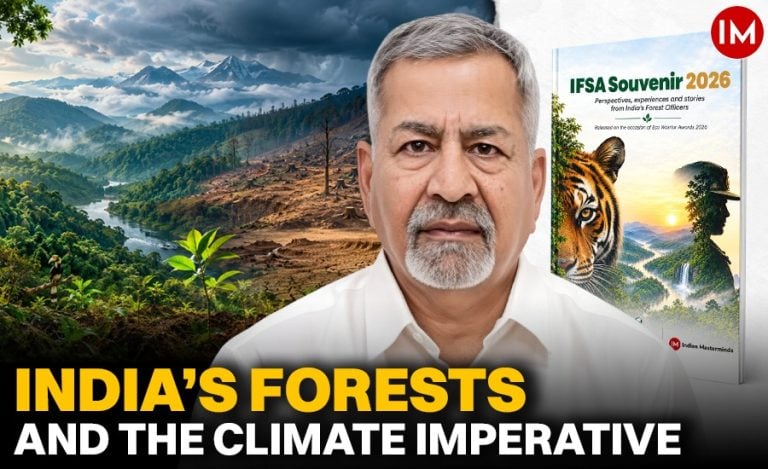
India’s forests, draped across over one-fifth of its landmass, are not just green patches on the map—they are the nation’s lungs, water towers, seed banks, and cultural soul. Yet, the policies meant to steward them have often resembled a cart without a horse, or worse, a compass without a destination. Since Independence in 1947, India’s journey from sustained yield forestry to Sustainable Forest Management (SFM) has been long, winding, and uneven, occasionally inspired but frequently stuck in the undergrowth of bureaucratic inertia and legal ambiguity.
From Timber Mines to Ecological Sentinels
At the dawn of independence, India inherited a forest regime shaped by colonial needs. The Indian Forest Act of 1927, still largely intact today, was a tool of control—crafted to extract timber and subdue communities. Forests were viewed less as ecosystems and more as standing inventories of wood, waiting to be felled with mathematical precision under the doctrine of “sustained yield.” This was forestry as accounting: how much wood could be removed without reducing the stock?
The 1952 Forest Policy, India’s first as a sovereign nation, made some nods to the protective role of forests, but the underlying ethos remained industrial. It advised maintaining one-third of the country’s land under forest, but continued to privilege commercial plantations and wood-based industries. Forest-dependent communities were seen as threats rather than stakeholders.
Also Read – Beyond Tigers and Safaris: How Corbett Literature Festival Wants to Change the Conservation Conversation
The Policy That Turned the Leaf
It took another 36 years before India began to see its forests through a different lens. The National Forest Policy of 1988 marked a watershed moment. For the first time, ecological security, biodiversity conservation, and the needs of forest-dwelling communities were placed at the centre of forest governance. The policy acknowledged that forests are not merely a source of wood but a mosaic of life, deeply intertwined with livelihoods, climate, and culture.
It was also the policy that birthed a buzzword that dominated the 1990s: Joint Forest Management (JFM). It introduced a participatory model where local communities were to be partners in protection and restoration efforts. In states like West Bengal, Andhra Pradesh, and Madhya Pradesh, the model initially flourished. Forests regenerated, and village protection committees became symbols of grassroots environmentalism.
But like a vine left unsupported, JFM too began to wither. The forest department, steeped in a command-and-control culture, remained the primary custodian. Communities were rarely treated as equals; benefit-sharing was often ill-defined; and institutional support for JFM groups was thin. It was participation on paper, not empowerment on the ground.
A Policy in Limbo, a Law in Chains
Even as the ecological imagination expanded, the legal framework remained fossilised. The 1927 Forest Act, designed for empire, still set the boundaries of action. In India, forest policy has always run ahead of the law, a legacy of colonial governance where edicts preceded legislation. As a result, every new policy has found itself straining against an outdated legal skin.
Efforts to draft a new forest policy after 1988 have failed to bear fruit. A draft circulated in 2018—heavy on private sector participation, light on community rights—met with strong resistance and was shelved. For over three decades, India has been navigating the future of its forests with a rear-view mirror.
Meanwhile, the Forest Rights Act of 2006 attempted to correct historic injustices by granting land and usage rights to tribal and forest-dependent communities. Though transformative in design, its implementation has been uneven and, in some states, fiercely resisted.
From Yield to Management: Enter the Age of SFM
Globally, forestry was undergoing a paradigm shift. The 1990s and 2000s saw the rise of Sustainable Forest Management (SFM)—a concept that expanded forestry beyond timber, to include soil conservation, biodiversity, carbon storage, water regulation, and livelihoods. In theory, SFM seeks to manage forests as dynamic ecosystems that provide a wide range of goods and services in perpetuity.
India endorsed this shift in its policy discourse. Terms like “ecosystem services,” “carbon sinks,” and “landscape-level planning” entered forest department documents. Yet, the translation of these ideas into everyday practice remained hazy. Most forest working plans—still the blueprint for local management—continue to focus on timber-centric operations. The tools and metrics for valuing and managing ecosystem services remain underdeveloped. Institutional capacity is stretched, and coordination between forestry, water, agriculture, and climate agencies is minimal.
The Climate Imperative: Forests as Carbon Currency
As climate change emerged as the defining challenge of the 21st century, forests were recast once again—this time as frontline actors in mitigation. India, under its Nationally Determined Contributions (NDCs) to the Paris Agreement, pledged to create an additional carbon sink of 2.5 to 3 billion tonnes of CO₂ equivalent through forests and tree cover by 2030. Programs like the Green India Mission were launched to operationalise this ambition.
Forestry was also included as a Clean Development Mechanism (CDM) activity, allowing forest projects to earn carbon credits. But participation has been dismal. Procedural complexities, lack of institutional support, and skepticism about benefit-sharing have kept communities and state agencies away.
Internationally, India signed on to REDD+ (Reducing Emissions from Deforestation and Forest Degradation), but its implementation has not gone beyond pilot projects. The potential for forests to contribute meaningfully to India’s climate strategy remains high but untapped.
Managing Beyond Boundaries: Landscapes and Services
Another shift in thinking, still embryonic in India, is the move from forest patches to landscape-level management. This approach recognises that forests do not exist in isolation—they are part of broader ecological and social systems, linked to agriculture, water, wildlife corridors, and human settlements.
Yet, administrative boundaries continue to dominate planning. Watersheds are divided by districts; ecosystems by bureaucracies. There is little coordination across ministries or with local governments. Forest boundaries are still rigid, even when rivers meander, animals migrate, and fires spread across jurisdictions.
Even more overlooked is the valuation of ecosystem services. Forests provide water filtration, soil stability, air purification, pollination, and spiritual sanctity, but these remain invisible in budget allocations and development decisions. Until these services are priced and protected, forests will continue to lose out to highways, mines, and real estate.
The Way Forward: From Rhetoric to Rooted Reform
India’s forests today stand at a critical juncture. They are expected to deliver on multiple fronts: biodiversity protection, climate regulation, water security, and rural livelihoods. Yet, the tools to manage them remain outdated, fragmented, and underpowered.
The way forward must begin with a new National Forest Policy, not as a document of aspiration but as a blueprint of action, backed by legal reform. The Indian Forest Act must be rewritten to reflect contemporary ecological realities and democratic values.
Second, SFM must be made operational, not merely rhetorical. This means training forest personnel in ecological science and participatory governance, equipping local communities with tools for monitoring and management, and establishing robust systems to measure ecosystem services.
Third, the focus must shift from plantation targets to landscape resilience—ensuring ecological connectivity, adaptive management in the face of climate variability, and integration across sectors.
Finally, communities must be seen not as passive beneficiaries but as equal co-managers. The success of India’s forest future will hinge on the depth of its democracy in the forest heartland.
A nation that hopes to lead the world on climate action cannot afford to mismanage its own green heritage. Forests are not just resources to be governed; they are living systems to be honoured, understood, and protected. The path ahead requires not just policy tweaks but a philosophical reimagining—a shift from managing forests as commodities to embracing them as commonwealth.
Also Read – One Plant, Many Solutions: Himachal’s First Biochar Project Targets Fires, Carbon and Rural Livelihoods