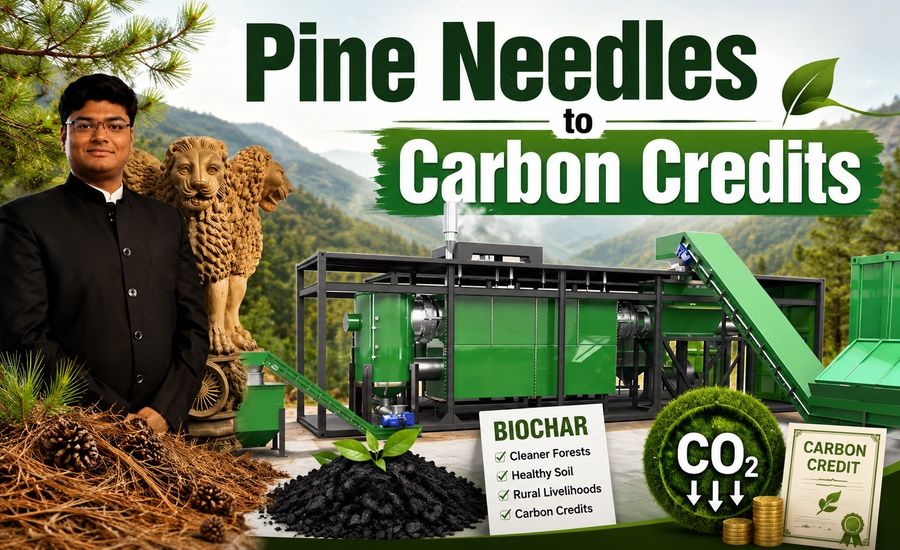
By transforming pine needles and forest biomass into biochar, Himachal Pradesh is pioneering a climate-smart model that promises cleaner forests, healthier soils, rural livelihoods and thousands of carbon credits – making environmental conservation economically rewarding.
As India intensifies its efforts to combat climate change while ensuring sustainable development, Himachal Pradesh is quietly laying the foundation for a model that could redefine the way forests are managed. Instead of treating forest biomass like pine needles, lantana, bamboo and other plant residues as waste – or worse, as fuel for devastating forest fires – the state is preparing to convert them into a valuable climate asset.
At the heart of this transformation is India’s first indigenous biochar initiative, being established in Hamirpur district under a unique partnership involving the Government of Himachal Pradesh, the Forest Department, Dr Y.S. Parmar University of Horticulture and Forestry, and Chennai-based ProClime Services Private Limited.
More than just another environmental project, the initiative seeks to address multiple challenges simultaneously – reducing forest fire risks, removing invasive species, improving soil fertility, generating rural employment, creating carbon credits, and contributing to India’s climate commitments. The project forms a crucial part of the HIM Evergreen Integrated Climate-Smart Agriculture and Agro-forestry Programme, which aims to integrate sustainable forestry with agriculture across 50,000 hectares of agricultural landscapes in Himachal Pradesh.
Recently, Chief Minister Sukhvinder Singh Sukhu reviewed the progress of the project at Neri in Hamirpur district, describing it as a significant initiative for sustainable forest resource management and employment generation.
To understand how the project will work on the ground, Indian Masterminds spoke to Ankit Kumar Singh, an Indian Forest Service (IFS) officer of the 2018 batch and Divisional Forest Officer (DFO), Hamirpur, who explained the Forest Department’s role, the science behind biochar, and why the initiative could become a game changer for the state’s forests.
Turning Forest Waste into Climate Wealth
For decades, pine needles have posed one of the biggest forest management challenges in Himachal Pradesh.
Unlike broadleaf litter that decomposes quickly, dry pine needles accumulate on forest floors, creating highly inflammable layers that often trigger or intensify forest fires during summer. At the same time, invasive species like lantana continue to spread aggressively, affecting native biodiversity.
Read Also: From AI to Gram Panchayats: India Celebrates 17 Digital Governance Breakthroughs at NAeG 2026
The new biochar initiative seeks to transform these liabilities into valuable resources.
Instead of allowing pine needles and other biomass to remain in forests, they will now be scientifically collected and processed into biochar through pyrolysis – a process that converts biomass into a stable carbon-rich material capable of storing carbon for centuries.
The initiative, therefore, does not merely remove hazardous biomass from forests; it creates a circular economy where environmental conservation directly generates economic value.
How the Initiative Took Shape
The project operates under a tripartite Memorandum of Understanding (MoU) signed in August last year between the Government of Himachal Pradesh, Dr Y.S. Parmar University of Horticulture and Forestry, and ProClime Services Private Limited, a Chennai-based company specialising in biochar production and carbon credit generation.
According to Singh, the project is currently in its early stages.
“An MoU has already been signed, and the company has established a pilot biochar plant in the Lehri area. The full-scale plant will come up after that. Since it is a private company, the exact implementation timeline will depend on them, but the process has already begun.”
The agreement proposes the establishment of two biochar plants in Hamirpur district—one at Neri and another at Jahu—with phased investments of up to one million US dollars by ProClime Services.
Although the pilot plant has already been installed, the commercial-scale facility is expected to become operational after the current preparatory phase.
Why Hamirpur Was Chosen
Hamirpur presents a unique opportunity for such an initiative. The district has approximately 60,000 hectares of forest area, of which nearly 11,500 hectares are covered by chir (pine) forests.
This extensive pine cover results in massive annual accumulation of dry pine needles, significantly increasing the risk of forest fires.
IFS Singh explained, “Hamirpur is predominantly a chir pine forest region. Because of the large pine forest area, accumulation of pine needles has always been a major concern. Along with pine needles, lantana, bamboo and other biomass will also be collected and converted into biochar.”
By targeting biomass that naturally accumulates every year, the project addresses one of the most persistent forest management challenges in the region.
What Exactly Is a Biochar Plant?
At the centre of the initiative lies biochar technology – an increasingly important tool in global climate mitigation.
A biochar plant is an industrial facility that converts organic biomass such as agricultural residue, forest waste, bamboo, invasive shrubs, wood chips and other plant material into a stable carbon-rich substance known as biochar.
Unlike conventional burning, the biomass is heated under oxygen-limited conditions through a process called pyrolysis.
Instead of releasing most of its carbon into the atmosphere, the process locks much of it into a highly stable solid form.
This biochar can then be applied to agricultural land or forests, where it remains stable for hundreds—and in many cases thousands – of years, effectively acting as a long-term carbon sink.
How Biochar Benefits the Environment
The benefits of biochar extend far beyond carbon storage. Because of its highly porous structure, biochar behaves like a natural sponge inside the soil.
It helps retain moisture, stores essential nutrients, provides habitat for beneficial microorganisms, improves soil fertility and reduces nutrient runoff into nearby water bodies.
It can also adsorb heavy metals and pollutants, thereby improving soil quality while enhancing agricultural productivity.
Most importantly, biochar enables carbon sequestration by permanently storing carbon that would otherwise return to the atmosphere through decomposition or open burning.
Reducing Forest Fires Through Better Biomass Management
One of the biggest advantages of the project lies in its potential to reduce forest fire risks.
Every summer, dry pine needles become one of the principal reasons behind rapidly spreading forest fires across Himachal Pradesh.
Removing this combustible material significantly lowers fire hazards.
Mr Singh described the approach as beneficial on multiple fronts. “It is basically a win-win situation. Carbon sequestration happens through biochar, and when pine needles are removed from forests, the hazard of forest fires is also reduced.”
The project also aims to remove invasive species such as lantana, whose spread has long affected forest ecosystems and biodiversity.
Together, these interventions create healthier forests while reducing annual fire risks.
The Forest Department’s Role: Facilitator, Not Operator
Although the biochar plant is being established by a private company, the Forest Department plays an indispensable facilitating role.
Singh explained that the department’s responsibility begins long before the biomass reaches the plant.
“Our role is to identify areas where pine needle accumulation is high and where collection can be carried out efficiently. We facilitate access, connect the company with local communities and provide all necessary permissions for stacking and baling.”
The department identifies forest areas vulnerable to fires, maps biomass availability, facilitates collection operations and grants permissions required for storage and transportation.
Equally important is connecting the company with local communities who become active participants in the initiative.
Creating Rural Livelihoods Alongside Climate Action
The project has been designed not merely as an environmental intervention but also as a livelihood programme.
Biomass collected from forests – including pine needles, lantana and bamboo – will be purchased from local residents at ₹2.50 per kilogram, along with performance-based quality incentives.
This creates a new income stream for villagers who traditionally had little economic use for such biomass.
According to Mr Singh, “We introduce the company to local self-help groups and Mahila Mandals engaged in collection work. The idea is that local people earn an income while the company gets the biomass required for operations.”
The initiative is expected to generate nearly 50,000 person-days of employment every year, in addition to creating direct jobs in plant operations.
Training programmes will also be organised jointly by the university and project partners to build local capacity in biomass collection, biochar applications in agriculture and climate change mitigation.
Carbon Credits: Adding Economic Value to Conservation
One of the most significant features of the initiative is its carbon credit potential.
As biochar stores atmospheric carbon in stable form over long periods, every tonne of carbon sequestered contributes towards verified carbon credits.
The Hamirpur biochar project is expected to generate nearly 28,800 carbon credits over its operational period.
Beyond direct environmental benefits, these carbon credits represent a new economic opportunity by monetising climate-positive actions.
The broader HIM Evergreen Integrated Climate-Smart Agriculture and Agro-forestry Programme is expected to bring nearly 13.5 million tonnes of carbon dioxide emissions under management across 50,000 hectares of agricultural landscapes in Himachal Pradesh.
The programme also aims to integrate trees into farming systems, improve biodiversity, strengthen soil health and create long-term economic opportunities for farming communities.
A Model for India’s Green Economy
The significance of the Hamirpur biochar project extends well beyond one district.
It demonstrates how climate action can be integrated with forest management, rural livelihoods and agricultural sustainability instead of treating them as separate goals.
By converting forest waste into a carbon-sequestering resource, reducing wildfire risks, generating employment and creating tradable carbon credits, the initiative presents a model of conservation that is both environmentally and economically sustainable.
As Himachal Pradesh prepares to operationalise India’s first indigenous biochar plant, the state is not merely building another industrial facility—it is pioneering a new approach where forests become active partners in climate mitigation, local communities become stakeholders in conservation, and environmental protection generates tangible economic returns.
If successfully implemented, the Hamirpur initiative could well become a blueprint for other forested states seeking to tackle wildfire risks, restore degraded landscapes and build resilient green economies in the era of climate change.