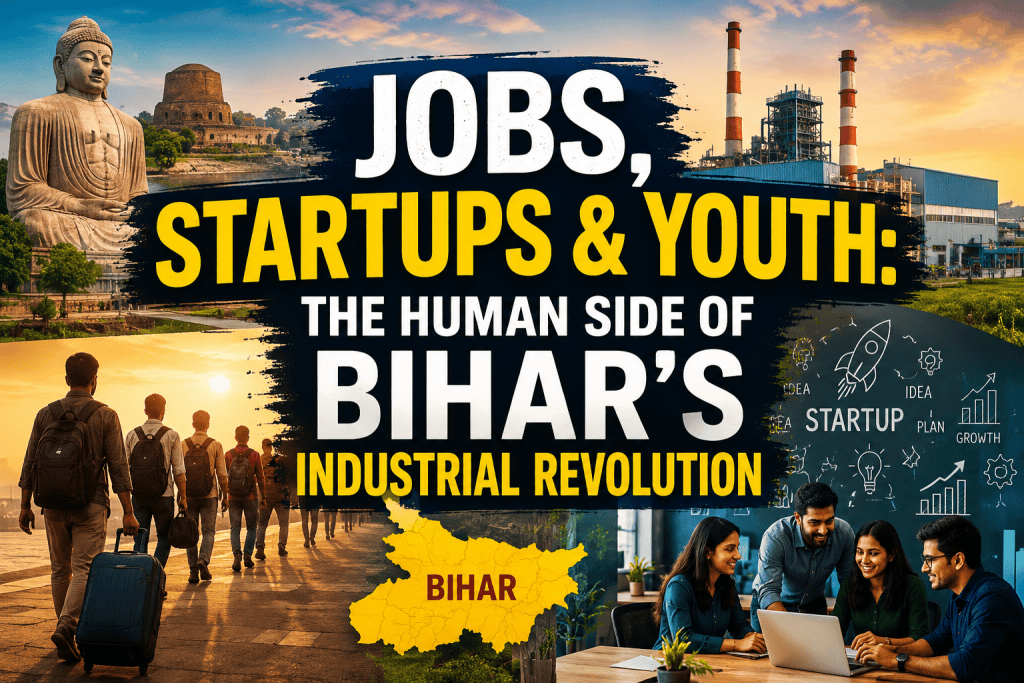
For decades, Bihar’s story was often told through one image: young men boarding trains to seek work in other states. Migration became a symbol of both aspiration and necessity. But today, Bihar is trying to write a different story—one where opportunities are created within the state, where young people can find jobs closer to home, where women become business owners, and where entrepreneurs no longer have to leave Bihar to fulfil their ambitions.
While factories and industrial parks are important symbols of economic growth, Bihar’s industrial transformation is increasingly focused on people. The state government is linking industrial development with employment generation, skill development, entrepreneurship and startup growth. The aim is simple: industrialisation should improve lives, not just increase investment figures.
EMPLOYMENT AT THE HEART OF INDUSTRIAL POLICY
Bihar’s industrial strategy places employment generation at its core. The state has introduced several measures to encourage industries to hire local youth and create sustainable jobs.
One of the major initiatives includes reimbursement of EPF and ESI contributions, reducing the cost burden on employers while encouraging formal employment. Employment-linked incentives are also being offered to industries that generate significant job opportunities.
The idea is to ensure that every new investment translates into meaningful employment for Bihar’s growing workforce.
“Industrial growth and job creation are inseparable. Every policy intervention is being designed with employment generation as a central objective,” a senior Industries Department official told Indian Masterminds.
The approach marks a shift from viewing industrialisation purely as infrastructure creation to seeing it as a vehicle for social and economic mobility.
Also Read – Why Sanjay Jaju Was Chosen to Lead Telangana’s Administration
SKILLING BIHAR’S YOUTH FOR NEW INDUSTRIES
Creating jobs alone is not enough. Young people must also have the skills needed to fill them.
Recognising this, Bihar has adopted a demand-driven skilling model. Training programmes are increasingly being designed in consultation with industry partners to ensure that skills match market requirements.
Special focus is being placed on sectors such as electronics, logistics, food processing, information technology and manufacturing. These sectors are expected to generate significant employment opportunities in the coming years.
Industry partnerships are helping training institutions understand emerging workforce requirements and prepare youth accordingly. The objective is to make Bihar’s workforce industry-ready and globally competitive.
For thousands of young people, this means better access to quality jobs without having to migrate long distances.
THE RISE OF FIRST-GENERATION ENTREPRENEURS
Perhaps one of the most significant changes underway is the rise of entrepreneurship.
Bihar is actively supporting individuals who dream of starting businesses but lack financial resources or family business backgrounds.
Through schemes such as the Mukhyamantri Udyami Yojana and the Bihar Laghu Udyami Yojana, the state is providing financial assistance and support to aspiring entrepreneurs.
The numbers are substantial. Over the last three years, nearly ₹4,000 crore has been disbursed under these initiatives.
Many beneficiaries are first-generation entrepreneurs—young people who are starting businesses for the first time and creating jobs within their communities.
The programmes are helping transform job seekers into job creators, particularly in smaller towns and rural areas.
BUILDING A VIBRANT STARTUP ECOSYSTEM
Bihar’s startup ecosystem is also gaining momentum.
Under the Bihar Startup Policy, entrepreneurs are receiving incubation support, seed funding, mentorship and networking opportunities.
The focus is not limited to urban centres. Rural innovation is being actively encouraged, allowing startups to address local challenges in agriculture, education, healthcare and digital services.
Incubation centres are nurturing young innovators while mentorship networks connect founders with experienced professionals and industry experts.
For many aspiring entrepreneurs, this support system provides the confidence and resources needed to turn ideas into successful enterprises.
“We are witnessing growing enthusiasm among young entrepreneurs. Bihar’s startup ecosystem is becoming stronger with every passing year,” the senior official told Indian Masterminds.
The state’s startup movement reflects a broader shift in mindset—from seeking jobs to building enterprises.
WOMEN ENTREPRENEURS LEADING CHANGE
One of the most encouraging aspects of Bihar’s industrial transformation is the increasing participation of women entrepreneurs.
The Mukhyamantri Mahila Udyami Yojana is helping women establish and expand businesses across sectors.
Many women who were previously associated with Self-Help Groups (SHGs) are now formalising their enterprises and entering mainstream markets.
From food processing units and handicrafts to service-based businesses and manufacturing ventures, women-led enterprises are contributing to local economic growth while creating employment opportunities.
The initiative is not only promoting financial independence but also changing social perceptions around women’s role in business and leadership.
Across districts, stories of women entrepreneurs are emerging as symbols of confidence, resilience and economic empowerment.
CALLING BIHAR’S DIASPORA HOME
Bihar’s development strategy also includes a message for its vast diaspora.
Thousands of entrepreneurs, professionals and business leaders with roots in Bihar have built successful careers across India and abroad. The state now wants them to look back home.
Improving infrastructure, competitive operating costs, policy support and growing market opportunities are being presented as reasons to invest in Bihar.
The government believes that returning entrepreneurs can bring not only capital but also experience, technology and global business networks.
For many members of Bihar’s diaspora, the state now offers opportunities that were difficult to imagine a decade ago.
A PEOPLE-CENTRIC INDUSTRIAL FUTURE
Bihar’s industrial story is still unfolding. New factories, industrial parks and investments will undoubtedly play an important role. But the real measure of success may lie elsewhere—in the number of jobs created, the entrepreneurs supported, the women empowered and the young people who choose to build their future within the state.
The transformation Bihar seeks is not merely industrial. It is social, economic and generational.
If successful, it could change not just where Bihar’s youth work, but where they choose to dream.
Also Read – One Plant, Many Solutions: Himachal’s First Biochar Project Targets Fires, Carbon and Rural Livelihoods