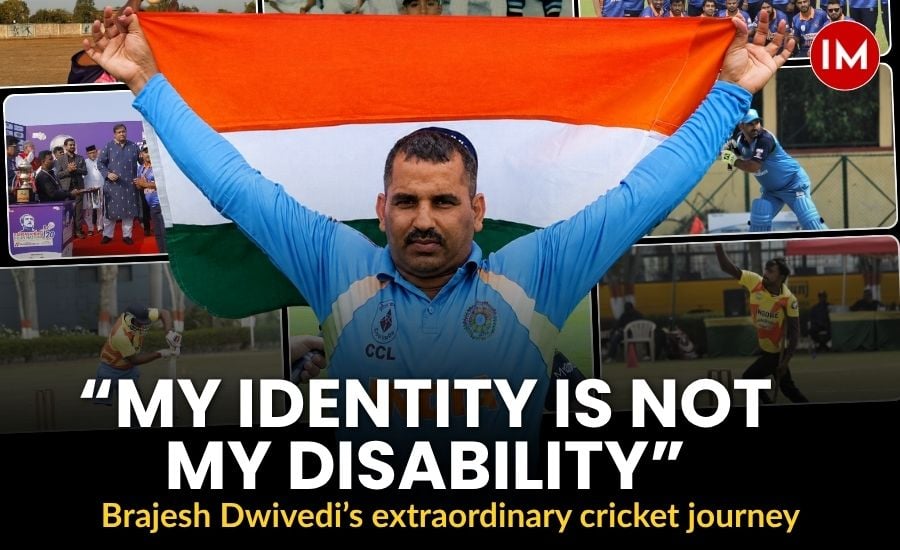
At 3:30 every morning, Brajesh Dwivedi would leave his home, cycle nearly 8 km to a stadium, and prepare the pitch himself before beginning his cricket practice.
He could not run. His legs had been severely affected by polio when he was just one-and-a-half years old. His family struggled to afford school fees, let alone cricket equipment. Yet, with a wooden bat and a makeshift ball made from cloth and plastic, Brajesh kept playing.
Decades later, the same player went on to captain the differently-abled Indian Test cricket team.
But Brajesh Dwivedi’s story is not simply about becoming an international cricketer. His larger achievement lies in helping create a cricketing pathway for hundreds of differently-abled players who once had little access to organised sport.
“I am just a face of this, because in this cricket I am one of the most senior and oldest players,” he shared with Indian Masterminds, making it clear that his journey is bigger than his own career.
From a Struggling Childhood to the Cricket Field
Mr Dwivedi’s childhood was marked by financial difficulties. His father worked as a conductor in the state transport department and supported a family of seven. Cricket equipment was beyond the family’s means, but that did not stop Mr Dwivedi from finding ways to play.
His disability affected both his legs, but he refused to let it decide what he could or could not pursue.
His routine eventually became extraordinary. He would cycle to the stadium before sunrise, prepare the pitch, and train for hours. He developed into a left-arm spin bowler despite being unable to run, regularly troubling batsmen and earning recognition in local competitions.
In 1999, he got an opportunity to appear for the Madhya Pradesh disabled cricket team trials and was selected. His cricketing journey then took him through Railway cricket between 2003 and 2007. In 2007, he scored 57 runs against Tamil Nadu.
Even after taking up employment, he remained connected with cricket. His later selection at IIT Indore in 2014 gave his career another push and helped him find new opportunities.
The Breakthrough Into International Differently-Abled Cricket
Mr Dwivedi’s major international breakthrough came in 2017 after his performance in the National Divyang Cricket Championship in Ajmer earned him selection for the India-Bangladesh Friendship Cup.
From there, his international journey expanded. He represented India in the India-Nepal series, the Tata Steel Cup in Kolkata, the India-Nepal CMI Cup in Ranchi and the Bangabandhu Cup in Bangladesh in 2022.
In September 2023, the first Indian differently-abled Test cricket team was formed, and Brajesh was chosen to lead the side.
In December 2023, he captained India against Nepal in the historic Test match at Agra, where India secured a four-wicket victory.
For Brajesh Dwivedi, however, international recognition was never the final goal.
“My story is not just about me. I am just a face of this,” he says.
Captaincy That Went Beyond the Cricket Field
Brajesh Dwivedi had already experienced leadership at the international level before captaining India.
In 2021, he led Mumbai Ideals in the Differently-Abled Premier League in Sharjah, a tournament modelled on the IPL. The team reached the semi-finals, while Mr Dwivedi was also named Man of the Match during the competition
Building a Cricket Movement in Madhya Pradesh
When Brajesh Dwivedi began his journey, finding enough differently-abled players to form even a divisional team in Madhya Pradesh was a major challenge.
Today, teams from 10 divisions are competing, with around 250 players involved, while eight players from the state have already represented India.
The transformation has also been aided by greater access to smartphones and social media. Young players and families are increasingly discovering differently-abled cricket and reaching out for opportunities.
“Now the change is that almost everyone has an Android phone in their hands,” Mr Dwivedi explains. “When a person sees all these things, he gets influenced and contacts us saying, ‘Brother, we also want to play.’”
Since 2019, he has worked towards training and supporting players across Madhya Pradesh, helping athletes from smaller towns and remote areas access tournaments and national and international opportunities.
He also organised trials and state-level competitions, including the Divyang Premier League in Jabalpur, while working towards his larger dream of establishing a state-level Disabled Cricket Academy.
His Biggest Victory Is Yet to Come
Brajesh Dwivedi is candid about the hardships he faced. Today, he works as a staff member at IIT Indore and says having a stable job helped him sustain himself and return to cricket after difficult years.
“I am an established man now, but I struggled a lot in life,” he says. “Today, I have a job, and my salary is such that I can survive.”
That experience has shaped the way he looks at the next generation.
He points out that many children entering differently-abled cricket come from families with very limited financial resources. For them, getting food and basic opportunities can itself be a challenge.
His biggest ambition, therefore, is not another personal record or medal.
“My achievements mean nothing until a poor differently-abled person from a village, standing in the last row of society, is able to establish himself as a player.”
That belief drives his work with young cricketers. He wants them not only to learn the sport but also to develop the confidence to introduce themselves, speak about their abilities and seek opportunities.
“I am slowly teaching them how to speak, how to talk to people about themselves,” he says.
‘My Identity Is Not My Disability’
Brajesh Dwivedi’s career carries a powerful message for every young player who has been told that their circumstances define their limits.
He began with a wooden bat, a makeshift ball and a family that could not easily afford sporting equipment. He cycled kilometres before sunrise to practise. He competed despite a physical disability that affected both his legs. He played for Railway, represented India internationally, and eventually captained the country in Test cricket.
But the most important part of his journey may be what he is doing for those coming after him.
His vision is simple: a child from a small village should be able to discover differently-abled cricket, receive proper training, enter the field, and build a career through talent.
And when that happens, Brajesh wants the player to be able to say with confidence:
“I am differently-abled, but my identity is not my disability… it is my talent.”
For Brajesh Dwivedi, that will be the real scorecard of his career—not the number of runs, wickets, or matches, but the number of players who found a place on the field because he chose to keep the door open for them.