Kaziranga National Park is known across the world for its one-horned rhinoceroses, but protecting its wildlife comes with challenges that extend far beyond the park’s boundaries. From organised poaching networks and annual floods to wildlife movement across highways and the need to secure community support, conservation in Kaziranga demands constant coordination, intelligence and field-level action.
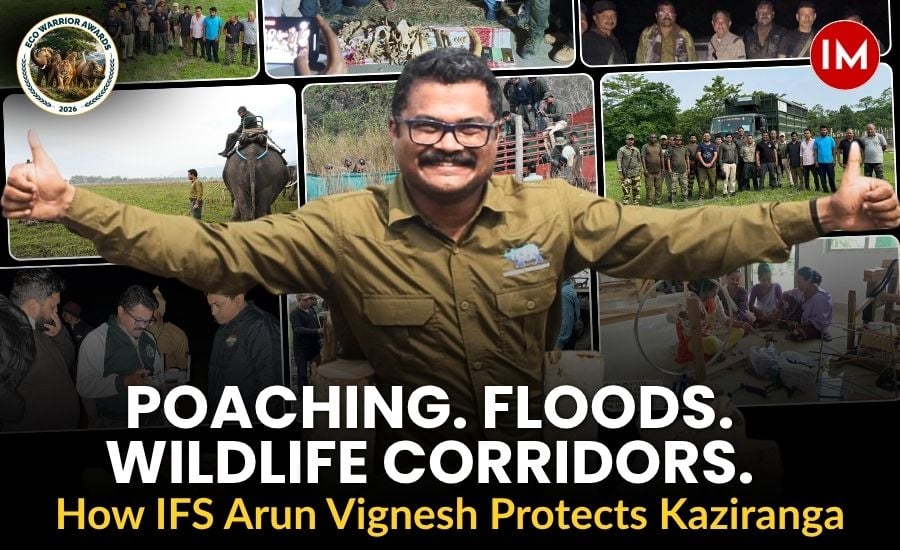
Leading several of these efforts is IFS officer Arun Vignesh C S, a 2016-batch officer of the Assam-Meghalaya cadre, currently serving as Divisional Forest Officer (DFO), Eastern Wildlife Division, Kaziranga National Park, Assam.
Over the years, his work has involved strengthening anti-poaching operations, responding to flood-related wildlife threats, introducing technology into protection measures and contributing to the successful translocation of wild buffaloes from Kaziranga to Kanha Tiger Reserve.
Tackling a Poaching Network Beyond the Park
One of the biggest challenges in protecting rhinos in Kaziranga is the park’s location. Its proximity to state borders and established trade routes makes it vulnerable to organised wildlife trafficking networks.
According to Arun Vignesh, many of those orchestrating poaching operations are based outside Assam, making intelligence gathering particularly important.
“Those who are organising this poaching network stay outside Assam. Local intelligence gathering and finding out how and when they are planning to advance — those are the things that have helped.”
The need for intelligence became particularly clear after two rhino poaching incidents in January 2024, on January 22 and 26. Follow-up investigations indicated that several incidents were connected to the same network of people.
The Assam Forest Department and Assam Police subsequently launched Operation Falcon, focusing on intelligence collection about individuals previously involved in poaching and wildlife trafficking.
Information was gathered not only across Assam but also from outside the state. Investigators mapped relationships within the network, identified key organisers and traced those involved in supplying weapons and facilitating the illegal trade in rhino horns and other wildlife articles.
The operation also focused on the people positioned close to protected areas, who would wait for an opportunity to exploit vulnerabilities.
As intelligence indicated that members of the network were moving towards Kaziranga, Orang and other protected areas, teams intervened before they could execute their plans. Weapons were seized, and arrests were made.
For the forest department, the operation is not a one-time exercise but an ongoing effort to stay ahead of organised poaching networks.
Protecting Wildlife During the Floods
Floods are an essential part of Kaziranga’s ecosystem. The park’s grasslands depend on the annual rise of water. But extremely rapid flooding can force animals out of the protected area and towards the National Highway that runs along its southern boundary.
From there, animals attempt to reach higher ground in the Karbi Anglong hills.
“The difficult part is ensuring that they are able to safely cross the National Highway on the southern side of the park and go to the higher areas like the Karbi hills,” IFS Arun Vignesh shared in a conversation with Indian Masterminds.
Managing this movement requires coordination between forest personnel, veterinarians, local communities and traffic authorities. Rather than immediately rescuing every animal that leaves the park, teams try to allow animals to move naturally wherever possible.
This approach proved particularly effective during the major floods of 2024. Despite exceptionally high water levels, traffic was regulated, and communities assisted the forest department in keeping wildlife safe while crossing vulnerable stretches.
The result was a sharp reduction in wildlife mortality along the highway, with only one animal reported to have died there during the flood period. In 2025, despite another flood episode, Kaziranga recorded zero wildlife mortality in the corridors.
Technology Meets Boots on the Ground
Technology has become another important component of wildlife protection in Kaziranga.
The department uses thermal drones, AI-enabled cameras, electronic surveillance systems and animal sensors to monitor wildlife movement and detect potential threats.
Animal sensors installed along vulnerable National Highway crossings can detect wildlife movement in real time and alert authorities, allowing teams to regulate traffic before animals reach dangerous stretches.
Inside the park, electronic eye systems monitor vulnerable entry points. Eight locations are monitored around the clock, throughout the year, helping officials track both wildlife movement and possible poaching activity.
The department has also started exploring passive acoustic monitoring for research and is looking at AI-based intruder alert systems.
Yet, IFS Arun Vignesh believes technology works best when supported by personnel on the ground.
“One of our biggest strengths is our foot soldiers. They follow each and every rhino that comes out of the park until they return back to the park.”
These frontline personnel play a crucial role during both anti-poaching operations and floods, monitoring individual animals and responding to changing situations in difficult terrain.
A Historic Wild Buffalo Translocation
Another major conservation initiative associated with Kaziranga has been the translocation of wild water buffaloes to Kanha Tiger Reserve.
The programme had been under consideration for several years, with Kanha identified as the destination and Kaziranga chosen as the source because it holds the largest population of wild water buffaloes.
The species has a much smaller population in central India, particularly in Madhya Pradesh and Chhattisgarh, making translocation an important conservation intervention.
But capturing the animals in Kaziranga presented its own challenges. The landscape consists largely of wetlands, grasslands and muddy terrain, while the presence of rhinos and elephants makes field operations more complicated.
The department studied the behaviour of the buffaloes and constructed specially designed holding facilities using natural materials. These facilities helped captured animals acclimatise before their onward journey.
With support from veterinary teams and frontline forest personnel, eight wild buffaloes were successfully captured and translocated to Kanha. The programme is expected to continue.
“The trickiest part was ensuring that after capturing, we don’t get much time to transport them to the holding facility, and after that also transporting them from Kaziranga to Kanha.”
Conservation Cannot Work Without Communities
For IFS Arun Vignesh, long-term wildlife protection is closely linked to the people living around protected areas.
He believes conservation becomes stronger when communities see tangible benefits from protecting wildlife and are given opportunities to participate in the local economy.
“Protection can never be successful without local communities.”
His earlier experience as a Range Forest Officer in Kaziranga also shaped this approach. Illegal fishing had been a major concern in Burachapori Wildlife Sanctuary and parts of the Brahmaputra river system. The department responded by developing riverine tourism centred around Gangetic dolphins.
People who had earlier depended on fishing gradually moved towards tourism-related livelihoods.
The same approach is now being used through eco-development activities around Kaziranga. Local communities have received handicraft training and platforms to market their products.
One recent initiative focuses on water hyacinth, an invasive wetland plant. Communities are being trained to convert its fibre into products such as yoga mats and other handicrafts, while entrepreneurs are being supported to explore its use in paper-making.
For Mr Vignesh, such initiatives demonstrate how conservation and livelihoods can work together rather than exist as separate objectives.
“If we can ensure that people have this connection with the park — they have always had the connection, but at some point it had weakened — we have to ensure that people get involved in the management of the park.”
From intelligence-led anti-poaching operations and technology-based surveillance to flood management, species translocation and community-led conservation, Arun Vignesh’s work reflects the many layers involved in protecting a landscape as complex as Kaziranga.
And while technology and enforcement continue to evolve, the foundation remains the same: a well-coordinated field team, informed local communities and the ability to respond before a threat becomes a crisis.