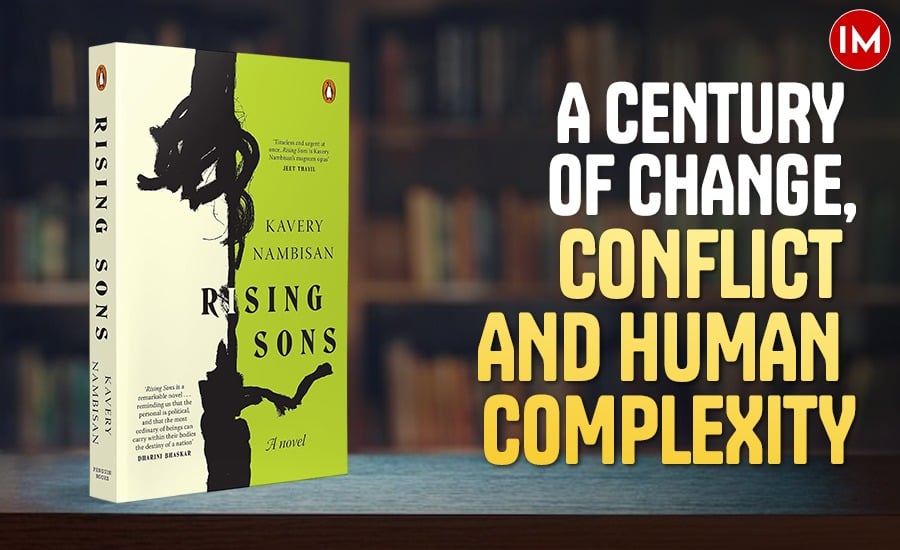
“At times, we observe a change in a person when, in actual fact, it is the situation that has changed. At other times, we fail to see the transformation, perceiving instead that the varied situation makes it appear so.” Our narrator in Rising Sons — an omniscient, non-bodied voice which carries the keen intelligence and wry sensibility of the book’s accomplished author Kavery Nambisan — knows the universal complexities of person and situation. There are other eternal truths observed by this narrative voice too, which occasionally address the reader directly and thus bring us into the story as characters produced by similar contexts of a country changing over a century.
Mud is life for the fifty-seven families in the village of Kesarugattu, and the rain-fed rivers are the water which sustain life. “We romanced the outside world through the newspaper. Knowledge burnished our rustic minds,” informs the narrative voice. “One day, we read the scandalous writings of a young wife of a Brahmin from Poona, about the plight of women,” and though the words of Tarabai’s letter resonated with our own book’s protagonist Gowru, who was also the young wife of a Brahmin, we will refrain from further description of her and instead move forward a couple decades to her titular sons. The eldest was Nanju, who dreamed of greatness, and “thought of himself in the guise of Vivekananda, of Aurobindo, of Tilak, but never as Gandhi. Personality and image mattered. His admiration settled on Naoroji, the elegant Parsi gentleman who had performed the unique feat of opposing the British while being friends with them.” The younger was Anna, who went to see owls with the Ai people at night, and spoke at a Congress rally in Mysoor “about growing up, his schoolboy dreams, his college days, the gradual understanding of how we were being ruled by a race of people from a faraway land and about the sure and steady swell of opposition to their rule.”
The father of these sons — and the husband of Gowru — is the twice-born Devaraya. He is a protagonist too. There are other fathers and sons, like Keshava Pujari and Vibhushana. There are also daughters: most notably Chinni, born to Gowru’s childhood friend Bhagya and her Malayali husband Dharma.
Also Read – How One Forest Officer Used Science, Cyber Intelligence and Law to Take on Tiger Poaching
Chinni, who understood early that the world is tilted because people hide their real selves, had written a two-page letter to Bhagat Singh in prison expressing both her admiration and displeasure: “Displeasure about the way the shooting had been done, without careful planning. If I had been there, I would have helped, I wrote. I added that I was ready to marry him, in prison, and carry out the unfinished work. It was a serious proposal of marriage.” She had her reservations about Gandhi and the ideals of sacrifice which he advocated. Wearing khadi whilst privileging the language of the colonizer seemed like contradictory swadeshi to Chinni. Could simplicity of clothes genuinely lead to a corresponding transformation as simplicity of spirit? An ascetic is ascetic regardless of what they wear; external image is only one thread of internal coherence. But enough about Chinni — we must get back to the sons now.
These are the main characters we are introduced to in the novel, but there are many other fishes we meet in the pond of Kesarugattu, and in the rivers which bring them there. There are Ai tribals, Brahmins, Chandals, Mussalmans. There is Shantadevi, Muduki, Uzman and Maimoona, Sumana, Hanumantha, Gagana, Vaidehi… and even if we visit these others only briefly, their essential contours reveal themselves to us clearly through the narrative voice, which gives even minor characters the dignity of keen attention. When the scene shifts to Delhi, there is “the old mother of the driver Karthab Singh and the roasted mutton pieces she fed him while crooning love songs about the longing to shield her beloved from all danger by enfolding him in her long hair. Her husband was long dead, and she had short, wispy hair that could not protect an ant. But singing love songs gave her pleasure.”
There is also another protagonist from the village who may be listed here last but in no feasible circumstance could be considered the least, and that is Kuppu the dog: “He is still there, our beautiful all-black Kuppu — at times he is a playful little pup, at times an adolescent, and, at other times, an aged, lumbering, peace-loving fellow. Which is why people say, Kuppu is forever.”
The eternal archetypes which our transient human and non-human characters embody are depicted with such genuine tenderness that even if the book were indeed re-titled Ondu Kaththeya Atma Kathe or ‘Memoirs of a Donkey’ (as one protagonist suggests grimly), it could still trace many of the same waves of supple affection and insightful censure which characterize Rising Sons.
Donkeys do not seem to have pride or prejudice, however, which are among the main themes of this book. Character decides destiny because it shapes our choices, but a bruised ego leads to reaction rather than choice — the spirals which emerge from wanting to be seen in certain ways can extend to dangerous shadows. Nambisan is an observer of individual tendency as much as of the social structures of family and village and politics which shape new citizens of a new country, which have shaped us..
Humans have a deep desire to ease each other’s pain, and a difficulty in balancing that against the restoration of their own selves. Idealism fights the cynicism of reality and sometimes stumbles so frequently that it becomes entirely unsteady. In India, virtues of Brahmin non-covetousness and Gandhian restraint were unable to stem the blood-dimmed tide of greed and vanity which too are fundamental human vices. This slow percolation of a self-serving culture in the outward guise of piety pushes the Ai people – rooted to the earth and all her creatures – into wearing “half-pants” and “proper saris” instead of the simple lengths of cloth which they traditionally used to wrap around their bodies. There is also the implicit bleakness of rural India becoming urban in the strange erosions and sediments which have metamorphosed Bengloor into Bangalore. Much is found, much is lost. Yet despite the fact that this pace of change is almost tragic when viewed as a generational saga, it is delivered through an authorial voice so deft and irreverent that this reader found herself smiling often, and on more than one page even laughing out loud.
Rising Sons is a story on fertile ground and rich soil, with much to recognize in the moments it portrays, as a missive which illumines the heart. It weaves its chapters in leisurely visits to the interior lives of its characters and their contexts in a manner which justifies the Irawati Karve quote with which the book begins: “Human toil, expectations, hates, friendships—all seem puny and without substance, like withered leaves eddying in the summer wind. But the people who toiled and dreamed and loved seem unforgettable…”
Also Read – Rajendra Chaturvedi: The Policeman Who Walked Alone Into The Chambal Ravines