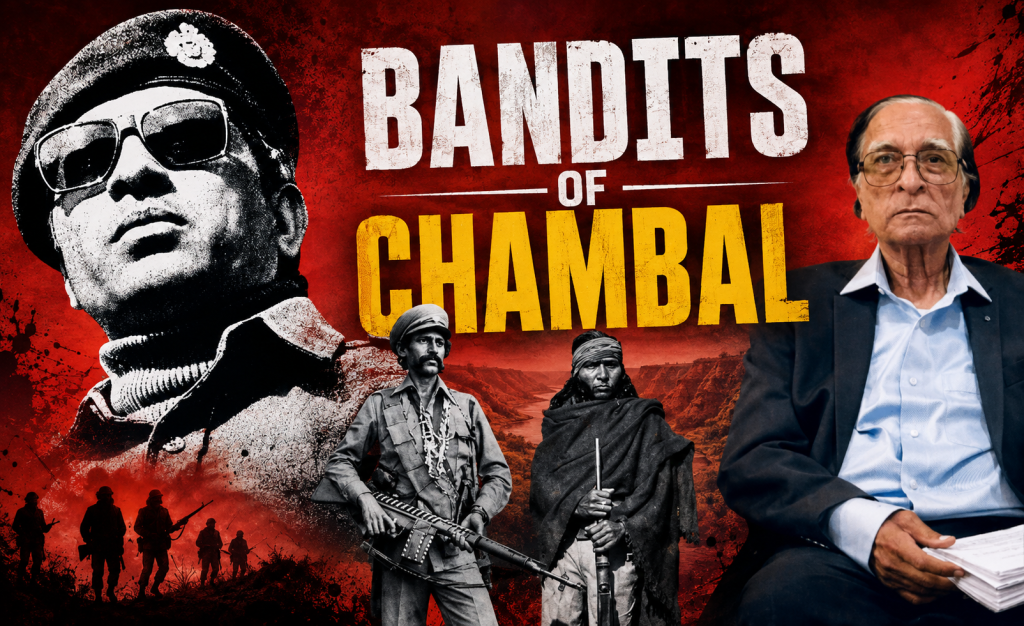
For most policemen, entering the Chambal ravines meant going in with men, weapons and a plan to come back alive. Rajendra Chaturvedi chose a different path. He often went alone.
Sometimes he rode a Bullet motorcycle. At other times, he travelled in an unmarked Jeep with a private registration number. He rarely wore his uniform. He carried a .32 pistol, an Instamatic camera and a portable voice recorder.
He also carried something less visible but more important: the trust of people inside the ravines.
Mr. Chaturvedi, a 1969-batch IPS officer of the Madhya Pradesh cadre, spent much of his early career in the Chambal region. Years later, when he returned as SP, Anti-Dacoity Operations, Gwalior, that experience would help him attempt something few believed possible.
He would try to bring armed dacoit gangs out of the ravines through negotiation and surrender. It was a risky idea. It was also deeply personal.
Now, decades later, those extraordinary experiences are set to reach readers through a forthcoming book titled “Bandits of Chambal.” The book is being written by his son, Swaroop Chaturvedi, who grew up watching his father navigate the dangerous world of the Chambal ravines.
For Swaroop, this is more than a record of police operations. It is a story of courage, trust, danger, betrayal and the belief that even a person living with a gun could be given a chance to choose another path.
And behind that story was a police officer who often entered the ravines not with a convoy, but with a conversation.
A LESSON LEARNT IN 1972
The roots of Chaturvedi’s approach went back to April 1972. At the time, he was serving as a probationary ASP in Bhind. The Chambal was witnessing a remarkable movement. More than 500 dacoits were preparing to surrender on April 14 and 16.
Also Read – Ritesh Randhir: The CRPF Officer Who Faced Bullets, a Venomous Snake and the Unpredictability of the Jungle
The effort was led by Gandhian figures such as Jayaprakash Narayan, Acharya Vinoba Bhave and Acharya Subba Rao. The Madhya Pradesh government, led by Chief Minister P. C. Sethi, also responded positively. The then State IGP, B. M. Shukul, supported the idea of creating a peace zone where dacoits could surrender their weapons and serve their sentences through an open-jail system.
For the young police officer, the experience left a lasting impression. He saw men who were feared across the region respond to dialogue and the possibility of a new life. That experience would remain with him for nearly a decade.
CHAMBAL HAD ALREADY SHAPED HIM
Between 1970 and 1976, Chaturvedi served in several important posts in the region. He was ASP Bhind, SDOP Dabra, Additional SP Morena and Additional SP Gwalior. These were not ordinary postings.
The Chambal was a difficult landscape. It had deep ravines, armed gangs and a complex social network. Mr. Chaturvedi began building relationships across this world. He developed his informers, or mukhbirs. He also came to know reformed dacoits and retired police officers. Over time, he learnt that information did not always come from official channels.
Sometimes, it came from the very people the police had once hunted. This network would become crucial when he returned to Chambal in 1981.
OPERATION 1 DOWN
In June 1981, Mr. Chaturvedi was serving as SP, Anti-Dacoity Operations, Gwalior. He approached the then Chief Minister of Madhya Pradesh, Arjun Singh, with an unusual proposal. Why not try surrender and rehabilitation once again? The idea received the Chief Minister’s approval.
What followed was a closely guarded initiative that came to be known as “Operation 1 Down.” The operation was kept secret even from many senior police officers. The reason was simple. Mr. Chaturvedi wanted negotiations with the gangs to continue without disrupting regular anti-dacoity operations.
Police encounters and operations would continue. At the same time, a second track would quietly work towards surrender. It was a delicate balancing act. The operation had to remain secret enough for negotiations to survive, but credible enough for the dacoits to believe that surrender was actually possible.
POLICE OPERATION UNLIKE THE USUAL
Chaturvedi’s methods often looked unusual even to his colleagues. He did not always travel with a police convoy. He sometimes moved through the Chambal in civilian clothes. He met informers and people connected with the gangs. He sometimes stayed in villages overnight. At home, his family slowly realised that something unusual was happening. His sons were rarely allowed to step outside the official residence without armed guards.
There were also days when Chaturvedi insisted on taking telephone calls himself. His movements were kept secret. His son, Swaroop Chaturvedi, remembers how different his father looked during those years.
“He was rarely in uniform. He was usually dressed in jeans, moccasins, photochromic glasses and a jacket or parka, with a holstered .32, his Instamatic camera and a portable voice recorder,” recalls Swaroop Chaturvedi, son of Rajendra Chaturvedi.
At times, even the family did not know where he had gone. He could disappear into villages and return days later. For his children, this was simply life at the time. Only later did they understand how dangerous those journeys were.
WHEN TRUST BECAME AN INTELLIGENCE NETWORK
One of Chaturvedi’s greatest strengths was the network he had built during his earlier Chambal postings. The men who had surrendered in 1972 were no longer just former criminals. Some had become sources of information.
Some continued to approach Chaturvedi and his family for help with their children’s education, employment and medical treatment. That goodwill mattered.
It meant that when Chaturvedi returned to the region in 1981, he was not entering the Chambal as a complete outsider. He already knew its people. He knew its terrain.
And, importantly, some people inside the ravines knew and trusted him. This is also why he preferred the term “baaghi” over “daaku” for some of the men. It did not mean that he excused their crimes. Rather, he believed that a person’s past did not have to decide his future.
THE DANGER BEHIND THE NEGOTIATIONS
But the surrender strategy was far from universally accepted. According to Swaroop Chaturvedi, there were rivalries within the police force. Some officers reportedly mocked his father for running a “one-man show.”
The risks went beyond criticism. Swaroop says his research for the family’s forthcoming book uncovered allegations that some people within the force tried to derail the surrender operations. There was even an alleged attempt to set up an ambush and blame it on dacoits. There was another serious allegation.
An SP from a neighbouring state allegedly sent an emissary to Chaturvedi with a proposal to have Malkhan Singh killed in a staged encounter. The offer, according to the account, came with a substantial reward. Chaturvedi refused.
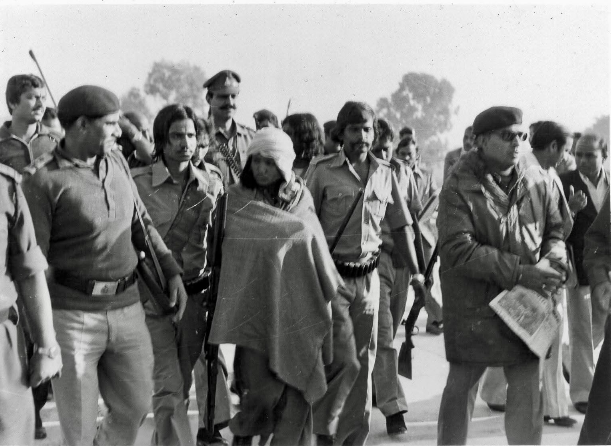
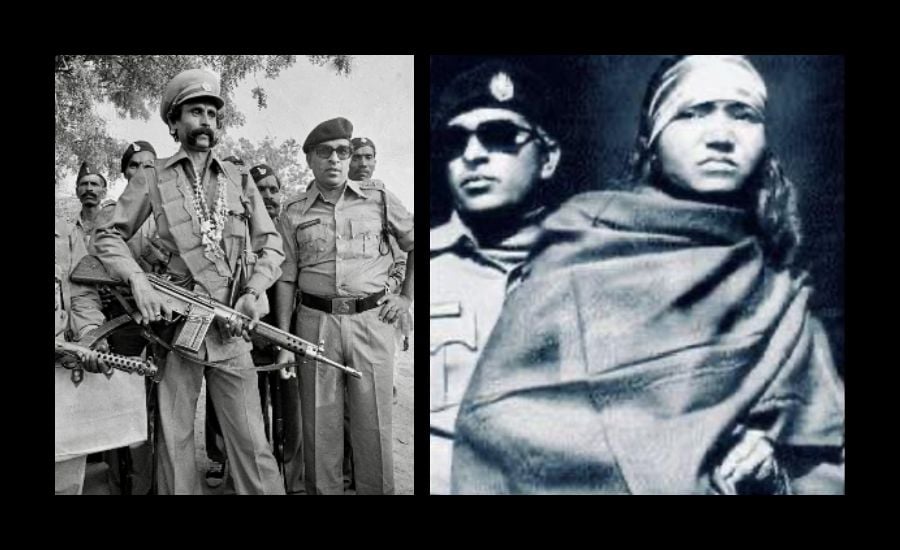
For him, the objective was not simply to eliminate a wanted man. It was to bring him out of the ravines alive. Malkhan Singh and the road to surrender In May 1982, Chaturvedi was posted as SP Bhind. He was now tasked with facilitating the surrender of Malkhan Singh, known as the Bandit King of Chambal, and later the surrender of Phoolan Devi and her gang. His trusted Circle Inspector, Chandan Singh Nagar, worked closely with him in planning the covert operations.
The work demanded patience. It also demanded courage. In June 1982, Chaturvedi’s family travelled to Bilao in Bhind to meet Malkhan Singh, who was expected to surrender within days. For the family, it was an extraordinary encounter. For Chaturvedi, it was another step in a carefully built process of trust.
THE SECRET JOURNEY OF SEPTMEBER 1982
One of the most revealing memories from this period comes from September 1982. On September 25, three days before his elder son Arunvithi’s birthday, Chaturvedi was staying at the Bhind Circuit House. He suddenly travelled to Gwalior and then took a night train to Delhi.
The purpose was a covert meeting involving Prime Minister Indira Gandhi and the Chief Minister. Three days later, he returned briefly to see his sons. He even took some birthday cake away. His children did not understand the significance at the time. Behind the ordinary family moment, however, were preparations for one of the most sensitive surrender operations in the Chambal.
Swaroop recalls that the family gradually realised that their father was involved in something far bigger than an ordinary police operation. “We were rarely allowed to step outside our official residence. It was essentially school and back, accompanied by armed guards,” says Swaroop Chaturvedi.
WHEN GUNS FINALLY WENT DOWN
The surrender operations involving Malkhan Singh and Phoolan Devi would become part of Chambal’s history. But the real story was not simply about getting armed men to put down their weapons.
It was about creating enough trust for them to believe that surrender was possible. Chaturvedi had spent years building that trust. His approach had begun with a lesson he witnessed as a young officer in 1972. It had continued through years of field postings, intelligence gathering and relationships with people on both sides of the law.
And by the early 1980s, it had become a bold experiment in policing. He had entered the ravines without the protection normally expected of a police officer.
He had chosen conversation alongside force. He had taken risks that even some of his colleagues questioned. And eventually, some of the very men who once lived by the gun began to see him differently.They gave him a name that captured the unusual nature of his approach:
“Kaptaan Vinobha ji.”
It was a name that linked a police officer to a Gandhian who had shown that even the most feared men could be persuaded to choose another path. For Rajendra Chaturvedi, the Chambal was never simply a battlefield. It was a place where he learnt one difficult lesson early in his career: sometimes, defeating a criminal is not the only measure of successful policing.
Sometimes, it is convincing him to surrender. And then giving him a reason to change.
Also Read – He Served in J&K, NIA, UIDAI and ACB. Now Anand Jain Leads Ladakh Police