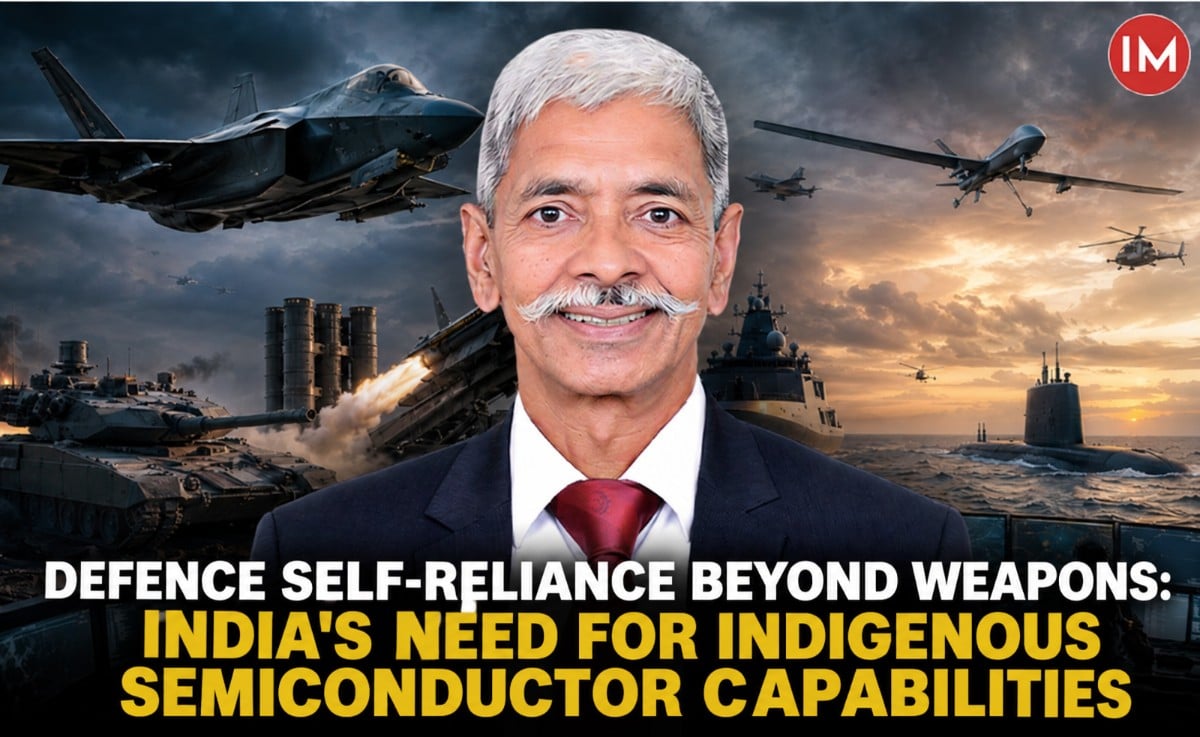
A country may manufacture its own fighter aircraft, missiles and warships. But if the electronic brains controlling these systems depend on components that it cannot access during a conflict, how independent is that country?
This is the question India must confront as it pursues defence self-reliance.
For years, our attention has centred on indigenous platforms, weapons, engines and ammunition. These remain important. But the foundations of military power are changing. Increasingly, the effectiveness of a weapon system depends on the chips, sensors, computing architecture and secure electronics embedded within it.
The next battlefield may well be decided inside a semiconductor factory rather than a weapons production facility.
Also Read – Beyond the Uniform: UP Police’s Film ‘Vardi’ Pays Tribute to Those Who Never Returned Home
The DRDO signal at ESTIC 2026
On 30 October 2026, the Defence Research and Development Organisation (DRDO) led a thematic session on Semiconductors and Next-Generation Chips at the Emerging Science, Technology and Innovation Conclave (ESTIC) 2026.
The participation of defence electronics specialists, industry and academia was significant. DRDO showcased indigenous Monolithic Microwave Integrated Circuits (MMICs), based on Gallium Arsenide (GaAs) and Gallium Nitride (GaN), Multi-Chip Modules and Infrared Focal Plane Arrays (IRFPAs).
These technologies support applications in radar, electronic warfare and missile seekers.
Semiconductor capability is no longer merely an industrial development objective. It is a national security requirement.
From weapons ownership to technology sovereignty
Modern military operations depend on interconnected systems. Surveillance, target acquisition, communications, precision strike and electronic warfare all require dependable electronic components and computing power.
An adversary may not always need to destroy a radar or communication installation physically. Disrupting its electronics, compromising its software or denying access to replacement components could achieve a similar operational effect.
This makes semiconductor dependence a strategic vulnerability.
The experience of international technology restrictions has demonstrated that access to advanced computing technology, manufacturing equipment and associated intellectual property can become an instrument of geopolitical pressure.
India must therefore distinguish between three things: manufacturing a defence platform, owning the technology inside it and retaining the ability to operate and sustain it independently.
Technology sovereignty does not mean manufacturing every component domestically. It means having sufficient design knowledge, intellectual property, production capability, trusted partnerships and assured access to maintain operational freedom during a crisis.
Governance must connect policy with production
India’s semiconductor ambitions will require more than investment announcements and manufacturing incentives. They need a governance framework that connects national security priorities with industrial capability.
Who identifies the critical technologies? Who funds their development? Who takes responsibility for moving a successful prototype into production? These questions must have clear institutional answers.
The Ministry of Defence, DRDO, the Services, the Ministry of Electronics and Information Technology, academia and private industry must work towards defined outcomes.
A dedicated defence semiconductor coordination mechanism could help map critical dependencies, identify priority technologies, monitor development and ensure accountability.
The objective should be to avoid fragmented initiatives and overlapping responsibilities.
Procurement governance also needs attention. Indigenous technology developers cannot be expected to invest for years without visibility on qualification requirements, procurement timelines and future orders.
Boards of companies entering this sector must recognise that semiconductor manufacturing is a long-term business. It requires patient capital, technical leadership, rigorous quality control and disciplined risk management.
An opportunity for Indian industry
The opportunity extends well beyond large semiconductor fabrication plants.
Indian companies can participate in chip design, specialised materials, electronic design automation, advanced packaging, testing, thermal management, secure processors and sensor integration.
Established businesses in telecommunications, automotive electronics, power electronics and industrial automation can also explore defence applications.
MSMEs and start-ups have a particular opportunity in specialised components and niche technologies. Not every Indian company needs to manufacture a complete weapons system. Some may contribute a critical electronic subsystem that becomes indispensable to it.
DRDO must help create this pathway.
Its role should extend beyond research and development to technology validation, industry partnerships, technology transfer and the development of reliable production capabilities.
The Technology Development Fund, Development-cum-Production Partner framework and DRDO Industry Academia Centres of Excellence provide useful foundations.
The next step is to connect these mechanisms with clearly articulated military requirements. Industry must be involved early, not brought in only after research is complete.
Research without a production pathway is incomplete. Equally, manufacturing without technology ownership creates another form of dependency.
Security begins with the component
Domestic manufacturing alone does not guarantee security. A chip may be fabricated in India while its design software, intellectual property, manufacturing equipment or critical materials remain dependent on external sources.
Hardware integrity must receive equal attention.
India needs trusted design environments, component traceability, independent testing, secure firmware management and audits of critical suppliers. Procurement contracts should address software dependencies, intellectual property rights, component obsolescence and access to upgrades.
Military electronics must also withstand extreme temperatures, vibration, electromagnetic interference and prolonged operational use. Commercial components cannot automatically be treated as suitable for defence applications.
The Services should maintain visibility over critical components and develop contingency arrangements for supply disruption. Electronics must be treated as part of defence logistics, alongside ammunition, fuel and spares.
Training and doctrine must catch up
There is a human capability gap that deserves greater attention.
India needs semiconductor process engineers, chip designers, materials specialists, hardware security experts and technicians trained in testing and maintenance.
The Armed Forces also need technically competent personnel who understand electronic vulnerabilities, system integration, software dependencies and technology lifecycle management.
Military training institutions and engineering universities should develop closer working relationships. Industry exposure, specialised courses and joint research programmes can help bridge the divide between operational requirements and technological development.
Doctrine must evolve alongside this capability.
Future operations will depend increasingly on networked sensors, unmanned platforms, artificial intelligence and precision weapons. Military planning must account for degraded communications, electronic disruption, technology denial and the possible unavailability of critical components.
Procurement assessments must move beyond platform performance. Technology ownership, repairability, upgrade rights and assured availability during hostilities must become part of the evaluation.
A technologically advanced force must also retain the ability to fight when some of its technological advantages are denied.
The real measure of Atmanirbharta
India need not attempt to replicate every advanced semiconductor technology available globally. It should prioritise those capabilities that directly affect national defence: specialised compound semiconductors, radar electronics, infrared sensors, secure processors, power electronics and advanced packaging.
International partnerships will remain necessary. But they must build domestic competence rather than perpetuate dependence.
As a military veteran who has been part of active combat operations, I can unequivocally state that preparedness is built well before a crisis tests it. Logistics, maintenance, training and institutional coordination determine how long a force can sustain operations. Technology must now be viewed through the same lens.
DRDO must connect research with production. Indian industry must move from assembly towards technology ownership. Academia must develop the talent. The Armed Forces must articulate future requirements and adapt doctrine. Government must ensure continuity, security and accountability.
The next measure of India’s defence strength will not simply be the number of weapons manufactured within the country. It will be the extent to which we can design, control, secure, sustain and upgrade the technology inside them.
The semiconductor factory may never appear on a military operations map. Yet its output could determine what a radar detects, what a missile tracks and how quickly a commander responds.
India must prepare for that battlefield before the first shot is fired.
Also Read – Meet the Former IPS Officer Who Left Policing, Studied at Wharton and Became an Entrepreneur