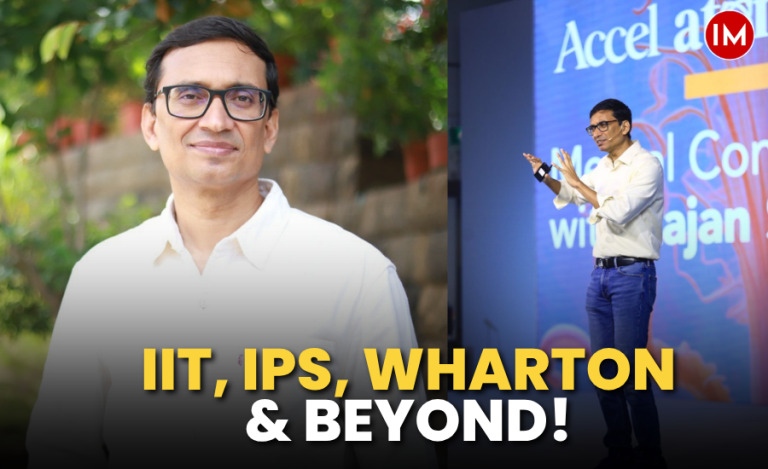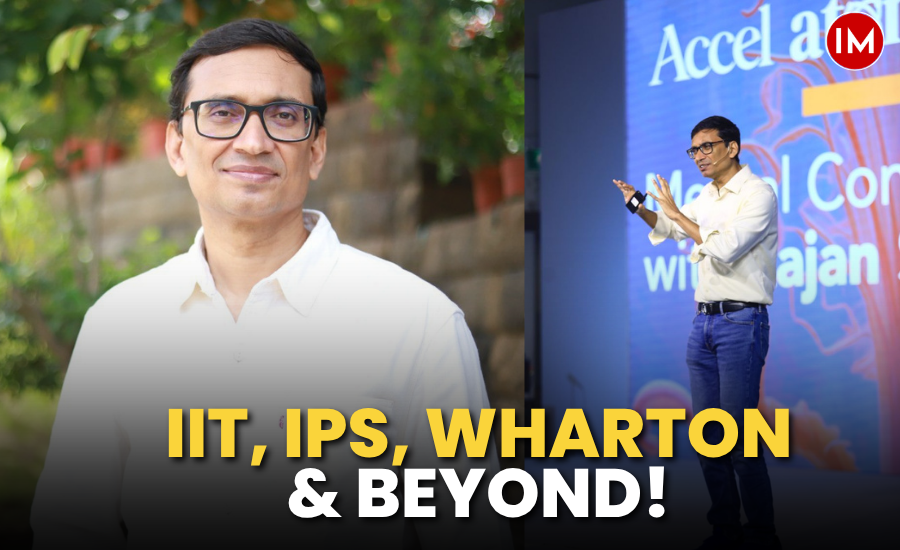
For former IPS officer Rajan Singh, a career has never been about following a predetermined path. From studying electrical engineering at IIT Kanpur to serving in the Indian Police Service (IPS), pursuing an MBA at the University of Pennsylvania’s Wharton School, working with McKinsey and eventually becoming an entrepreneur, he has repeatedly stepped into unfamiliar territories, choosing new challenges over the comfort of an established position.
An IIT graduate and Wharton MBA, Singh has served as the Police Commissioner of Thiruvananthapuram, worked as a management consultant with McKinsey, entered the private equity industry as an investment professional, taught finance and physics, and ventured into technology and entrepreneurship. He is now associated with HabitStrong, a startup offering neuroscience-backed focus and productivity programmes.
Yet, behind these professional milestones lies a story shaped as much by opportunity and access as by ambition and hard work.
Sharing his journey during a TED Talk, Singh reflected on how a series of seemingly small opportunities changed the course of his life and influenced the way he looks at success.
From a Modest Background to IIT Kanpur
Rajan Singh was born into a financially modest family in a rural village in eastern Uttar Pradesh. His father served in the armed forces, an association that gave the family opportunities to move beyond their village and experience different parts of the country.
As a child, Singh was extremely shy and lacked confidence. He was neither particularly interested in sports nor comfortable participating in activities with other children. His parents tried encouraging him by buying him cricket kits and footballs, hoping he would become more active. However, academics eventually became the area where he found his confidence.
Everything began to change when he topped his class in Class 5. For a child who had often felt that he was not particularly good at anything, academic achievement gave him a sense of identity.
“Studies became that something which gave me the license to be special, which made me feel a little different from everybody else,” he recalled.
Although he aspired to become an engineer, he had little exposure to people who had pursued higher education. His extended family and social circle had very few college graduates, making engineering an ambitious goal.
A significant change came when his father was transferred from Assam to Allahabad during his school years. The city exposed Singh to a more competitive academic environment and better preparation opportunities.
The turning point came in Class 11, when two IIT Kanpur students visited his school and spoke about the IITs and the IIT-JEE examination. Their stories introduced him to a world he had barely known existed.
Inspired, Singh bought a book containing previous years’ IIT-JEE question papers. However, his initial enthusiasm quickly met reality. Despite being a school topper, he struggled to solve even a single question.
The experience made him realise how different classroom performance could be from the demands of a highly competitive entrance examination. Nevertheless, he began preparing seriously, using the coaching facilities and academic resources available in Allahabad. After a year of hard work, he secured admission to IIT Kanpur in Electrical Engineering.
From Engineering to the Indian Police Service
At IIT Kanpur, Singh found himself in an environment that offered not just academic education but also exposure to possibilities beyond his immediate surroundings.
His next major decision came during his final year at IIT. Inspired by seniors who had successfully entered the civil services, he decided to prepare for the examination himself.
The presence of successful role models made the seemingly difficult journey appear achievable. With access to preparation strategies, guidance and the confidence that others from his institution had succeeded, he prepared for six to eight months.
Soon after completing his B.Tech, Singh cleared the UPSC Civil Services Examination and joined the Indian Police Service. He was allotted the Kerala cadre.
A Young Police Commissioner Seeking Another Challenge
Singh’s IPS career took him to several responsibilities, including serving as the Police Commissioner of Thiruvananthapuram. He became one of the youngest and longest-serving Police Commissioners of the city.
His early years in policing were filled with challenges, from managing law-and-order situations and crowd control to handling VIP security. However, with time, the excitement of the job began to fade.
By the time he was around 30, Singh found himself questioning whether he wanted to continue on a well-established career path or explore something entirely different.
He acknowledged that remaining in the IPS would have offered professional stability, respect and a promising future. However, he was increasingly drawn towards learning and exploring new fields.
“Do I go for job security, or do I go for self-expression?” he asked himself.
Eventually, despite strong opposition and advice against the decision, Singh resigned from the IPS to pursue an MBA.
From the Police Force to Wharton and McKinsey
Singh set his sights on some of the world’s leading business schools, including Harvard, Stanford and Wharton. His IIT background once again proved valuable, providing him with the confidence, peer network and guidance required to navigate the competitive admission process.
He secured admission to the Wharton MBA programme, where he entered a classroom of approximately 800 students as the only former police officer.
Coming from a completely different professional background, he initially encountered situations where he felt others underestimated his business knowledge. Rather than allowing this to discourage him, he treated it as motivation to prove his capabilities.
He worked hard throughout the two-year programme and graduated among the top five per cent of his class, earning the distinction of Palmer Scholar.
Following Wharton, Singh joined McKinsey, one of the world’s leading management consulting firms. Remarkably, he entered the corporate world without any previous private-sector experience and soon found himself advising senior executives of major corporations on business strategy, operations and organisational improvement.
Reflecting on this transition, he shared an important lesson: “Experience is not everything. Knowledge can be gained through a lot of other means.”
From Private Equity to Teaching and Entrepreneurship
After his stint at McKinsey, Singh returned to India and moved to Mumbai, where he joined a private equity fund as an investment professional.
However, his professional journey did not stop at consulting and investing. Over the years, he went on to explore several more careers, taking up roles that were vastly different from one another.
His fifth career brought him into teaching as a finance educator. He subsequently ventured into technology entrepreneurship, working on learning products. He also became a physics teacher, combining his interest in academics with entrepreneurship.
His next venture took him into the field of neuroscience-backed productivity and habit formation. Singh founded HabitStrong, a startup offering online habit programmes for a happier life.
Through the venture, he works as a trainer in neuroscience-backed focus and productivity, helping individuals build better routines, strengthen their discipline and improve their ability to concentrate.
From engineering and policing to consulting, investing, teaching and entrepreneurship, his professional journey has crossed eight different career paths. What connects these seemingly unrelated experiences is his willingness to keep learning and his belief that professional growth does not have to be restricted to one field.
Why Rajan Singh Believes in Reinventing Yourself
Reflecting on his unconventional career path, Singh acknowledged that committing to a single profession has its own advantages. Staying in one field can help individuals develop deep expertise and enjoy the long-term benefits of specialisation.
However, he believes that exploring different fields offers another kind of advantage: the ability to recognise connections between seemingly unrelated subjects, identify patterns and develop insights that may not emerge through a single professional experience.
He describes this process as “horizontal compounding”—where knowledge and experiences gained across different careers accumulate, allowing individuals to approach problems with a broader perspective.
“But diverse experiences help you see unrelated patterns, connect dots, and generate insights that would otherwise be impossible. In some sense, you go through a veritable ‘horizontal compounding,’ if you will,” he shared in his LinkedIn post.
He believes the traditional idea of choosing one subject in college and building an entire 35-year career around it is no longer relevant. In a rapidly changing professional landscape, individuals must remain open to learning new skills, exploring unfamiliar areas and reinventing themselves.
“That is what makes life exciting. Because every day is a new day—the game of life starts again,” Singh added.
His journey offers a different perspective on career success. Rather than measuring professional achievement through designations or years spent in one organisation, Singh’s story highlights the value of curiosity, adaptability and the courage to begin again.
For someone who started out as a shy schoolboy from a modest rural background, his eight distinct career experiences demonstrate that professional identity need not be fixed. Sometimes, the most rewarding opportunities emerge when one is willing to leave behind what is familiar and explore what lies ahead.