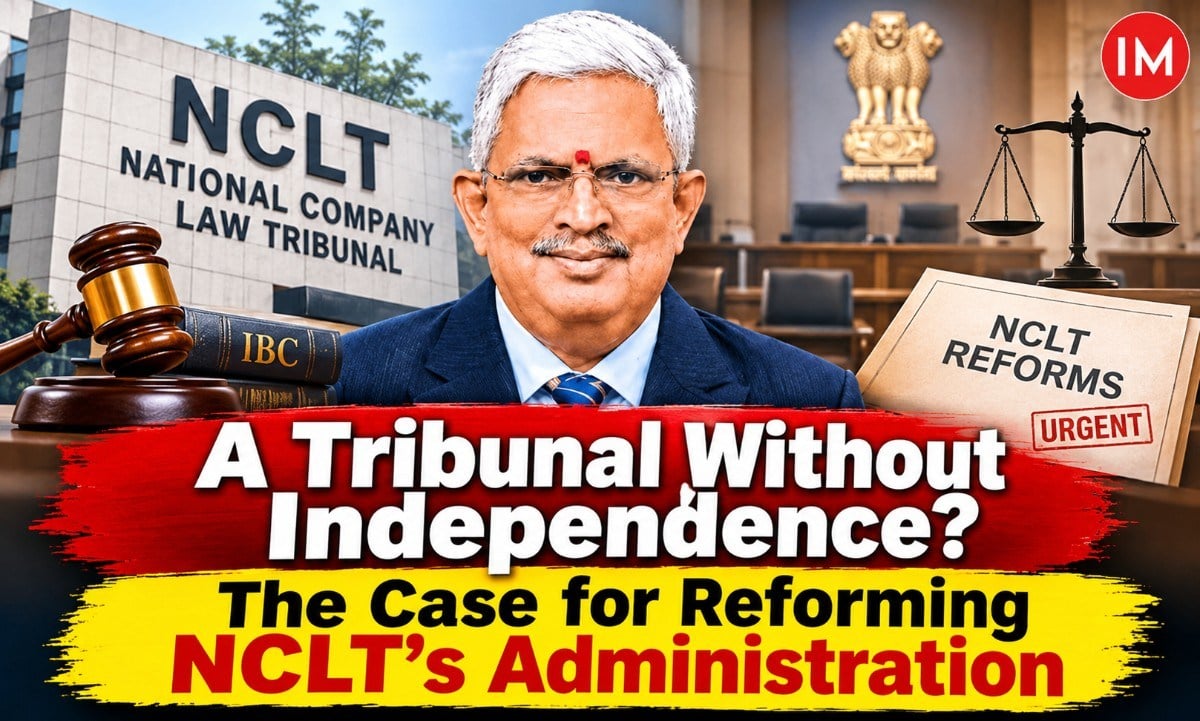
On 29 October 2026 a Bench of the Supreme Court headed by Chief Justice Surya Kant told the Union government that the administration of the National Company Law Tribunal (NCLT) had been “completely hijacked” by the Ministry of Corporate Affairs (MOCA). The trigger was small: a contract, awarded on 6 October, under which a private firm would supply the tribunal’s deputy registrars, assistant registrars and stenographers. The grievance behind it was large. Only 67 of 320 regular administrative posts are filled, sixteen member posts are vacant, two floors of the Principal Bench are shut, and 383 resolution plans were found stuck in April, some for as long as four years.
This note attempts to trace how a tribunal that the Supreme Court has repeatedly said must not live under its parent ministry still does, nearly three decades after L. Chandra Kumar and sixteen years after R. Gandhi. It sets out the Ministry’s best defence before testing it, shows how the Ministry has failed the tribunal administratively and legally, and explains how delay, a leaky registry and soft statutory gates are exploited by defaulting promoters and other vested interests. It then draws on the British, American and Canadian experience of separating the people who run courts from the people who appear before them, and closes with a practical agenda: move the purse and the payroll out of the Ministry, build a professional tribunal secretariat, write a binding framework compact on the British model, tie bench strength to caseload, and close the loopholes that make delay profitable.
Prologue: A Court That Rents Its Own Clerks
Let us picture a cricket match where one of the two teams also hires the umpire’s scorer, decides how many sightscreens the ground gets, and signs the cheque that keeps the floodlights on. Nobody needs to prove that the scorer has cheated. The arrangement itself is the scandal. That, in one image, is what the Supreme Court found when it looked closely at India’s insolvency court this week.
The National Company Law Tribunal (NCLT) is where India’s distressed companies go to be saved, sold or buried. Under the Insolvency and Bankruptcy Code (IBC or the Code) it holds the keys to lakhs of crores of stressed assets, the jobs that depend on them and the savings of the banks and depositors who lent against them.
Yet the officers who keep its files, list its cases and type its orders are recruited, paid and now outsourced by the Ministry of Corporate Affairs (MOCA), a department that is itself a regular litigant before the same tribunal. When a Bench of the Supreme Court headed by Chief Justice Surya Kant said that the tribunal’s administration had been “completely hijacked” and that the situation was “most unfortunate”, it was not making a passing remark from the bench. It was naming a structural defect that the Court has been trying to correct, without success, for almost thirty years.
Also Read– India’s Waste Crisis Is Growing. Can Scientific Waste Management Turn It Into an Opportunity?
What Happened in Court on 29 October
The Bench of Chief Justice Surya Kant and Justices Joymalya Bagchi and V. Mohana was hearing the Court’s own suo motu case on vacancies, infrastructure and administrative difficulties at NCLT benches, together with a connected petition filed on behalf of contractual employees. Their counsel told the Court that on 6 October the Ministry had awarded a contract to a foreign company operating in India to deploy administrative staff, including Deputy Registrars, Assistant Registrars and stenographers, and that existing contractual workers could be displaced from 1 or 2 November. The name of the contractor has not been reported.
The employees came looking for protection. They left with something they had not asked for. The Bench refused interim relief and asked, pointedly, whether people who had never faced a competitive selection could claim a right to continue. It called them “backdoor entrants” too, observed that contractors “don’t care about judicial/technical members”, and said that the company should also be disbanded. Its central holding was that the reference for staff must come from the NCLT President, and that the entire power of appointment must rest with the President alone.
One report attributes to Justice Bagchi a careful distinction: the mechanics of recruitment may be outsourced to a specialist agency, but operational control may not. That remark appears in a single report and has not been corroborated elsewhere. Bar & Bench reports that the Court also voiced concern about alleged removal of judicial records and criminal cases against some contractual employees, again an account carried in one report.
Then came the numbers, and they were brutal. Of 320 regular administrative posts, 67 are filled and 253 are vacant. Sixteen posts of judicial and technical members are vacant. Senior Advocate Sanjiv Sen, for the NCLT Bar Association, described a Principal Bench in Delhi whose roofs are collapsing, whose seventh and eighth floors have been shut, and whose courts are running at half strength. The Court asked the Presidents of the NCLT and NCLAT to submit, within four weeks, comprehensive proposals on land, buildings, support staff and officers of Deputy or Joint Registrar rank for every bench, and it asked Attorney General R. Venkataramani to impress upon the Centre the need for basic amenities. The Attorney General said appointment recommendations were already in the pipeline and offered a joint meeting of the government, the NCLT President and the Bar. The Court suggested a road map of its own: experienced government officers on deputation first, phased regular recruitment after that, and possibly recruitment through the Union Public Service Commission or the Staff Selection Commission. It also noted a quieter casualty of the crisis: ordinary Companies Act matters are being pushed down the queue because insolvency cases take priority.
Background: A Tribunal Born in Litigation and Raised in a Ministry
The NCLT has never known a quiet childhood. The idea of a single company tribunal goes back to the Eradi Committee, was legislated in 2002, and was promptly challenged by the Madras Bar Association. In 2010, in Union of India v. R. Gandhi, a Constitution Bench upheld Parliament’s power to create the tribunal but rewrote its architecture, and in 2015 the Court gave the reworked tribunal under the Companies Act, 2013 a qualified approval with riders. The tribunal finally opened its doors on 1 June 2016, a few months before the Insolvency and Bankruptcy Code (IBC) turned it from a company-law court into the engine room of India’s credit system.
Running through every one of these judgments is a single, stubborn principle. As far back as 1997, the seven-judge Bench in L. Chandra Kumar called for a wholly independent agency to administer tribunals and said that, until one existed, a single nodal ministry, the Ministry of Law and Justice, should oversee them. R. Gandhi went further and directed that tribunals must not function under the aegis of a parent ministry against which they have to pass orders, and that their administrative support should come from the Law Ministry. In the fourth Madras Bar Association case in 2020, the Court directed the creation of a National Tribunals Commission (NTC) and ordered that, until it came into being, a separate wing under the Finance Ministry should look after the tribunals so that they would no longer depend on the ministries appearing before them. The Union answered with the Tribunals Reforms Act, 2021, which re-enacted much of what the Court had already struck down. On 19 November 2025 a Bench led by Chief Justice B. R. Gavai invalidated its key provisions and gave the Centre four months to set up the Commission (NTC).
Parliament finally obliged, but late. The Tribunals Reforms Act, 2026 received Presidential assent on 13 August 2026 and establishes a National Tribunals Commission (NTC) headquartered in New Delhi. From the text as summarised in the public domain, the Commission’s working core is the selection of chairpersons and members through search-cum-selection committees and the building of a National Tribunals Data Grid. Whether it will also control the registry, the staff cadre and the budget of each tribunal is far less clear. Meanwhile, at the level where files actually move, the old wiring is untouched. Section 418 of the Companies Act requires the Central Government to provide the tribunal with officers and employees “in consultation with” it. In October 2019 the Ministry delegated that power to the President of the NCLT and the Chairperson of the NCLAT. But the 2020 staff rules that followed still require Central Government approval for every appointment at Level 11 of the pay matrix or above, which covers the registrars who run the benches, and they let the government relax the rules after consultation. The tribunal was handed the pen and denied the ink.
None of this would matter much if the Ministry were a neutral bystander. It is not. It prosecutes company-law offences through the Registrars of Companies, and it brings oppression and mismanagement cases under the Companies Act. In December 2017 the Attorney General had to concede before the Supreme Court that the Ministry had erred in its petition to the NCLT seeking control of Unitech, after the tribunal had let it nominate ten directors to the board. A litigant that controls the registry of the court it appears before is in exactly the position R. Gandhi forbade.
Anatomy of the Angst: Why the Bench Lost Its Patience
The anger of 29 October did not come out of nowhere. It had been building through 2026, one hearing at a time. On 16 April a Bench of Justices J. B. Pardiwala and K. V. Viswanathan, hearing an ordinary dispute arising from the insolvency of AVJ Developers, discovered a resolution plan that had sat unapproved for nearly two years and demanded nationwide data. The answer arrived on 29 April: 383 applications for approval of resolution plans were pending, with delays ranging from 48 days to 738 days, and in some cases close to four years. The Bench called the picture “grim and dismal”, said the time-bound objective of the IBC or Code was impossible to achieve as things stood, and took suo motu cognisance in the larger public interest. The case was registered on 19 May 2026 as In Re: Appointment of Judicial and Technical Members and Inadequate Infrastructure in NCLT and Ancillary Issues, and has been before the Chief Justice’s Bench since.
Every hearing since then has peeled back another layer. The NCLT Bar Association told the Court that the tribunal’s sanctioned strength is still 63 members, the figure fixed before the IBC multiplied its work, and that a roster effective from 24 August showed at least eighteen benches sitting only half-days. It complained of frequent outages of the electronic Document Management System that forced adjournments because neither benches nor lawyers could open the case records, and it asked for 246 permanent support posts to be operationalised. In September the Court heard that only 50 of the 63 members were in position and that eighteen would retire by December 2027; it directed the Union to file a status report on amenities at every regional and circuit bench and to identify, with the NCLT President, what was urgently needed. Against that backdrop, discovering that the Ministry’s answer to a staff famine was to bring in a private manpower agency for the tribunal’s registrars was the last straw.
The outcome numbers explain why judges who are normally sparing with adjectives reached for strong ones. By 31 March 2026 the average time to close an insolvency case through a resolution plan had stretched to 744 days, 2.8 times the 270-day period the law contemplates; realisations in the March 2026 quarter were just 23 per cent of admitted claims, and the cumulative haircut for lenders stayed at 68 per cent. Even the one bright statistic cuts both ways: the ratio of resolutions to liquidations touched an all-time high of 0.92, which still means that more companies went to the graveyard than to the hospital. CareEdge’s reading of the June 2026 data put average resolution time at 757 days, with close to three-quarters of ongoing cases past the 270-day mark. Delay in insolvency is not a neutral inconvenience. A stalled factory loses customers, staff and value every month it waits, so each month of delay transfers wealth from creditors to whoever is sitting on the asset.
There is a constitutional sting too. The Supreme Court has spent three decades telling the executive that a tribunal which replaces the High Court for a whole branch of law must carry the independence of a court. Each time the government has replied with a new statute that reproduced the old defect. The outsourcing contract looked to the Bench like the same disobedience moved to a lower floor: if the Ministry could not control the members, it would control the people around them.
The Ministry’s Case, Steel-Manned
Fairness demands that the Ministry’s position be put at its strongest before it is judged. The first argument is accountability. The NCLT is paid for from the Consolidated Fund through the Ministry’s demand for grants, and it is the Minister, not the NCLT President, who answers to Parliament for every rupee. An authority that carries financial responsibility, the argument runs, cannot be stripped of financial control. The approval clause for senior appointments in the 2020 rules is simply the standard way the Government of India keeps senior posts tied to its pay discipline.
The second argument is that the delegated power was not used. Since October 2019 the President of the NCLT has held the authority to appoint officers and staff. If, seven years later, only 67 of 320 regular posts are filled, the Ministry can fairly ask whose desk the files have been sitting on. Seen this way, hiring an outside agency to supply people quickly is a pragmatic stopgap of the kind used across the government, not a power grab. The Supreme Court itself accepted that the contractual staff now being displaced had entered without open competition, which is hardly an advertisement for the status quo.
The third argument is that the Ministry has not been idle. In January 2025 it appointed eleven judicial and thirteen technical members in one notification, a significant infusion by any standard. It drove the Insolvency and Bankruptcy Code (Amendment) Act, 2026 through Parliament, introducing a creditor-initiated process, tighter admission timelines and group and cross-border frameworks designed partly to take load off the tribunal. And a fourth argument, rarely said aloud, is that judges are not administrators. Court registries run by judges are not models of efficiency either, and some of the delay in insolvency comes from the appellate tiers themselves. The Supreme Court ordered Bhushan Power and Steel into liquidation in May 2025, more than five years after the NCLT had approved JSW Steel’s plan, only to recall that judgment and later uphold the plan. It is not only the tribunal that keeps companies waiting.
Where the Ministry Has Failed: The Verdict
Each of these arguments has some truth in it, and none of them survives contact with the facts. Let us take accountability first. Paying for a court does not entitle the payer to run it. Parliament funds the High Courts and the Supreme Court as well, yet no one suggests the Law Ministry should hire the Supreme Court’s registrars. The relevant principle was settled in R. Gandhi sixteen years ago: a tribunal must not depend on a ministry against which it passes orders. The Ministry’s financial responsibility is an argument for a transparent budget line and an audit trail, not for control of the payroll.
The delegation argument is weaker than it looks. A power to appoint that cannot be exercised for any senior post without the Ministry’s approval, that sits inside rules the Ministry may relax, and that depends on the Ministry first sanctioning the posts and releasing the money, is not autonomy. It is responsibility without authority, which is the most reliable recipe for paralysis in Indian administration. If the NCLT President did not fill posts, the honest response was to remove the bottlenecks or press the President to act, not to hand the registrar’s chair to a private vendor whose contract runs to the Ministry. That is the core of the Court’s objection: the vendor’s accountability runs to whoever pays the invoice, and the bench is not that person.
The record on members is no better. The Supreme Court has had to push for appointments repeatedly, and newly appointed members have waited weeks to be assigned benches. The sanctioned strength of 63 has not been revisited even though the tribunal’s jurisdiction ballooned after 2016; the Parliamentary Standing Committee on Finance flagged in 2021 that the tribunal was functioning without a regular President and 34 members short of its strength, and recommended that only High Court judges serve as judicial members. Four years later the same Committee again blamed shortages of benches and judicial and administrative vacancies for the delay. Infrastructure is the most visible failure. A Principal Bench with collapsing roofs, shut floors and courtrooms too few for its benches does not reflect a lack of money in a Union budget of this size. It reflects a lack of priority, and a document system that fails often enough to adjourn hearings reflects the same thing in digital form.
The legal failure is the deepest. The Union has defended, in court after court, arrangements that the Supreme Court had already declared incompatible with judicial independence. It took a judgment in November 2025 and a hard deadline to produce the National Tribunals Commission the Court had first ordered in 2020, and it arrived months after the deadline. Even now there is no sign that the Commission will take over the NCLT’s housekeeping, which is where the hijacking the Court described actually occurs. A ministry that keeps losing the same constitutional argument and keeps the arrangement in place anyway is not merely slow; it is choosing control over compliance. That is why the Chief Justice’s Bench spoke of a ministry determined to keep a complete grip. On the evidence, that description is fair.
Gaming the Gaps: How Vested Interests Profit from a Crippled Tribunal
A weak tribunal is not merely inefficient. It is a business opportunity for people who benefit from delay, and in insolvency those people are usually the ones who caused the default. The Code was designed on the premise that a defaulting promoter loses control the moment a case is admitted. Every week between filing and admission is therefore a week in which the old management still signs cheques. The Standing Committee warned in 2021 that slow admission enables asset stripping and diversion of funds by defaulting promoters, and it asked that cases be admitted within thirty days. When benches sit half-days and registries are short-staffed, that window stays open for months.
Once the process begins, delay becomes a weapon of its own. The Standing Committee’s December 2025 review identified frivolous litigation by promoters and by losing bidders as a cause of value erosion, and recommended steeper penalties and an upfront deposit before unsuccessful resolution applicants can litigate. The tactic is simple. File an objection, then an appeal, then an application to recall, and let the calendar do the rest. A bidder who knows the creditors are exhausted can renegotiate. A promoter who knows the asset is decaying can return with a settlement offer that looks generous only against a liquidation value that the delay itself has driven down.
The statute offers its own back doors. Section 29A was inserted in 2017 to bar defaulting promoters and their connected persons from bidding for their own companies. Section 12A, added a year later, allows a case to be withdrawn if ninety per cent of the creditors agree. In the Sterling Biotech matter, whose promoters had fled the country, the NCLAT allowed a withdrawal under Section 12A, and in Shweta Vishwanath Shirke it held that a withdrawal approved by ninety per cent of the creditors could not be rejected on the ground of Section 29A ineligibility. Settlements can be good for creditors, but a route that lets a barred promoter walk back in, with little tribunal scrutiny of where the settlement money came from, is precisely the kind of gap that a well-resourced bench would examine and a stretched one waves through.
The biggest leak is the money that went out of the door before insolvency began. Resolution professionals are required to chase preferential, undervalued, fraudulent and extortionate transactions, known in the trade as PUFE. As of 31 March 2026, more than Rs 4.38 lakh crore across 1,878 such avoidance applications was pending before the tribunal. That is roughly equal to the Rs 4.3 lakh crore that creditors had recovered through all resolution plans since 2016. Up to September 2024, a mere 338 such cases had been decided with a recovery of just Rs 7,516 crore. For a promoter who siphoned funds before the default, a tribunal that cannot hear clawback cases in time is the best insurance policy money can buy.
Then there is the registry, which is where the Chief Justice’s remark about contractors playing their hands lands hardest. In any court, the person who controls the listing of a case, the movement of a file and the uploading of an order holds quiet but real power. A matter that is never listed, an order that is uploaded a week late, a record that goes missing, can each be worth a fortune to someone. A registry staffed by temporary hands whose contract runs to a private vendor, and whose loyalty runs to whoever renews it, is a registry built to be gamed. The Court’s reported concern about removal of judicial records shows it is not speaking in the abstract.
The pressure does not stop at the registry door. In August 2025 Justice Sharad Kumar Sharma, a judicial member of the NCLAT in Chennai, recused himself from an insolvency appeal after recording that a colleague had been approached by “one of the most revered members of the higher judiciary” seeking an order for one party; the Supreme Court ordered an inquiry within days. In 2022 a liquidator alleged before the NCLAT that orders at a Chennai bench of the NCLT had been sold through a network that included a member’s relative, with gains put at over Rs 1,000 crore. That allegation rests on a single line of reporting relayed from ETPrime, was denied by the member concerned, and has not, so far as is publicly known, been proved. It is recorded here not as fact but as a symptom: when a tribunal’s institutional immune system is weak, allegations of this kind multiply, and honest members pay the price in public confidence.
The Jet Airways saga shows the end state. The tribunal approved a plan in 2021; the successful bidder failed for years to meet its core obligations; the NCLAT nonetheless allowed ownership to be transferred and let a performance guarantee be adjusted against an unpaid instalment. In November 2024 the Supreme Court set that aside, invoked Article 142, forfeited Rs 200 crore and ordered liquidation, citing a five-year delay in completing the resolution. An airline that might have been sold as a going concern was sold for parts. Delay did not merely postpone the outcome. It became the outcome.
What the World Has Learned
Britain faced India’s problem a generation ago and solved much of it. In 2001 Sir Andrew Leggatt, a former Lord Justice of Appeal, reviewed the country’s sprawling tribunal system and found that many tribunals were not independent of the departments whose decisions they reviewed. He recommended that they be brought together into a single system and separated from their sponsoring departments. The Tribunals Service was launched in April 2006, bringing together the tribunals already run by the Department for Constitutional Affairs and others transferred from line ministries, with the explicit aim of making tribunals visibly independent of the original decision-makers. In 2011 it merged with the courts service to form HM Courts and Tribunals Service, which operates under a Framework Document as a partnership between the Lord Chancellor, the Lord Chief Justice and the Senior President of Tribunals. Its staff carry joint responsibility to the minister and the judiciary, and the Lord Chief Justice and Senior President may end the partnership if they conclude it has become incompatible with judicial independence. The lesson for India is that the executive can fund and staff a court without owning it, provided the judiciary holds a written veto.
The United States puts its insolvency court inside the judiciary altogether. Bankruptcy judges are appointed by the federal court of appeals for their circuit, serve fourteen-year terms, and can be removed only by the circuit’s judicial council for incompetence, misconduct, neglect of duty or disability; the bankruptcy court is a unit of the district court, and its staff and expenses are provided for within the judiciary’s own statutory chapter. The executive’s role is real but separate. The Justice Department’s United States Trustee Program acts as a watchdog on cases and professionals; it does not run the court’s registry. The American model draws a clean line between the department that polices bankruptcy and the court that decides it.
Canada offers a middle path that suits a country with many tribunals. In 2014 it passed legislation consolidating support services for eleven federal administrative tribunals into one integrated body, the Administrative Tribunals Support Service of Canada, which provides registry, legal research and corporate services while the tribunals’ adjudicative independence is protected. A pooled service of this kind gives small tribunals economies of scale, professional career paths for registry staff, and a single accountable chief administrator, without tying any tribunal to the ministry that appears before it.
Three lessons emerge. First, the body that runs a court’s administration should never be a party that regularly appears in that court. Second, independence lives in paperwork: a framework document, a dedicated budget line, a staff cadre that answers to the bench, and an exit clause for the judiciary. Third, pooling works. India does not need to build a separate bureaucracy for every tribunal; it needs one professional service that all of them can draw on, run at arm’s length from the line ministries.
The Way Forward
The first step is to move the purse and the payroll. The administrative control of the NCLT and NCLAT, including staff, buildings and technology, should pass from the Ministry of Corporate Affairs (MOCA) to the new National Tribunals Commission (NTC) or, failing that, to a tribunals wing outside any litigating ministry, as the Supreme Court first directed in 2010. The tribunal’s budget should be shown as a distinct demand or a ring-fenced grant, with the NCLT President as the controlling officer, so that money arrives without a sanction file attached. The Ministry would remain accountable to Parliament for policy and for the Code; it would cease to be the tribunal’s landlord.
The second step is to build a real tribunal secretariat. The 2020 staff rules should be amended to remove the requirement of Central Government approval for appointments at Level 11 and above, and the power to relax the rules should pass to the President. The Court’s own road map is sensible and should be adopted in full: experienced officers on deputation for twelve to eighteen months, a phased regular recruitment through UPSC or SSC to fill the 253 vacant posts, and a Deputy or Joint Registrar at every bench who answers to its members. Outsourcing can be used for services such as housekeeping, security or data entry under the President’s supervision, but never for posts that touch the listing, custody or movement of judicial records.
The third step is a written compact. India should borrow the British Framework Document idea and have the Union, the NCLT President and the NCLAT Chairperson sign a public agreement setting out who decides what, how disputes are escalated, what service standards apply and when the tribunal can call the arrangement off. A compact of this kind costs nothing and turns vague constitutional principles into operational rules that a court can enforce.
The fourth step is capacity that follows caseload. The sanctioned strength of 63 members belongs to a pre-Code world. It should be recalculated from filing and disposal data, with a standing formula that adds members and benches automatically when pendency crosses agreed thresholds. Successors should be appointed before incumbents retire, not after, so that the eighteen retirements due by December 2027 do not become eighteen more half-day benches. Dedicated benches for insolvency and for Companies Act matters would end the silent starvation of ordinary company cases that the Court flagged. The building at the Principal Bench should be repaired on an emergency footing, and the document system should carry a published uptime standard.
The fifth step is to make delay unprofitable. The Standing Committee’s proposals for higher costs on frivolous applications and an upfront deposit before unsuccessful bidders may litigate should be enacted. Avoidance applications above a threshold value should go to dedicated benches with time limits, so that the Rs 4.38 lakh crore question is answered within years rather than decades. Withdrawals under Section 12A that would return control to a promoter barred under Section 29A should require a reasoned order on the source of settlement funds. Listing should be computer-randomised, with every movement of a file logged, so that the registry cannot be quietly bent. And the tribunal should publish, bench by bench, a live dashboard of pending plan approvals so that a 738-day delay cannot hide in a cupboard again.
The sixth step is accountability for everyone, the tribunal included. Autonomy is not immunity. A freed tribunal must publish annual reports on disposal, pendency and staffing, and must subject itself to independent audit. The Comptroller and Auditor General (CAG) is well placed to carry out a performance audit of the support the Union has provided to the NCLT and NCLAT since 2016, covering sanctioned posts, funds released, infrastructure projects and the outsourcing contract of 6 October, and to repeat it once the new arrangements bed in. Sunlight on the money is the best guarantee that independence does not become a new excuse for delay.
Epilogue: Give the Umpire His Own Scorer
The Supreme Court did not ask for much on 29 October. It asked that the people who keep a court’s records be chosen by the court, that a building where judges sit not fall on their heads, and that a tribunal entrusted with the fate of India’s largest corporate failures be given the staff to do the job. These are not radical demands. They are the minimum conditions for a court to be a court.
The Ministry of Corporate Affairs (MOCA) has done much to build India’s insolvency regime, and it deserves credit for that. But its continued grip on the tribunal’s machinery has become the regime’s weakest link, and the people who benefit most from that weakness are the defaulting promoters and patient opportunists the Code was meant to discipline. The government now has four weeks before the NCLT President’s proposals land on the Supreme Court’s desk. It can treat them as a reason to negotiate its way back to the status quo, or as the moment to do what three decades of judgments have asked. The first course will produce another hearing. The second could produce a tribunal worthy of the Code it serves.
About The Author– Mr. P Sesh Kumar is a retired 1982-batch officer of the Indian Audit and Accounts Service (IA&AS) who served as Director General of Audit at the Comptroller & Auditor General of India.
Disclaimer—(The views and opinions expressed in this article are solely those of the author and do not necessarily reflect the views of Indian Masterminds. For feedback or queries, please write to [email protected].)
Also Read – India’s Per-Capita Emissions Argument: A Case for Climate Justice or an Excuse for Inaction?