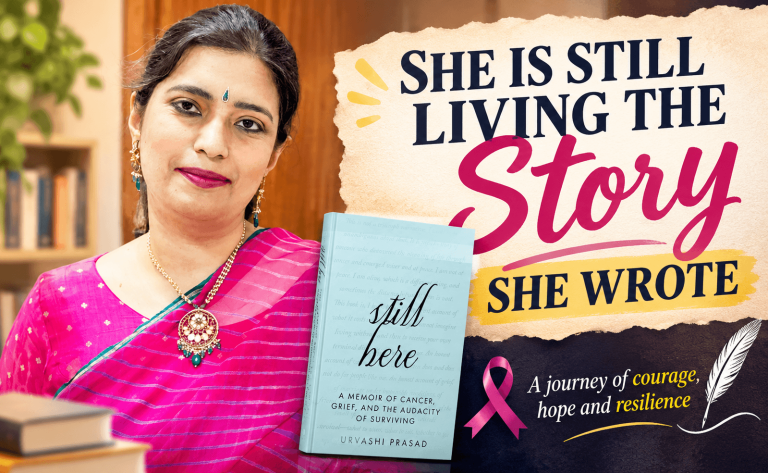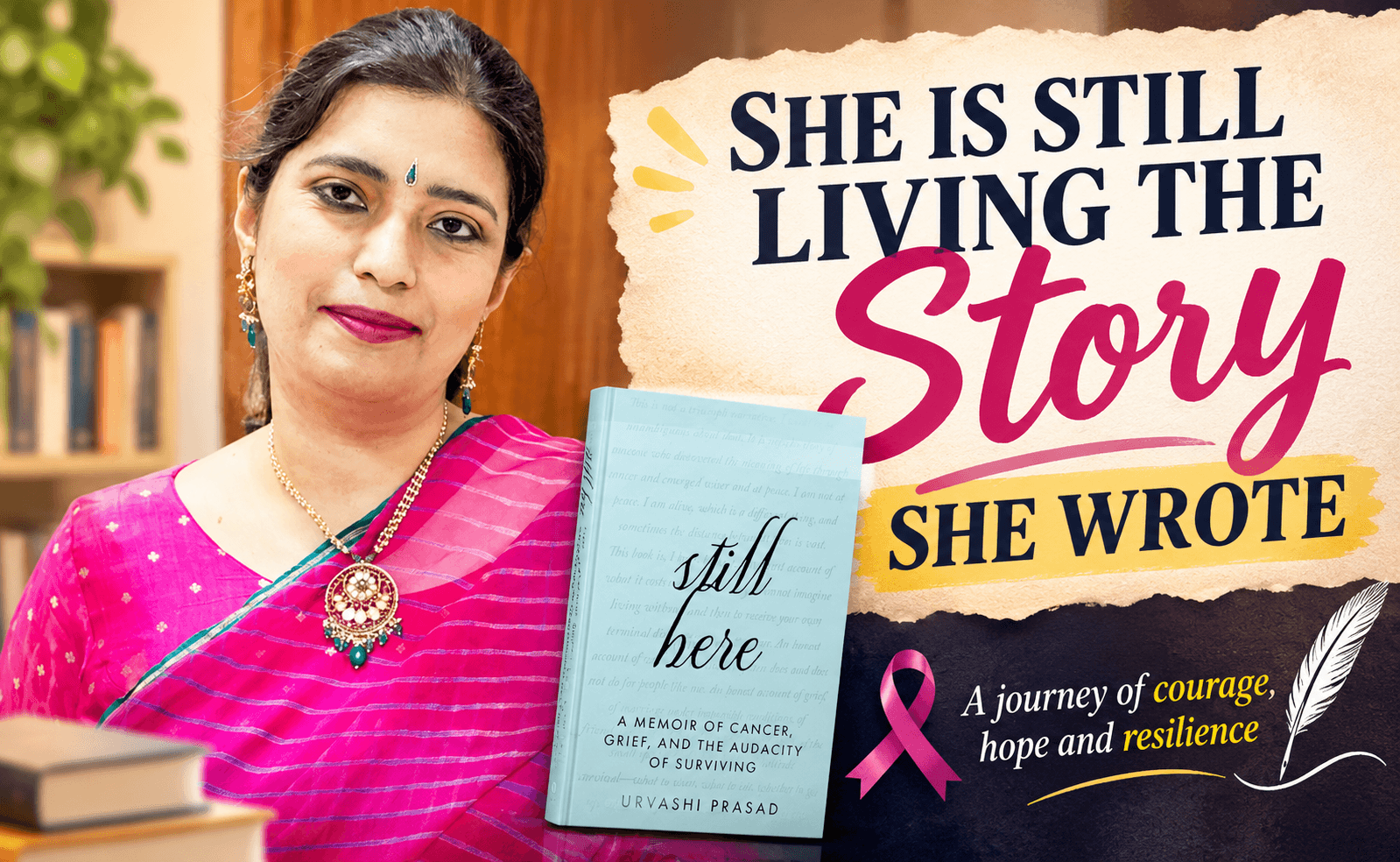
There are moments when life divides itself into two parts: everything that happened before a diagnosis, and everything that follows it. For IAS officer and public health professional Urvashi Prasad, that dividing line came at the age of 35, when she was diagnosed with stage IV lung cancer, despite never having smoked.
Until then, life had followed a course she had worked hard to build. She was a public health professional, a dancer, a woman deeply attached to her family, and someone whose world revolved around work, relationships and everyday plans. But after having already endured the devastating loss of her father, she was confronted with another reality she could never have prepared for.
What followed was not a neatly written story of recovery, nor a journey with a guaranteed happy ending. It was years of hospital visits, treatment, uncertainty, grief, difficult conversations and the exhausting business of learning to live with a condition that did not simply disappear.
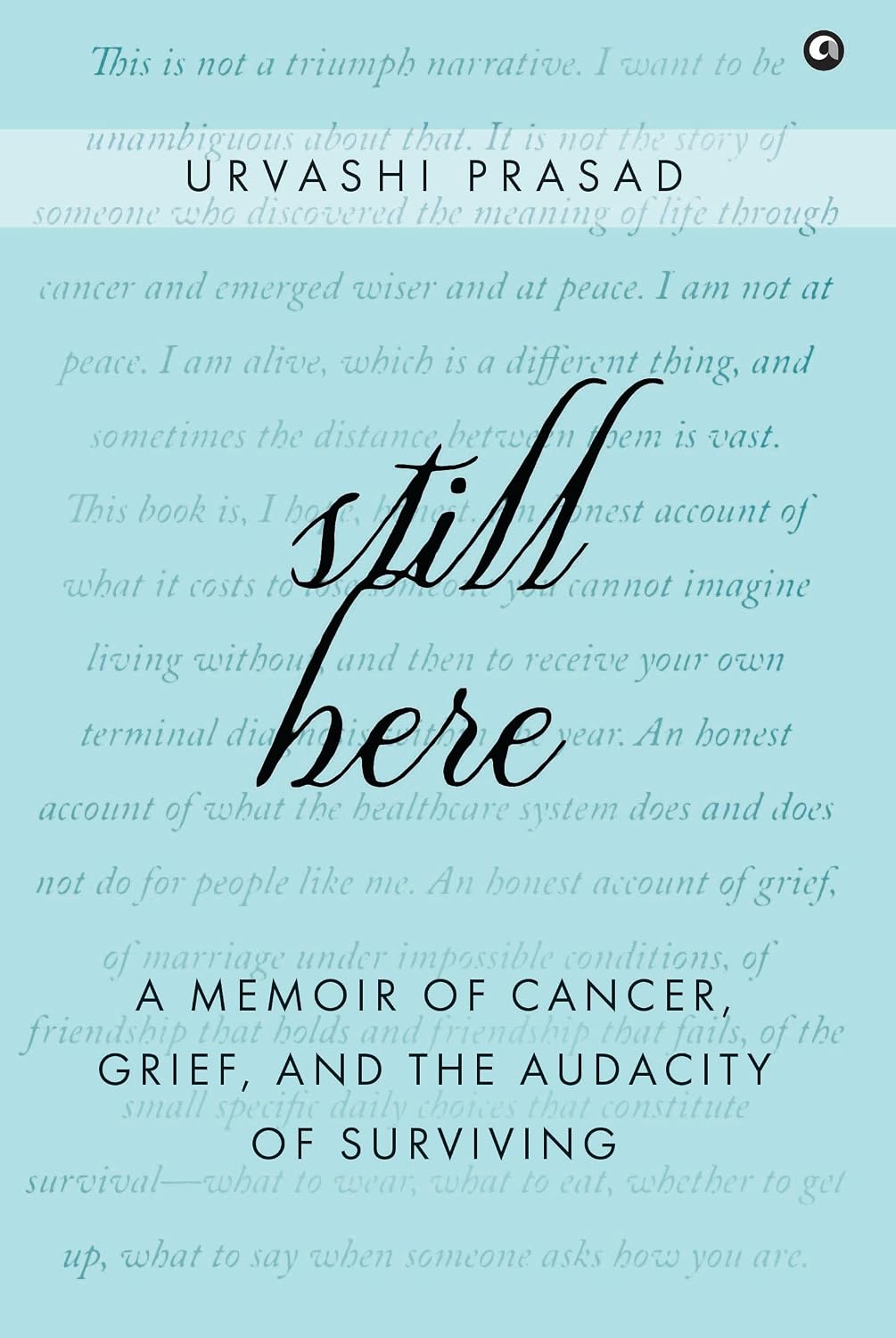
In her first book, Still Here: A Memoir of Cancer, Grief, and the Audacity of Surviving, Prasad brings that deeply personal experience to the page. The memoir opens a window into the life of someone navigating serious illness while continuing to remain part of the world around her.
And perhaps its most striking quality is that she is writing this story while still living it.
Also read: Dancing Through Adversity: Urvashi Prasad’s Inspiring Battle with Cancer and Life
A Story That Has No Convenient Ending
Most accounts of serious illness are told from a distance, after treatment has ended and the difficult chapter has supposedly been left behind. Prasad’s experience is different. Four and a half years after her diagnosis, she remains on treatment, with the challenges of living with cancer continuing alongside her professional and personal life.
Explaining why she chose to write the book, she says, “It’s basically my story of the last few years.”
But she is quick to clarify that this is not a retrospective account of a difficult period that has passed. The uncertainty remains, and so does the treatment.
“It’s not a culmination because I’m still very much in it now. I’m still very much in treatment and actually that’s where my book is different. It’s not a triumph narrative, it’s a very real, honest, candid account,” she shared in an exclusive conversation with Indian Masterminds.
That distinction shapes the entire memoir. Rather than offering readers a familiar narrative in which illness is followed by recovery and everything eventually falls into place, Prasad writes from the middle of an ongoing experience. There is no convenient conclusion, no promise that every difficult day will lead to a better one, and no attempt to make suffering appear more beautiful than it is.
Honesty is central to what makes Still Here different. It acknowledges that sometimes life does not offer closure, and that people must find ways to continue living even when their circumstances remain uncertain.
Behind Hospital Doors: The Parts of Cancer Nobody Talks About
Cancer is often discussed through medical reports, treatment protocols, survival statistics and recovery stories. But the experience of living with it extends far beyond the hospital room.
In Still Here, Prasad explores the fear that arrives before every scan, the emotional exhaustion of prolonged treatment and the ways in which serious illness changes relationships. Some friendships grow stronger, while others quietly fall away. Family dynamics shift, intimacy becomes complicated, and even ordinary decisions begin to carry an unfamiliar weight.
She also addresses subjects that are often pushed aside in conversations about cancer: depression, the financial burden of treatment, the limitations of healthcare systems, miracle cures and the emotional labour involved in simply getting through another day.
Her account challenges the comforting assumptions that illness automatically brings families closer, that every patient remains positive, or that survival is always accompanied by a sense of victory.
Rather than treating cancer as an isolated medical condition, Prasad examines what it reveals about healthcare, relationships, identity, mental health and the people around a patient.
Not Just a Book for Cancer Patients
Although the memoir emerges from her experience with cancer, Prasad does not see it as a book meant exclusively for patients or their families. Its themes extend to anyone who has experienced grief, faced an unexpected crisis, struggled with mental health or watched a familiar version of life change beyond recognition.
“It’s not just for patients, in fact, it’s for anybody really who wants to read about issues of grief, mental health, illness and various other aspects of all of this,” she says.
The book also has something to offer healthcare professionals, medical students and caregivers. By placing the patient’s emotional and everyday experience alongside the clinical realities of treatment, it invites readers to look at illness beyond prescriptions and medical outcomes.
From Public Policy to Patient Advocacy
Prasad’s work outside the pages of her memoir has also been shaped by her engagement with public health and access to treatment.
A genetics graduate of the University of Birmingham, which awarded her an honorary doctorate in 2026, she went on to earn an MPhil in Bioscience Enterprise from the University of Cambridge and an MSc in Public Health in Developing Countries from the London School of Hygiene & Tropical Medicine.
From 2016 to 2024, she served at NITI Aayog, India’s apex public policy institution. She is currently a Senior Fellow at the Pahle India Foundation and Editor-in-Chief of the Global South Healthcare Journal. She also serves as a British Council Alumni UK Ambassador for SDG 10.
Her other roles include Executive Director of ALK Positive India, the country’s first oncogene-specific lung cancer support group, co-founder of the White Ribbon Project-India, and founding director of PAVANA, the Centre for Air Pollution and Environmental Health.
Her work spans financial toxicity, access to modern therapies, air pollution and young adult cancers. She also supports children living in poverty, children with cancer, tuberculosis patients and street animals.
In 2025, she received the ASLC Patient Advocate Education Award and was selected as a 2026 ASLCSTARS Scholar.
What It Means to Be Still Here
The title of the book carries a meaning that becomes clearer as its story unfolds. Being here does not necessarily mean being free of pain, having overcome every obstacle or having found peace with everything that has happened.
It can mean continuing treatment, making plans despite uncertainty, laughing with friends, grieving someone you have lost and allowing yourself to experience ordinary happiness without knowing what tomorrow holds.
Prasad’s memoir does not ask readers to admire suffering or turn illness into an inspirational slogan. Instead, it asks them to understand the person living through it.
For those facing serious illness, it offers the reassurance of being seen without being expected to remain positive all the time. For those who have never experienced it, it offers an opportunity to understand the fears, silences and emotional complexities that patients and their families navigate.
And for everyone else, it is a reminder that life does not always unfold according to plan, and that empathy should not have to wait until tragedy enters someone’s home.
Also read: Urvashi Prasad: A Trailblazer in Public Policy and Health