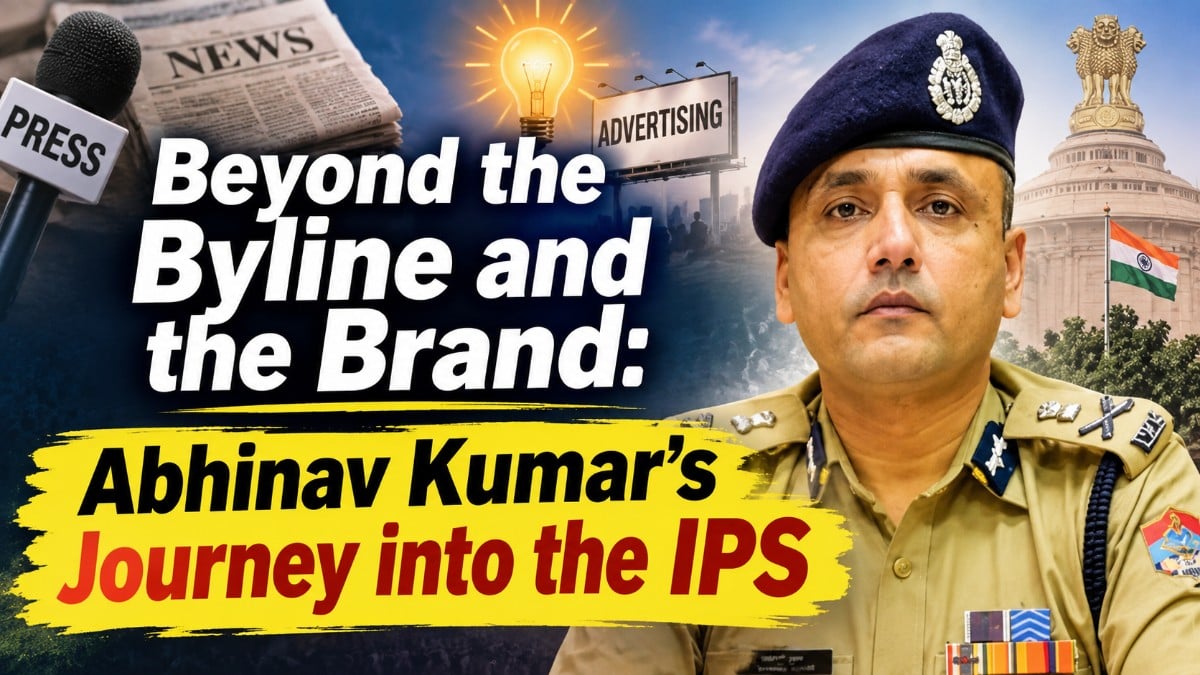
Before he became an IPS officer, Abhinav Kumar had already experienced three different worlds. Journalism taught him to observe society and question institutions. Advertising taught him how to communicate clearly and earn people’s attention. But neither gave him what he was looking for: the opportunity to take responsibility for what happened around him.
His decision to join the Indian Police Service was not driven by a sudden inspiration or a childhood ambition. It came from years of observing the country, understanding its challenges and gradually realising that he wanted to do more than report on events or comment on them. He wanted to be directly involved in bringing change.
A fourth-generation policeman from his mother’s side of the family, Kumar had grown up with a connection to the police service. Yet, he says, that legacy did not play a major role in shaping his early ambitions. His education at The Doon School and the University of Oxford, followed by his professional experiences in advertising and journalism, took him in a different direction before he eventually found his calling in policing.
Today, Abhinav Kumar is an Indian Police Service officer of the 1996 batch, Uttarakhand cadre. He is currently serving as Director General, Intelligence and Security, and Director General, Prisons Administration and Correctional Services Department, Government of Uttarakhand. He also served as Director General of Police, Uttarakhand, from 30 November 2023 to 25 November 2024.
In a conversation with Indian Masterminds, Kumar reflected on his unusual career journey, the influence of journalism and advertising on his policing style, the importance of public trust and the personal lessons he has gathered over the years.
Also Read – Delhi’s BS-IV Vehicle Ban: Why Should Registration State Determine Who Can Enter the Capital?
THE JOURNEY FROM A NEWSROOM TO THE UNIFORM
Kumar’s professional journey began far away from a police station. His education at Doon and Oxford helped him develop the ability to think critically and argue his point. He then entered the advertising industry, working with HTA, where he learnt the art of persuasion. Later, as a journalist with India Today, he developed the ability to observe people, institutions and events closely.
Each experience added a different skill. But over time, he felt that he was still standing outside the action. He could report on a problem, persuade people through a campaign or analyse an event, but he was not directly accountable for its outcome.
A defining moment came in May 1996, when he covered the bomb blasts in Lajpat Nagar, Delhi. The experience made him think deeply about the country’s preparedness to deal with such incidents and the limitations of the criminal justice system.
It also brought a change in his own thinking. He no longer wanted to remain a spectator to the challenges facing the country. He wanted to take responsibility and work within the system.
Recalling this turning point, Kumar told Indian Masterminds, “I wanted, for better or worse, to be accountable for outcomes, not merely for opinions.”
His uncle, the late Kanhaiya Lal Gupta, also influenced his decision. As an IPS officer, his uncle gave him a close view of the demands and responsibilities of police service. It was not a dramatic intervention, but his example helped Kumar reflect on what he wanted his life to stand for.
The decision surprised many of his friends. He was giving up a comfortable career abroad for the uncertainties of the civil services. Some questioned his choice, but Kumar has never regretted it. For him, the uniform offered something that journalism and advertising could not: the opportunity to protect ordinary citizens and stand against injustice.
JOURNALISM TAUGHT HIM TO SEE THE OTHER SIDE
His experience as a journalist continued to shape his understanding of policing even after he joined the IPS. Reporting on crime had shown him that every incident had several versions. There was the police account, the victim’s account and the truth, which often lay somewhere between the two.
As a reporter, he had seen the police from the outside. At times, the force appeared opaque and defensive. At other times, it seemed insensitive. There were also moments when police officers displayed courage and commitment.
These experiences made him conscious of how citizens viewed the institution. He remembered what it felt like to wait outside a police station for information that should have been available. He wanted to carry that understanding into his own career.
For Kumar, the press should not be treated as an adversary simply because it questions the police. A journalist doing their job can often identify problems that an institution has failed to recognise. This outside perspective, he believes, is important for any public institution that wants to improve.
The Lajpat Nagar blasts also remained an important reference point for him. The incident had exposed gaps in preparedness and the ability of the criminal justice system to respond to a major security challenge. Years later, while reviewing investigations as a supervisory officer, he continued to think about the people affected by such crimes.
He believes that police work must never become limited to files, procedures and statistics. Every case represents people waiting for answers, often after experiencing great loss.
WHAT ADVERTISING TAUGHT HIM ABOUT POLICE COMMUNICATION
Before joining journalism, Kumar had worked in advertising with HTA. That experience gave him a different set of lessons, particularly about communication.
Advertising taught him that people do not automatically pay attention to what an organisation wants to say. A message has to be clear, credible and relevant to its audience. If it fails to connect, people simply ignore it.
He believes government communication, including police communication, can learn from this principle. Official statements are often filled with technical language and long explanations. Citizens may find it difficult to understand what the police are trying to communicate.
His experience in copywriting taught him to value simple language. A message should be easy to understand, whether it is being delivered to senior officials or constables during a roll call.
He also believes that communication must be designed around the needs of the audience. For instance, a cybercrime awareness campaign should speak in language that an ordinary citizen can understand. It should address the concerns of a retired schoolteacher in Haldwani as much as those of an urban professional.
Advertising also taught him the importance of trust. A brand that makes promises it cannot fulfil risks losing credibility. The same principle applies to the police. Public confidence cannot be built through publicity alone. It grows when people see that the police are doing what they have promised.
His time in advertising also brought memorable experiences, including working on Pepsi campaigns. Yet, he considers the most important campaign of a police officer to be the everyday effort to earn public confidence through action.
WHY WRITING REMAINS IMPORTANT TO HIM
Even after entering the police service, Kumar never gave up writing. It had been a part of his life long before he joined the IPS. For him, writing is a way of understanding the world and making sense of experiences.
Policing has given him an unusual view of Indian society. He has witnessed how people respond to crime, conflict, disasters and difficult situations. He feels that these experiences offer important lessons about the country and its institutions. Writing allows him to reflect on them.
It also helps him think more clearly. An opinion piece requires an argument to be presented without hiding behind official language or complicated explanations. Weak reasoning becomes visible when an idea has to be expressed in a limited number of words.
However, Kumar is conscious that a serving police officer must write with care. Readers may interpret an officer’s personal views as the official position of the institution. He therefore tries to focus on ideas rather than individuals and remain fair, even when discussing difficult subjects.
He sees writing and policing as two experiences that strengthen each other. Policing gives his writing substance, while writing encourages him to examine his own thinking.
THE PERSON BEHIND THE UNIFORM
Away from official responsibilities and public writing, Kumar describes himself as less serious than his columns might suggest. Reading remains one of his strongest interests. His bedside usually has a stack of books, ranging from history and fiction to thrillers. He admits that there are always more books waiting to be read than he can finish.
Reading gives him an opportunity to step away from the immediate pressures of the job. It also allows him to look at events from different perspectives.
He is equally aware of the sacrifices made by his family during his years in the police service. Police families often have to adjust to sudden transfers, missed birthdays and long periods of uncertainty during emergencies. These sacrifices may not receive much public attention, but they remain an important part of an officer’s professional journey.
Kumar believes that protecting time for family is necessary in a profession that can easily take over one’s entire life. The demands of policing are constant, and small personal routines help maintain balance.
LESSONS FROM A LIFE IN POLICING
Looking back, Kumar believes that the decision to join the IPS was the right one, though the journey has been more demanding and rewarding than he had imagined. If he could advise his younger self, he would ask him to listen more than he speaks, especially during the early years of service.
He would also remind himself to respect every rank in the police force, from the constable to the commissioner. Authority, he believes, should never be confused with wisdom. He would also advise his younger self to maintain a diary because memory can be an unreliable witness.
His years in policing have given him a deeper understanding of India’s strengths and vulnerabilities. He has seen communities turn against each other with frightening speed. He has also witnessed ordinary people risk their lives to protect strangers from another faith.
Both experiences have shaped his understanding of society. They have taught him that India can be fragile in moments of tension, but it also has extraordinary reserves of courage and resilience.
For Kumar, the expectations of ordinary citizens from the state are not complicated. People want fairness, dignity and the assurance that someone will listen to them. When public institutions provide these basic things, citizens are often willing to overlook many other shortcomings.
These lessons, he says, cannot be learnt entirely in classrooms or universities. They emerge at the scene of a crime, during a village meeting, beside a hospital bed or at the funeral of a colleague.
From observing society as a journalist to understanding persuasion through advertising and finally taking responsibility as a police officer, Kumar’s journey has been shaped by a desire to connect ideas with action. Each profession gave him a different way of looking at people and institutions. The IPS brought these experiences together, giving him the opportunity to turn observation into responsibility and public service.
Also Read – From Makhana Jalebi to Healthy Drinks: How Katihar Is Turning a Traditional Crop into a Business Opportunity