For generations, coal mining shaped almost every aspect of life in Meghalaya’s East Jaintia Hills. In this remote, hilly district, mining was more than an occupation. It was the primary source of livelihood for families, influenced children’s choices and often determined whether they continued their education or joined the workforce.
When coal mining was halted, thousands of families lost their immediate source of income. With few alternative livelihood opportunities available, many turned to daily wage labour. Children, too, were increasingly drawn into work, often at the cost of their schooling. The district was left facing a challenge that went beyond economic rehabilitation: how could it help an entire generation see education as a pathway to a better future?
The scale of the problem was reflected in the numbers. Only 25–28 per cent of students in East Jaintia Hills were clearing their Class X board examinations. Behind this poor performance were two interconnected challenges: weak educational foundations and a significant language barrier.
For many parents, who had themselves grown up in an economy centred on coal mining, alternative career opportunities were unfamiliar. As a result, education often took a back seat when families needed additional income.
At the same time, Meghalaya’s school curriculum, textbooks, classroom instruction and board examinations were in English, while most children in the district were more comfortable speaking Khasi and Pnar. Students were expected to understand and answer examination questions in a language they had limited exposure to beyond their textbooks.
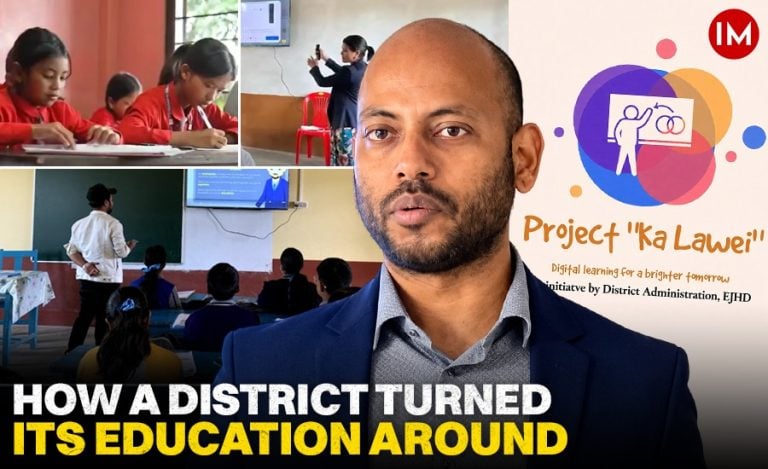
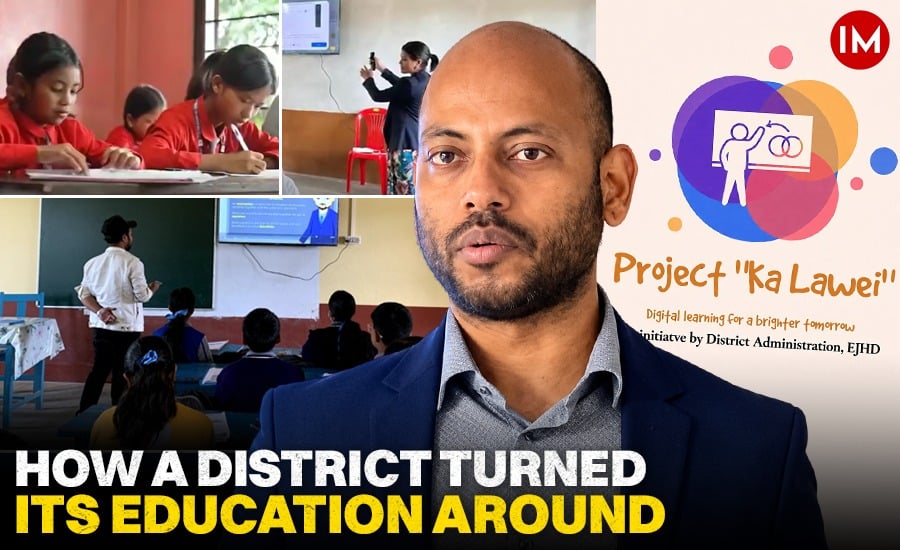
Recognising the need for a focused intervention, the district administration, under the leadership of Abhilash Baranwal, a 2018-batch IAS officer of the Assam-Meghalaya cadre, launched Project Ka-Lawei, meaning ‘The Future’. Baranwal, who is currently serving as Deputy Commissioner of Ri-Bhoi district, Nongpoh, Meghalaya, spearheaded the initiative during his tenure in East Jaintia Hills.
The project sought to use technology to make classroom learning more accessible, strengthen foundational knowledge and improve students’ performance in board examinations. Rather than introducing an internet-dependent digital education system, the administration chose a model suited to the district’s infrastructure and available resources.
Also read: Ganga Bai Gaur: The Woman Farmer Saving India’s Traditional Seeds and Forgotten Millets
Taking Smart Classrooms to Schools
Project Ka-Lawei began with a pilot across 20 schools. Each school was equipped with a smart classroom featuring an affordable smart TV and a pen drive containing curriculum-aligned digital learning material. The system did not require an internet connection, making it practical for schools in areas with unreliable connectivity.
The pen drives came preloaded with iPrep, an offline learning platform offering English-medium content for students from Classes VI to X, mapped to the Meghalaya State Board curriculum. It included animated concept videos, practice questions, digitised textbooks, classroom activities and a digital library containing stories, poems and biographies.
For students who had limited opportunities to engage with English outside their textbooks, the audio-visual format offered a different way of approaching the language and understanding academic concepts. Lessons could be repeated, allowing children to learn at their own pace and revisit topics they found difficult.
However, the administration understood that installing digital equipment alone would not address the underlying learning crisis. Before expanding the intervention, it needed to understand where students actually stood academically.
Identifying the Learning Gaps
A baseline assessment conducted across the pilot schools revealed a concerning finding: Class X students had learning gaps of up to four grade levels.
This meant that many students were being taught advanced concepts without having mastered the foundational knowledge required to understand them. Moving ahead with the prescribed syllabus without addressing these gaps would have done little to improve learning outcomes.
The administration therefore introduced a structured bridge course through iPrep. It identified the foundational concepts students needed to revisit and guided teachers on which topics from earlier grades should be covered before moving to the current syllabus.
Teachers were trained by on-field teams to integrate the bridge course into their existing classroom schedules. This made remedial learning a regular part of teaching rather than an occasional exercise conducted separately from the curriculum.
The initial response was encouraging. Within six months, the 20 pilot schools collectively recorded 4,500 hours of Smart Classroom usage. The figures indicated that the technology was being actively used in classrooms and had become part of the teaching process.
Following the pilot’s progress, the administration expanded the programme to 166 classrooms, keeping improvement in the Class X pass percentage as its primary objective.
From Digital Lessons to Measurable Results
As the initiative expanded, another important component was introduced: monthly assessments through the iPrep Assessment App.
Students were assessed on the topics covered during the preceding month. The results gave teachers a clearer picture of what students had understood, where they were struggling and which concepts required further attention.
This created a continuous feedback mechanism. Instead of following the same remedial approach for every student, teachers could use assessment data to identify learning gaps and modify their teaching accordingly. The bridge course, therefore, remained responsive to students’ actual needs.
The impact of the intervention became increasingly visible over the next three years.
Smart Classroom usage, which stood at 4,500 hours during the initial pilot phase, increased to more than 53,000 hours annually. More importantly, the district’s Class X pass percentage rose from 25–28 per cent at the beginning of the initiative to 62 per cent by the end of the second year. By the end of the third year, it had crossed 90 per cent.
For a district that had struggled with such low board examination results, this marked a significant improvement.
A Model Beyond Digital Infrastructure
What makes Project Ka-Lawei particularly relevant is not simply the introduction of digital classrooms but the way technology was integrated into a larger educational strategy.
The administration first assessed students’ learning levels, identified foundational gaps, introduced a structured bridge course, trained teachers and established regular assessments to track progress. Each intervention addressed a specific problem, making the overall model more purposeful and measurable.
Technology served as an enabler rather than a replacement for teachers. It provided accessible learning material, supported classroom instruction and helped educators respond more effectively to students’ individual learning needs.
The next priority for the district is to move beyond improving examination pass percentages. With more students now clearing Class X and progressing towards higher education, the administration is focusing on improving actual marks, strengthening conceptual understanding and ensuring that students acquire learning outcomes appropriate to their grade levels.
Project Ka-Lawei also offers a model that other districts can adapt, particularly those facing similar challenges of poor connectivity, language barriers, inadequate foundational learning and limited educational resources. Its affordable infrastructure and offline delivery system make it suitable for implementation through public-private partnerships.
As the district works towards building livelihood opportunities beyond coal mining, improving access to quality education has become an important part of its larger transition.
East Jaintia Hills once depended heavily on what lay beneath its hills. Project Ka-Lawei is helping its children look towards what lies ahead. With a Class X pass percentage now exceeding 90 per cent, the district is demonstrating how a focused administrative intervention, supported by technology and sustained teacher engagement, can help change the educational prospects of an entire generation.
In the true spirit of Nexus of Good, it is a model whose impact need not remain confined to one district. It can be adapted, scaled and replicated wherever children need a stronger bridge between the classroom and their future.
Also read: Police Must Serve the Law, Not Politicians: Former IPS Officer Yashovardhan Azad