New Delhi: Delhi High Court Justice Prathiba M Singh has called for dedicated Intellectual Property (IP) courts across India to improve the handling of intellectual property disputes. She also proposed a national Judicial Stack, wider use of artificial intelligence (AI) in courts, and stronger protection for trade secrets to make India’s justice system more efficient.
Justice Prathiba M Singh Calls For Specialised IP Courts
Delhi High Court Justice Prathiba M Singh has stressed the need to establish specialised Intellectual Property (IP) courts across India.
Read also: How This One Rolls-Royce Proposal will Boost India’s Fifth-Generation Fighter Programme
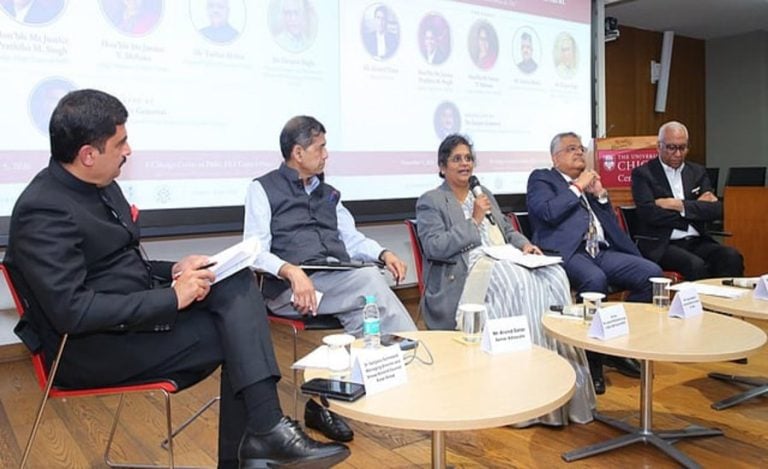
Speaking at a discussion titled Shaping The Legal Architecture Of Viksit Bharat 2047, Justice Singh suggested amending the Commercial Courts Act to create dedicated IP courts at both district and High Court levels.
She said that India needs a uniform system of specialised IP courts to improve the quality of justice and ensure consistency in decisions.
According to Justice Singh, specialised courts would also help judges receive proper training in intellectual property laws and develop a better understanding of complex IP disputes.
The discussion was organised by the University of Chicago Center in Delhi, the Nani Palkhivala Foundation and the General Counsels’ Association of India (GCAI). Sanjeev Gemawat moderated the discussion.
Justice Singh Proposes National Judicial Stack
Justice Prathiba M Singh also proposed creating a national Judicial Stack, similar to India’s existing India Stack digital infrastructure.
The proposed system could help improve court administration by providing better access to judicial information and digital services.
She highlighted that nearly 5 crore cases are pending in Indian courts. This figure does not include pending matters before tribunals and revenue authorities.
Justice Singh suggested providing access to judicial data through Application Programming Interfaces (APIs).
This could help researchers, technology companies and policymakers develop new digital solutions for the justice system.
The proposed Judicial Stack could also support data-driven reforms and make court-related information more accessible. However, it remains a proposal rather than an existing nationwide judicial platform.
Artificial Intelligence In Courts Gains Attention
Justice Singh also highlighted the growing role of Artificial Intelligence in the global judicial system. She referred to the ninth World Intellectual Property Organization (WIPO) Intellectual Property Judges Forum, held on October 14 and 15, 2026, in Geneva, Switzerland.
According to WIPO, the forum received registrations from more than 970 judges worldwide, with 167 judges attending in person.
Discussions at the forum focused on the use of AI in judicial systems and the challenges created by emerging technologies.
Justice Singh shared that 52 percent of judges who responded to a questionnaire expressed interest in using AI to draft judgments.
AI could help judges with legal research, document analysis and judgment preparation. However, human supervision and judicial decision-making remain important.
India Has Made Progress In Intellectual Property Protection
Justice Singh also discussed India’s progress in intellectual property rights enforcement. She identified three major developments that have helped strengthen India’s IP protection system:
- Innovative judicial remedies developed by courts.
- The introduction of the Commercial Courts Act.
- The establishment of Intellectual Property Divisions in High Courts.
She explained that courts cannot create new laws or regulations on their own, but they can develop effective remedies within the existing legal framework.
Justice Singh highlighted the importance of protecting well-known trademarks, cross-border brand reputation and intellectual property against online infringement.
She also referred to dynamic injunctions and dynamic-plus injunctions as important judicial remedies for tackling online copyright and trademark violations. These remedies can help courts respond to changing online infringement activities and protect intellectual property owners.
Specialised IP Courts: Justice Singh Calls For Stronger Trade Secret Protection
Justice Singh also called for a dedicated law to protect trade secrets in India. Trade secrets include confidential business information, manufacturing processes, technical knowledge and commercial data that provide companies with a competitive advantage.
She highlighted that trade secret protection is becoming increasingly important as businesses use more digital technologies and artificial intelligence.
She referred to recommendations made by the Law Commission of India for stronger legal protection of trade secrets.
A dedicated legal framework could provide businesses with better protection against the misuse or unauthorised disclosure of confidential information.
Commercial Court Reforms And Faster GST Refunds Suggested
Justice Singh also called for extending procedural reforms introduced under the Commercial Courts Act to ordinary civil cases.
The objective is to make civil litigation faster and reduce unnecessary delays in the justice system.
She also highlighted the need to resolve Goods and Services Tax (GST) refund cases more quickly.
Although GST collections have increased, businesses and taxpayers still face delays in receiving refunds.
She pointed out that a large number of writ petitions are filed in courts seeking the release of pending GST refunds. Faster resolution of these cases could reduce unnecessary litigation and improve the overall efficiency of the legal system.
What Do Specialised IP Courts Mean For India’s Judicial System
Justice Prathiba M Singh’s proposals highlight the need to modernise India’s judicial infrastructure.
Dedicated IP courts could improve the handling of complicated intellectual property disputes, while a national Judicial Stack could support digital access to court information.
Similarly, responsible AI adoption could help judges manage their workload and improve administrative efficiency.
Stronger trade secret protection could also provide greater confidence to businesses, innovators and technology companies. These proposals underline the importance of combining specialised legal institutions, digital technology and effective judicial reforms to build a more efficient justice system.
FAQs
The Judicial Stack is a proposed national digital infrastructure for India’s judiciary. It could provide API-based access to judicial data and support research, technological innovation and better court administration.
India needs dedicated IP courts to resolve intellectual property disputes more efficiently, provide specialised judicial training and ensure consistent decisions in trademark, copyright and patent cases.
Artificial intelligence can assist judges with legal research, document analysis, case management and drafting judgments. However, human supervision and judicial independence must remain central to the justice system.