For many forest-dependent communities, the forest is not just a landscape. It is a source of food, income and survival. But when livelihoods depend on the illegal extraction of forest resources, both people and forests can suffer.
For Rahul Kishan Jadhav, this challenge called for a different approach. Instead of looking at forest protection only through enforcement, he focused on creating alternative sources of income for tribal and forest-dependent communities.
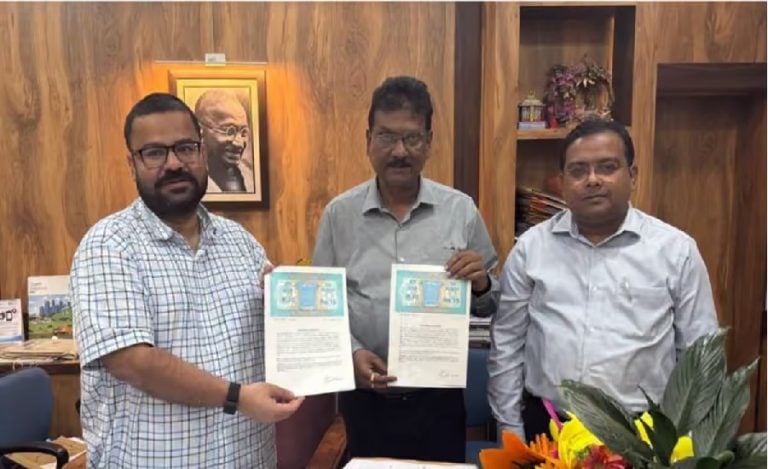
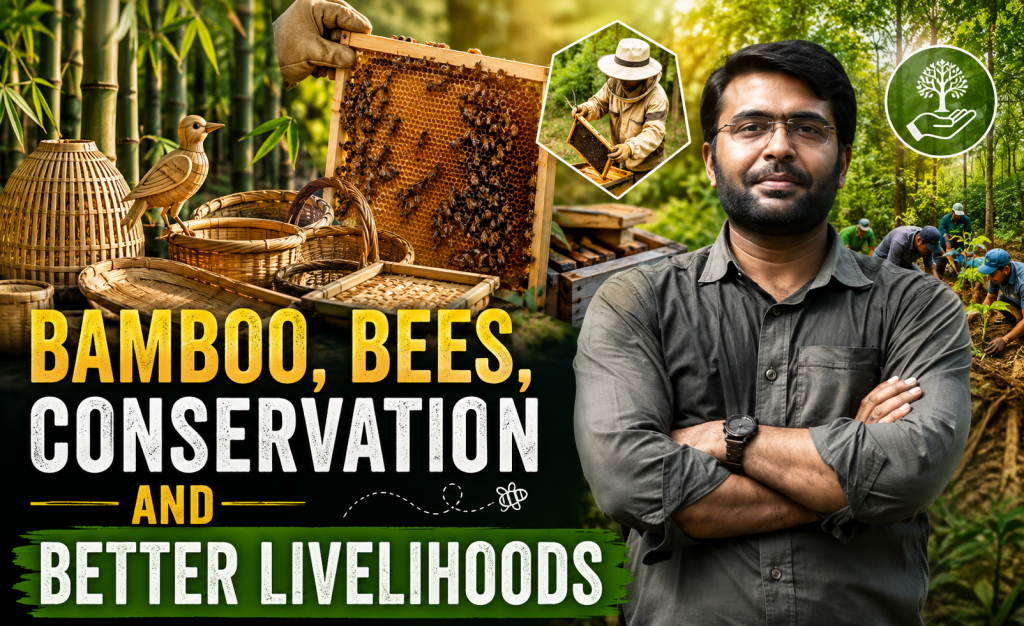
Rahul Kishan Jadhav, IFS, Telangana 2018, formerly served as District Forest Officer (DFO), Mulugu, and is presently working as DFO, Mancherial. During his tenure in Mulugu, he worked on a range of community-based initiatives that linked livelihoods with conservation.
From training the Medara community in modern bamboo crafts to introducing beekeeping among Koya tribal families, his efforts were built around one simple idea: people are more likely to protect forests when conservation also improves their lives.
WHEN ILLEGAL FOREST USE BECAME A LIVELIHOOD ISSUE
One of the challenges Jadhav encountered was among the Medara community in Jangalapally village. The Medaras are traditionally skilled in bamboo craft. They make baskets, storage bins, mats, ladders, ritual structures and temporary structures used during festivals and other occasions. But the community had limited opportunities to earn from these traditional skills.
Also Read –From Forests to Wetlands: The Conservation Leadership Transforming Odisha’s Wild Landscapes
They depended on bamboo illegally cut from nearby forests. The situation created problems on both sides. The forest was being damaged, while the community members were facing cases and seizures for illegal extraction. The work itself was also difficult. Villagers had to climb a hillock and carry bamboo sticks on their shoulders. Despite the effort and risk, the income from traditional products remained low.
For Jadhav, this was not simply a case of illegal forest use. It was also a livelihood problem. “The twin challenges of tackling the low socio-economic condition and stopping illegal cutting of bamboo led us to think about ways to address both together,” Jadhav explains.
The answer was to build on the skill the community already possessed instead of asking them to abandon it.
TURNING TRADITIONAL SKILLS INTO BETTER INCOMES
Jadhav and his team realised that bamboo products had a much larger market beyond traditional baskets and mats. Modern bamboo figurines, animal and bird models, trays, decorative pieces and sustainable gifting products were gaining popularity. Corporates were also looking for eco-friendly alternatives for gifting. The skill already existed in the community. What was missing was training, design and access to markets.
The Forest Department therefore invited two bamboo craft trainers from Madhya Pradesh. A Forest Department meeting hall was converted into a workshop for nearly a month. The training was completely free. The participants received tools and raw materials such as bamboo, thermocol, glue and decorative material. Since the training continued through the day, lunch was also provided. A small daily stipend was given to compensate for the loss of their regular labour income.
The idea was to make sure that poverty did not prevent the participants from completing the training. At the same time, the Forest Department addressed the question of raw material. Bamboo extracted legally from forest department bamboo coupes was made available to the group. This created an important link between livelihood and conservation.
The community could continue working with bamboo, but without illegally entering the forest to obtain it.
FROM ₹300 BASKETS TO ₹1,200 FIGURINES
The change became visible in the products the community began making. The artisans started producing decorative figurines, trays, showpieces and gifting articles. The difference in earnings was significant. A traditional bamboo basket could fetch around ₹200-300. A bird figurine, on the other hand, could earn the artisan around ₹1,000-1,200.
The intervention therefore did not simply provide an alternative occupation. It helped increase the value of an existing skill. The Forest Department also worked to connect the artisans directly with potential buyers. NGOs and corporate groups were invited to see their products. The District Administration purchased their crafts as gifts for participants during the Miss World 2025 visit to Mulugu and the Ramappa Temple.
The products also received attention during the visit of Telangana Governor Jishnu Dev Varma, who appreciated the work of the group and encouraged them to continue. For a community that had earlier been associated mainly with illegal bamboo extraction, the change brought visibility as well as confidence.
Jadhav says the transformation was particularly encouraging among the young women of the community. “The traditional knowledge was already there. What we needed was to refine it, introduce modern designs and connect their skills with the market.”
WHEN THE FOREST BECOMES A SOURCE OF OPPORTUNITY
The bamboo initiative was one part of Jadhav’s larger approach to conservation. A similar philosophy guided his work with Koya tribal communities living around the Eturnagaram Wildlife Sanctuary. The Koyas have a close relationship with the forest. They collect seasonal forest produce such as honey, chironji, mahua flowers and wild fruits including jamun, tendu, pala pandu and amla.
Much of this produce is consumed by families themselves. Some is sold along highways and local markets. Jadhav saw an opportunity in one particular skill that the community already possessed — harvesting wild honey. Instead of limiting the activity to collection from the forest, he explored whether the community could produce honey through apiculture.
The objective was simple: create an additional source of income without increasing pressure on natural forest resources.
BRINGING BEEKEEPING TO THE DOORSTEP
With support from the Forest College and Research Institute, Telangana, the initiative was introduced in two villages. Around 100 bee colonies were provided through approximately 50 apiary boxes in each village. Around 30 community members from each village were selected for the programme.
Smt. Sailaja V., Assistant Professor of Entomology at the institute, played an important role in the initiative. The participants received seven days of training covering bee rearing, handling and honey extraction. They were also given certificates after completing the training.
The beneficiaries began rearing bees and producing honey. Most of the honey was sold in local markets, providing families with an additional source of income. For communities living on the edge of forests, even an additional income stream can make a meaningful difference.
More importantly, the intervention showed that conservation does not always have to mean restricting communities. It can also mean helping them earn differently.
MAKING CONSERVATION A COMMUNITY JOURNEY
For Jadhav, the larger lesson from these initiatives is that forests cannot be protected by enforcement alone. People living around forests have economic needs. Ignoring those needs can make conservation difficult. His approach has therefore been to combine awareness, enforcement, livelihood support and community participation.
“Forest conservation cannot be driven by a single agenda. If we want lasting protection, we have to take the people dependent on the forest along with us.”
The bamboo artisans of Jangalapally and the Koya beekeepers represent two different examples of the same idea. In one case, traditional bamboo skills were converted into higher-value products. In the other, knowledge of wild honey was developed into organised apiculture. Both interventions sought to create income while reducing dependence on unsustainable extraction.
For Jadhav, this is where conservation becomes sustainable. When the forest is protected and the community also sees a better future, conservation stops being an external rule and becomes a shared interest.
Also Read – How IFS Suman W M Sivachar is Making Forest Conservation a Community Effort in Nagaland