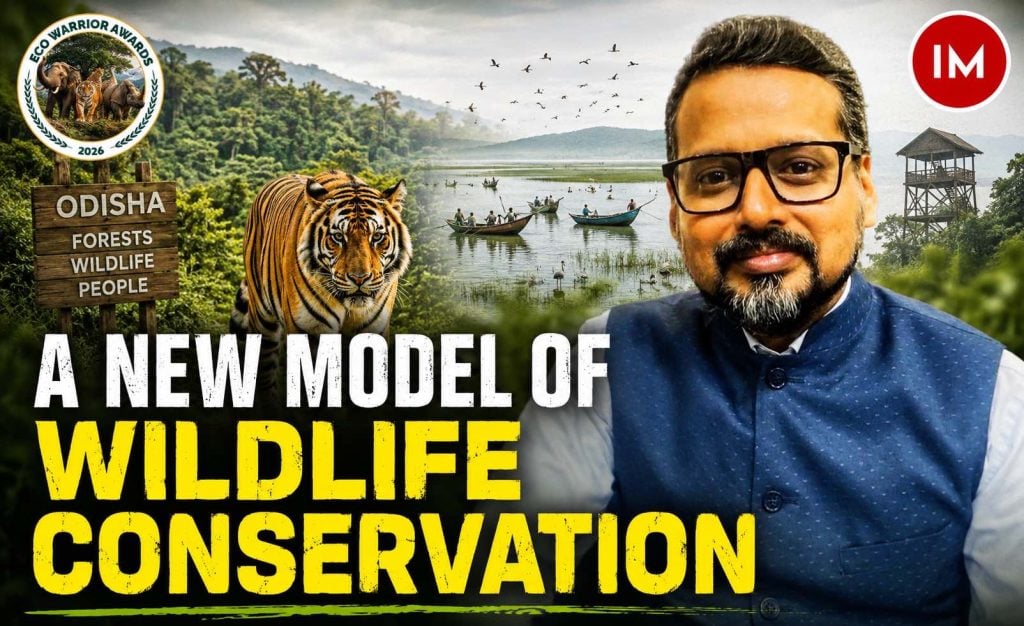
Conservation is no longer simply about protecting forests from human pressure; it is about finding a sustainable balance between ecological security and the aspirations of the communities that depend on these landscapes. In Odisha, this philosophy has shaped the work of M. Yogajayanand, an Indian Forest Service (IFS) officer of 2005 batch from the Odisha cadre and Chief Executive of the Chilika Development Authority.
Across some of the state’s most complex wildlife and wetland landscapes, he has sought to turn conservation goals into measurable action – strengthening protection on the ground, restoring habitats, involving communities and introducing institutional reforms.
His career reflects an approach in which scientific assessment and field-level intervention go hand in hand. From strengthening tiger protection in Similipal and Satkosia to contributing to the creation of Odisha’s first Conservation Reserve, developing a mega nursery and preparing a long-term restoration plan for Chilika Lake, his initiatives have addressed both immediate conservation threats and the larger ecological systems behind them.
For Yogajayanand, however, the foundation of successful conservation remains simple: consistent presence on the ground, strong institutions and engagement with people.
Indian Masterminds interacted with IFS Yogajayanand to understand the initiatives undertaken during his various assignments, the strategies behind them and their impact on Odisha’s forests, wildlife and wetland ecosystems.
How It Started: Strengthening Protection in Similipal
One of the clearest examples of this approach emerged during his tenure as Field Director of Similipal Tiger Reserve. Spread across nearly 4,750 sq km, Similipal presents enormous logistical challenges, particularly during the monsoon when heavy rains can make parts of the landscape difficult to access.
IFS Yogajayanand identified year-round accessibility and continuous protection as crucial priorities.
“Similipal is a huge landscape, 4,750 sq km. During monsoon and all, during rains, it becomes difficult to access also,” he explained.
Read Also: From Conflict to Conservation: How IFS Manish Singh Is Reimagining Forest Protection in Pilibhit
His response was to strengthen the road network so that protection personnel could reach different parts of the reserve throughout the year. Alongside this, he introduced the “One Beat–One Camp” strategy, aimed at ensuring a visible protection presence across the landscape.
“We ensured that 365 days, throughout the year, accessibility will be there, by ensuring and strengthening the road networks,” he said. “And secondly, each beat, one protection camp – that was the main motto. So that our people presence will be there in each and every beat of this entire landscape.”
The strategy was not merely about infrastructure. It was about creating a sustained frontline presence capable of deterring poaching, responding quickly to threats and monitoring wildlife more effectively.
From Protection to Measurable Tiger Recovery
The results of intensified protection were reflected in tiger monitoring. Camera-trap data showed the number of identified tigers increasing from eight in 2018 to 16 in 2022.
“Earlier only eight tigers were there, in camera trap tigers. So during those two years, it was doubled,” Mr Yogajayanand recalled.
The interventions included intensive patrolling, strengthening anti-poaching camps, habitat restoration, prey augmentation and relocation of villages from critical tiger habitats. These efforts were complemented by closer engagement with local communities.
The improvement was also reflected in the Management Effectiveness Evaluation conducted by the Ministry of Environment, Forest and Climate Change. Similipal moved into the “Excellent” category, securing a 100 per cent score in the Context parameter.
“So, in that also, we have scored 100% marks in the context category. Again, we got from very good category to excellent category,” he said.
For Yogajayanand, such assessments provide an important indication that field-level interventions are producing tangible conservation outcomes.
Community Participation: Ending a Long-Standing Hunting Practice
Protection, however, cannot rely solely on enforcement. In landscapes where traditional practices and livelihoods are closely linked with forests, lasting conservation requires the participation of local communities.
During his tenure, sustained engagement with communities helped bring an end to the traditional Akhanda Shikar, a mass hunting practice that had posed a serious threat to wildlife.
The strategy combined community engagement with livelihood-oriented interventions, including ecotourism opportunities. Rather than viewing communities only through the lens of enforcement, the approach sought to create alternatives that could align local economic interests with conservation.
This philosophy extended beyond Similipal. His field career included efforts involving habitat management, village relocation and strengthening community participation in protected-area conservation.
Building Institutions for Long-Term Conservation
Yogajayanand’s contribution to conservation also extended beyond individual protected areas. During his tenure in Similipal, he played a key role in establishing the Similipal–Hadgarh–Kuldiha Conservation Reserve, resolving long-standing inter-district and stakeholder issues.
The initiative represented an important institutional step for landscape-level conservation, bringing multiple ecological and administrative interests within a common conservation framework.
His work also included the development of a mega nursery with a capacity of 10 lakh seedlings. What began as an initiative during his tenure subsequently emerged as a model for other parts of the state, with divisions and districts adopting similar nursery models.
“During my tenure, we have developed one mega nursery which has become a model for the entire state,” he said. “Now each division has a model like mega nursery. Each district has a model nursery now.”
The initiative was aimed at strengthening the availability of quality planting material and supporting ecological restoration at scale.
From Forests to Wetlands: A New Chapter at Chilika
While forests and tigers formed an important part of his earlier assignments, Yogajayanand’s current role at the Chilika Development Authority has brought another major ecological challenge into focus: the conservation and restoration of Asia’s largest brackish-water lagoon.
One of the significant initiatives under his leadership has been the preparation of a Detailed Project Report for the holistic restoration of Chilika Lake, developed in collaboration with IIT Madras.
“For 25 years, [there had not been] one holistic development [plan] of Chilika Lake. We have developed a detailed project report in collaboration with IIT Madras,” he said.
The report provides a structured framework for restoration, bringing together scientific understanding and long-term ecological planning.
His work at Chilika has also included efforts to address illegal prawn enclosures, with more than 5,000 acres of such enclosures removed, alongside ecological restoration measures.
Policy Beyond the Field
Yogajayanand’s conservation work has also extended into policy-making. While serving at the state headquarters, he contributed to the formulation of the Odisha Agroforestry Policy 2025, described as a pioneering initiative in the country.
The policy reflects the broader principle that conservation and livelihood needs need not remain opposing objectives. Agroforestry can create opportunities for farmers while simultaneously supporting tree cover, ecological resilience and sustainable land use.
Other contributions include efforts toward Ramsar recognition for Satkosia and interventions in wildlife crime investigations, including leading a Special Investigation Team in the Athagarh elephant poaching case, where advanced forensic techniques were employed.
A Conservation Legacy Built on Action
From doubling camera-trapped tigers in Similipal to strengthening year-round protection, from ending a traditional mass hunting practice to establishing large-scale nurseries, and from creating conservation reserves to developing a scientific restoration blueprint for Chilika, Yogajayanand’s work illustrates a consistent theme: conservation succeeds when vision is matched by implementation.
His approach brings together science, enforcement, infrastructure, policy and community participation rather than treating them as separate components.
“The protection, we have strengthened the protection, and we have also worked closely with the communities,” he said, summarising the philosophy behind the results.
For Odisha’s forests, wildlife and wetlands, such an integrated approach offers more than individual success stories. It provides a model of conservation leadership in which institutions become stronger, communities become partners and ecological recovery becomes measurable.
Ultimately, the lasting measure of conservation leadership is not the number of initiatives launched, but whether landscapes are healthier, wildlife is safer and communities have a greater stake in protecting the natural systems around them. In Odisha, Yogajayanand’s journey across forests and wetlands demonstrates how determined leadership can help turn that vision into enduring action.