In a world where most people depend on markets for their everyday needs, some find fulfilment in exploring simple, sustainable alternatives right at home. Sometimes, an idea born out of curiosity can grow into a meaningful pursuit, bringing personal satisfaction while contributing to the environment. In Sikkim, one IAS officer has demonstrated how a small household experiment can evolve into a rewarding passion for self-reliance and nature conservation.
Mingma Tempa (M.T.) Sherpa, a 2011-batch IAS officer of the Sikkim cadre, has turned a corner of his home in Gangtok into a small beekeeping space. What began around 2020 as an experiment during his tenure in the Horticulture Department has gradually developed into a passion for scientific honey harvesting. Using specially designed bee boxes installed on his balcony, he now harvests approximately 8–10 litres of honey annually through three harvesting cycles. While most of the honey is used for household consumption, he has occasionally sold the surplus to people interested in buying it.
However, for Sherpa, the initiative is about much more than obtaining pure honey. His approach focuses on protecting honeybees, minimising damage during extraction and recognising the important role these insects play in pollination and agricultural productivity.
In an exclusive conversation with Indian Masterminds, Mr Sherpa shared how an official assignment in the Horticulture Department inspired him to practise at home what the government was encouraging through its initiatives, how he adopted scientific beekeeping and why he believes even small individual efforts can make a difference.
How It Started: An Official Assignment Became a Personal Passion
The beginning of Sherpa’s beekeeping journey can be traced to his association with the Horticulture Department, where he had an opportunity to understand different aspects of horticultural development, including beekeeping.
While working on initiatives connected with the department, he felt that promoting a practice through government programmes should also encourage people involved in its implementation to experience it themselves.
Also Read: From Ban to Action: Sikkim’s Comprehensive Approach to Plastic Pollution
Explaining what motivated him, he told Indian Masterminds, “There was an assignment of Horticulture during my tenure in the government. Horticulture also has a component of beekeeping. So, when we implement these kinds of projects, I thought we should also practise them in our real lives.”
This thought eventually translated into action around 2020. Instead of looking for a large agricultural space or establishing a commercial unit, Sherpa decided to begin on a small scale at his residence in Gangtok.
His house was located in an urban area, where limited vegetation and space could make beekeeping difficult. However, the greenery around Gangtok offered some favourable conditions.
He installed scientific bee boxes on his balcony and began observing the process.
Initially, he maintained three boxes. However, managing them alongside his official responsibilities became challenging, particularly because beekeeping requires regular attention. Consequently, he gradually reduced the number and currently maintains one box.
What started as a practical household experiment has now become something he genuinely enjoys pursuing.
Scientific Bee Boxes: A Better Way of Harvesting Honey
One of the most interesting aspects of Sherpa’s initiative is his preference for scientific bee boxes over conventional honey extraction practices.
Traditional honey harvesting often involves manually removing or crushing honeycombs to extract honey. According to Sherpa, this approach can damage the honeycomb, contaminate the honey and cause harm to honeybees, including their eggs and developing young.
He wanted to adopt a method that would allow him to collect honey without unnecessarily disturbing the bees.
Explaining the difference, he said, “Normally, there is a traditional way of beekeeping in which you have to use your hands. When you take out the honey, you have to handle the honeycomb. In that process, many honeybees and their young ones can also get damaged.”
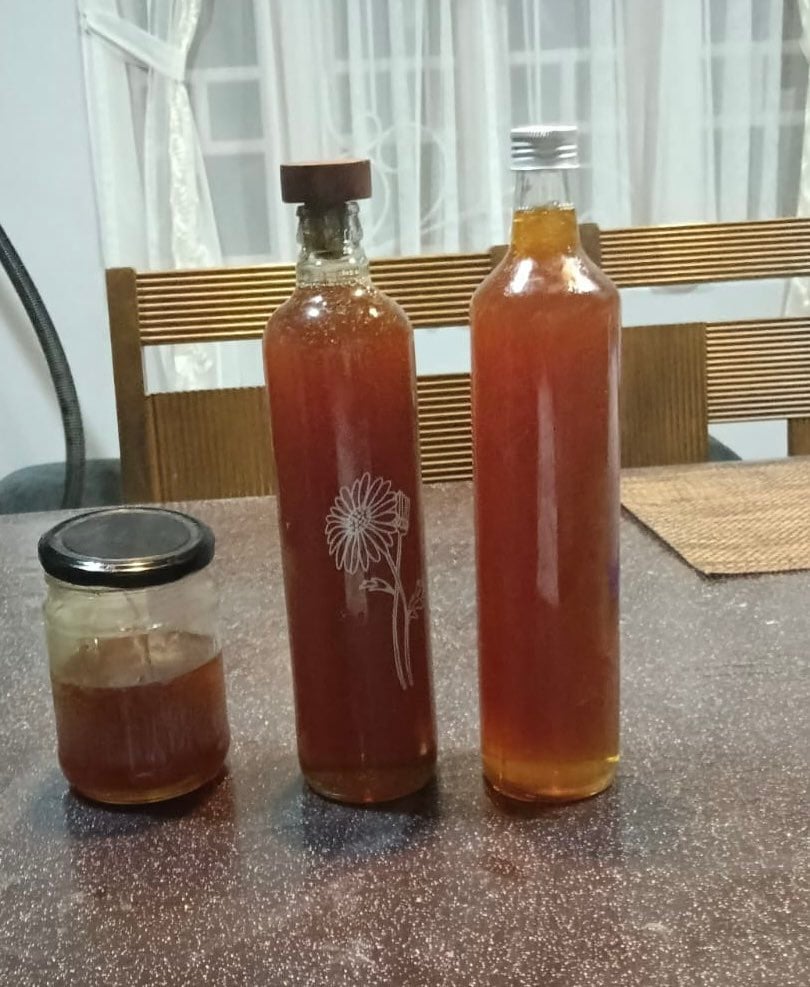
The scientific bee box he uses has a different arrangement. It allows honey to be extracted through a rotating mechanism rather than crushing the honeycomb manually.
The honey is collected in a vessel using the extraction device and subsequently filtered. This reduces direct handling of the honeycomb and helps minimise contamination.
For Sherpa, the most important advantage is that the process is less harmful to the bees.
“There is a scientific method of extraction. You do not have to put your hands inside or crush the honeycomb. The honey comes out through the mechanism, and then it is filtered and stored,” he explained.
Protecting the Bees While Harvesting Honey
For Sherpa, harvesting honey should never mean depriving honeybees of the resources they need to survive.
He particularly emphasises the importance of distinguishing between the chambers used for honey storage and those containing the queen, eggs and developing bees.
The scientific arrangement allows him to extract honey from a separate chamber without disturbing the brood section, where the queen and developing bees are located.
He explained that completely emptying the box of honey would leave the bees without their food reserves. Therefore, a portion must always be retained for their consumption.
“We do not touch the chamber where the queen and eggs are present. We extract honey from the other chamber. If we empty everything and leave the bees hungry, that would be an injustice to them,” he said.
This approach reflects his larger understanding of beekeeping as an activity that requires responsibility towards the insects rather than simply focusing on the quantity of honey produced.
He also believes that honeybees are generally harmless when they are not disturbed or threatened.
Although people often fear being stung by bees, Sherpa says they do not pose a threat when allowed to carry out their natural activities without interference.
8-10 Litres of Honey Annually from One Box
Despite being a small household initiative, Sherpa’s beekeeping experiment has produced encouraging results.
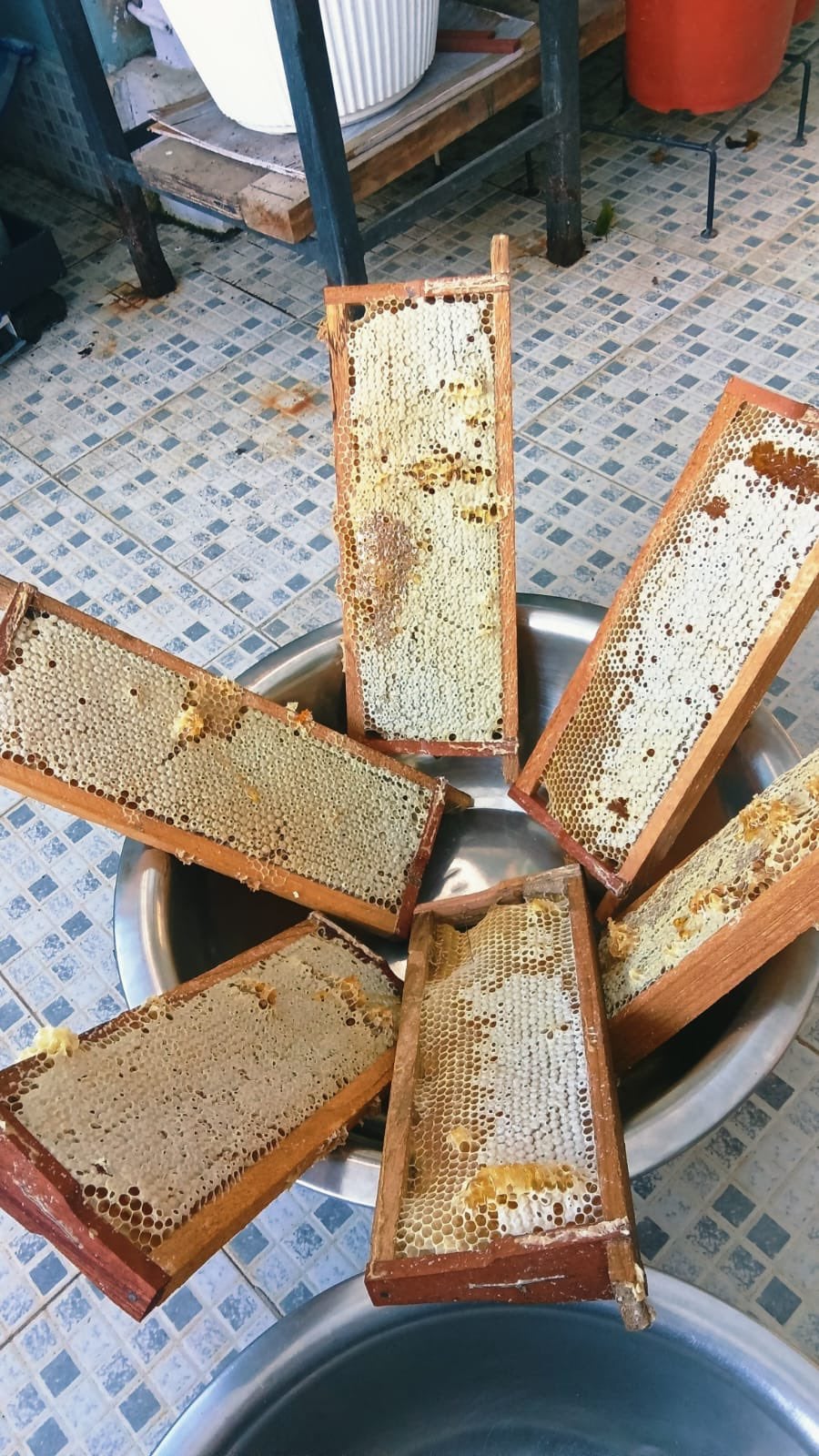
He harvests honey approximately three times a year. From a single bee box, the annual yield can reach around 8–10 litres, depending on the season and availability of flowers.
The honey is primarily meant for his family’s consumption. Since the activity has not been developed commercially, he has not focused on large-scale production or marketing.
However, the quality and interest among people have occasionally encouraged him to sell some of the surplus.
He revealed that he had sold honey once or twice when people approached him, charging approximately Rs 2,000 per litre.
For him, the satisfaction comes primarily from producing honey at home, knowing how it has been harvested and ensuring that the process remains clean.
Speaking about the current production, he said that he had already obtained around six litres during the year and expected another one to two litres.
He is also interested in gradually increasing the number of bee boxes. However, space remains a limitation, particularly because the boxes require suitable shaded locations.
Beyond Honey: Supporting Pollination and Agriculture
While honey is the most visible outcome of Sherpa’s initiative, its environmental contribution extends much further.
Honeybees play an essential role in pollination, helping flowering plants and crops reproduce. As they move from one flower to another in search of nectar, they transfer pollen and support the natural process that contributes to agricultural production.
Sherpa believes that maintaining honeybee colonies can therefore benefit not only his household but also surrounding vegetation and agricultural activities.
“My honeybees go to different fields and flowers. They contribute to pollination, which is also beneficial for farming and better agricultural production,” he said.
Unlike honey produced from a single flowering crop, the honey harvested in Gangtok can come from different varieties of flowers available in the surrounding areas.
IAS Sherpa describes it as multi-flower honey because the bees collect nectar from different flowering plants rather than depending on one particular crop.
Depending on the availability of flowers, the honey may carry characteristics associated with different floral sources.
He also pointed out that honeybees are important to the larger food system and that their disappearance would have serious consequences for agriculture and food production.

A Small Initiative with a Larger Message
M.T. Sherpa’s beekeeping experiment is not a commercial venture, nor does it involve a large investment or extensive infrastructure. It is essentially a personal initiative shaped by professional exposure, curiosity and a willingness to practise what one has encouraged through official responsibilities.
Yet, its significance lies in the larger message it conveys.
As an IAS officer currently serving as Commissioner-cum-Secretary in the Sikkim Government, Sherpa’s professional responsibilities involve public administration. But his interest in beekeeping demonstrates how individuals can pursue meaningful environmental practices beyond their official assignments.
His journey also highlights the possibility of adopting sustainable activities even in urban settings, provided suitable conditions and responsible methods are available.
From three bee boxes to one carefully maintained scientific box, his experience has taught him the importance of patience, observation and giving nature the space to function.
He now hopes to expand the activity whenever suitable space becomes available.
Ultimately, Sherpa’s story reminds us that meaningful environmental contributions do not always begin with large projects or ambitious investments. Sometimes, they begin with a simple thought: if an idea is worth promoting, why not practise it ourselves?
And from a modest balcony in Gangtok, one IAS officer is doing exactly that, turning a little curiosity into a sweet harvest while giving nature another reason to flourish.
Also Read: Bihar’s ‘Sweet Revolution’: Madhugram Women’s Honey Business Reaches ₹5.4 Crore Turnover