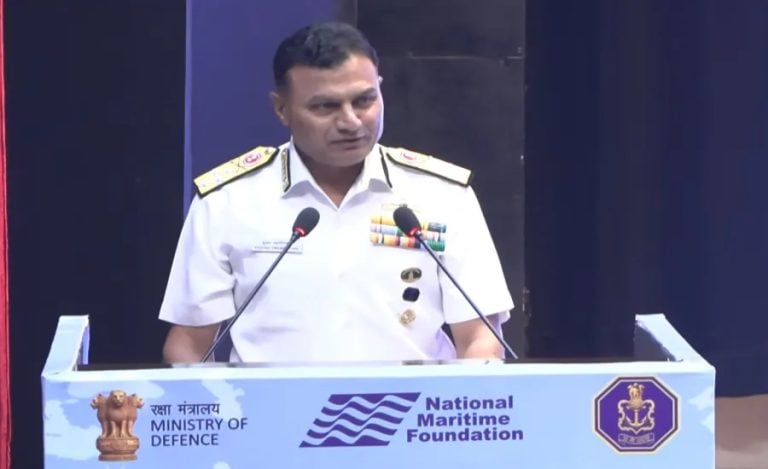
New Delhi: India’s indigenous warship-building programme has received a major boost after Navy Chief Admiral Krishna Swaminathan confirmed that all 49 ships currently on order are being constructed in Indian shipyards.
Speaking at the ANI National Security Summit 3.0 in New Delhi, he said the Indian Navy has moved from being a buyer of foreign-built warships to a builder of its own vessels. However, the Navy still depends on foreign suppliers for certain critical technologies, including marine propulsion systems, weapons and sensors. India now aims to achieve complete naval self-reliance by 2047.
Indian Navy Has 49 Indigenous Warships Under Construction
Admiral Krishna Swaminathan said that all 49 warships currently on order are being built in Indian shipyards. This reflects the growing strength of India’s domestic defence manufacturing industry.
Read also: India Unveils Ambitious ₹80,000 Crore Project-18 Warship Program for Naval Dominance
He also highlighted that the Indian Navy now operates more than 100 indigenous vessels. The Navy recently crossed an important milestone by commissioning its 100th indigenously designed and constructed ship.
According to the Navy Chief, India has already moved beyond its earlier dependence on foreign countries for building major naval platforms.
He described this transformation by saying that the Indian Navy is no longer a buyer’s navy but has become a builder’s navy.
India’s Indigenous Warship-Building Journey
India’s journey towards building its own warships started several decades ago. The Navy Chief recalled that India built its first indigenous warship in 1960. Later, the Central Design Office was established in 1964 to strengthen the country’s ability to design and develop naval vessels.
This organisation played an important role in developing India’s domestic warship design capabilities and eventually evolved into the present-day Warship Design Bureau.
One of the biggest achievements of this journey is INS Vikrant, India’s first indigenously designed and built aircraft carrier.
The aircraft carrier was commissioned into the Indian Navy in September 2022. It demonstrated India’s growing ability to develop complex naval platforms within the country.
India has also developed the capability to design and build nuclear-powered ballistic missile submarines domestically, placing it among a small group of countries with such capabilities.
Why Does The Indian Navy Still Depend On Foreign Technology
Despite major progress in domestic shipbuilding, complete defence self-reliance remains a challenge.
Admiral Swaminathan acknowledged that the Indian Navy still depends on foreign suppliers for several important technologies and equipment. These include:
- Marine Propulsion Systems: Advanced systems required to power naval ships.
- Weapons Systems: Certain specialised weapons and advanced combat technologies.
- Sensors: Modern systems used for detecting, tracking and monitoring potential threats.
- Critical Subsystems: Technologies and components that are not yet fully developed or manufactured in India.
These technologies are important for the operational capabilities of modern warships. Therefore, building a warship in India does not automatically mean that every system installed on it is also manufactured domestically.
Reducing this dependence will be an important part of India’s future naval modernisation programme.
Public And Private Defence Industries To Support Naval Self-Reliance
To address these technological gaps, the Indian Navy is working with the Ministry of Defence and India’s domestic defence industry.
Both public sector undertakings (PSUs) and private defence companies are expected to play important roles in developing advanced naval technologies.
The main objective is to create a strong domestic manufacturing ecosystem that can produce complex marine propulsion systems, weapons, sensors and other critical equipment.
This approach will also create opportunities for Indian defence manufacturers, research organisations and technology developers.
Greater domestic production could reduce dependence on foreign suppliers and strengthen India’s long-term maritime security.
Indigenous Warships: Indian Navy Targets 100% Self-Reliance By 2047
The Indian Navy has set an ambitious target of becoming a completely Aatmanirbhar force by 2047.
The goal is to develop the ability to design, manufacture and integrate all the major platforms, weapons, propulsion systems and other critical technologies required by the Navy within India.
The target also supports the government’s broader Aatmanirbhar Bharat initiative. Achieving this goal will require continuous investment in research, technology development, domestic manufacturing and cooperation between government organisations and private industries.
The Navy’s progress in indigenous aircraft carriers, submarines and frontline warships provides a strong foundation for this long-term ambition.
FAQs
The Indian Navy aims to become completely Aatmanirbhar by 2047, including developing its own critical naval technologies, weapons and propulsion systems.
According to Navy Chief Admiral Krishna Swaminathan, the Indian Navy has 49 ships currently on order, and all are being constructed in Indian shipyards.
The Indian Navy still depends on foreign suppliers for certain marine propulsion systems, specialised weapons, advanced sensors and other critical subsystems.