By Harvir Singh
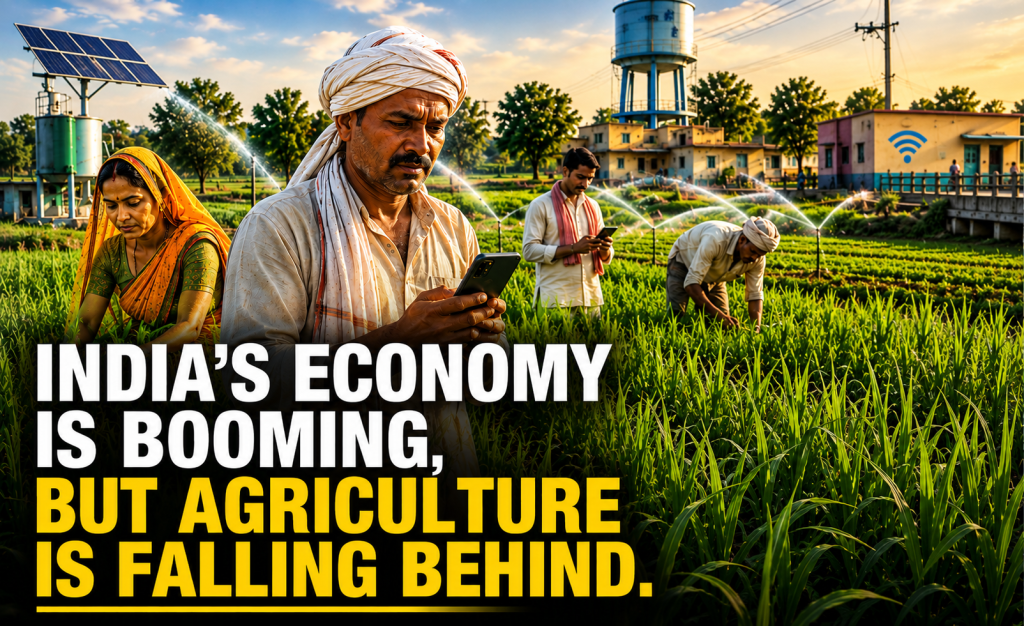
Despite a normal monsoon in 2025 and the government’s repeated claims of record agricultural production, India’s farm sector expanded by only 1.2 per cent in FY 2025-26, even as the overall economy grew by an impressive 7.7 per cent. The sharp contrast underlines a widening disconnect between India’s macroeconomic success and the ground realities of agriculture.
The current kharif season paints an even more troubling picture. Below-normal rainfall has delayed sowing, leaving cultivated acreage below last year’s levels. With most of the sowing window already over, the shortfall is now largely irreversible. The strengthening El Niño phenomenon has heightened concerns that the upcoming rabi season may also witness deficient rainfall, exposing farmers to another difficult production cycle.
Recent developments further highlight the fragile condition of Indian agriculture. The first concerns pulses, where India continues to face an annual production deficit of nearly six million tonnes, forcing the country to rely heavily on imports. The second indicator comes from the NABARD Rural Economic Conditions and Sentiments Survey (Round 12, July 2026), which reveals a significant deterioration in rural incomes. Only 27.7 per cent of rural households reported an increase in income over the previous year—the lowest level since the survey began in September 2024. While 52.6 per cent said their incomes remained unchanged, 19.8 per cent reported a decline. In effect, nearly three-fourths (72.4 per cent) of rural households saw no improvement in their earnings.
Weakening Rural Consumption
The survey also points to weakening rural consumption. The proportion of households reporting higher consumer spending fell to 74.1 per cent, only the second time it has slipped below 75 per cent. Rural families now spend 66.5 per cent of their monthly income on consumption and another 12.5 per cent on debt repayment. Savings have weakened sharply, with only 17.8 per cent of households reporting higher savings—the lowest reading since the survey began. At the same time, dependence on informal borrowing from relatives and moneylenders has increased, reflecting growing financial stress.
Read Also: The Organic Miracle: How Sikkim Became India’s First Organic State
Global developments have compounded domestic challenges. The Gulf conflict disrupted fertiliser supplies, causing shortages in several regions. Although the government imported urea at almost double last year’s prices, reports of scarcity continued despite official claims of comfortable stocks. Prices of non-urea and non-DAP fertilisers also rose, while several states resorted to indirect rationing. Simultaneously, higher global crude oil prices pushed up diesel costs, increasing cultivation expenses at a time when farmers were already struggling with erratic rainfall.
Although the government issued advisories and contingency plans to help farmers cope with below-normal rainfall, it refrained from providing direct financial assistance. Reduced rainfall has not only curtailed sowing in many regions but has also raised cultivation costs where planting has taken place. Acreage under pulses, oilseeds and cotton has declined significantly, while the area under paddy and coarse cereals has also contracted, raising concerns over food inflation.
Deeper Structural Weaknesses
Several commodity-specific developments reflect deeper structural weaknesses. Sugar production has fallen below domestic consumption, leading to export restrictions and stock limits. Cotton presents an even more striking example. Imports have crossed one million tonnes, while domestic production has fallen to around 29.2 million bales, compared with more than 39 million bales nearly a decade ago when India was a major exporter. Policy shortcomings and inadequate support have gradually transformed India into a significant cotton importer.
The government’s broader policy approach has also come under scrutiny. The latest Union Budget provided little additional support to agriculture. Allocation for agricultural research was reduced, no major flagship programme was announced, and since the 2020-21 farmers’ agitation, the government has largely avoided major legislative or policy reforms in agriculture. Although nearly 10,000 Farmer Producer Organisations (FPOs) were promoted, a substantial number are now either inactive or financially distressed.
Farmers’ Income Ignored
Another concern is that official discussions around weak monsoons and El Niño have largely focused on the risk of food inflation rather than on farmers’ declining incomes. Meanwhile, increases in Minimum Support Prices (MSP) for kharif crops have remained modest—₹72 per quintal for paddy, ₹10 for maize and ₹12 for moong—far below the rise in cultivation costs, providing little incentive to farmers.
Indian agriculture today faces a structural paradox. While surplus production in some crops depresses farm-gate prices, the country continues to rely heavily on imports of edible oils, pulses and cotton. The government’s 2016 promise to double farmers’ incomes within five years remains unfulfilled and rarely features in official discussions.
Some economists compare the present situation with the 1991 economic crisis and advocate sweeping reforms. However, many proposals remain confined to market liberalisation and subsidy rationalisation, overlooking the sector’s deeper structural problems. The real issues are stagnant productivity, rising input costs, climate vulnerability and the persistent inability to improve farmers’ incomes.
The Suggestions
To strengthen the agricultural sector, the government must formulate a comprehensive, long-term policy. This policy needs to focus on everything from allocating greater resources for developing new crop varieties to prioritizing climate-resilient crops. At the same time, major reforms are needed on the marketing front so that farmers can secure better prices for their produce.
Apart from paddy and wheat, the government typically steps in for other crops only when market prices plunge below the Minimum Support Price (MSP) or when farmers take to the streets in protest. This clearly demonstrates the absence of a robust framework to prevent severe price drops, leaving everything dependent on ad-hoc, temporary relief.
Similarly, for domestic farmers to benefit from global markets, there must be a balanced alignment between domestic production, market dynamics, and export policy. Instead, key decisions are made by the Ministry of Consumer Affairs and the Ministry of Commerce without any meaningful dialogue with the primary stakeholders—the farmers—even though export bans or cheap imports hit farmers the hardest.
(Author is Editor-in-Chief of RuralVoice.com and is an expert in Agri-economy)
Also Read: From Aravallis to Sundarbans: The Officers Fighting to Save India’s Most Fragile Ecosystems