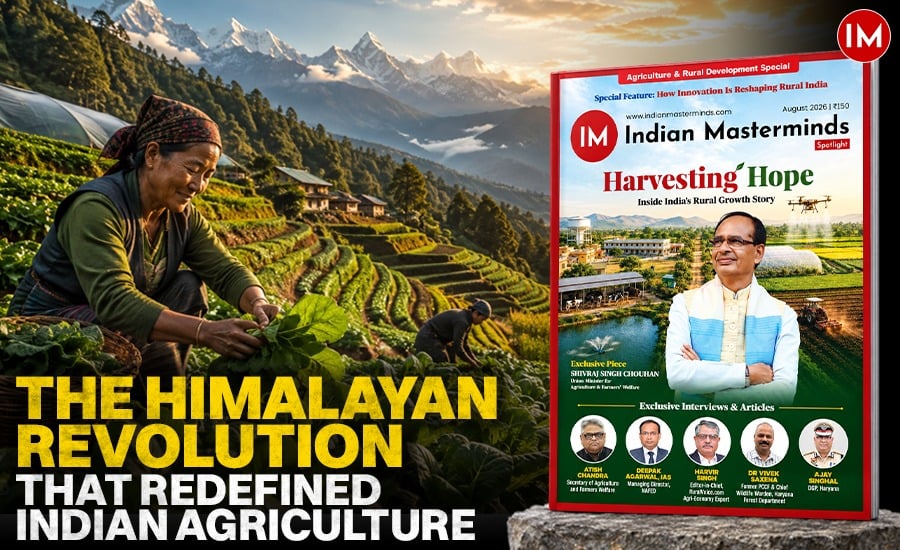
For decades, India’s agricultural success was measured by one number alone—production. The Green Revolution transformed the country into one of the world’s largest food producers through chemical fertilisers, pesticides and high-yielding crop varieties. While this ensured food security for millions, it also left behind depleted soils, polluted water sources, declining biodiversity and rising cultivation costs. As most states continued to rely on chemical-intensive farming, one small Himalayan state chose a different path.
Nestled in the Eastern Himalayas with a population of barely seven lakh people, Sikkim envisioned an agricultural future where farming worked in harmony with nature. What initially appeared to be an impossible experiment gradually became one of India’s finest governance success stories. Today, Sikkim is recognised as India’s first fully organic state and among the first regions in the world to achieve complete organic certification. While Lakshadweep has also achieved 100% organic certification, Sikkim remains the pioneer that proved an entire state’s farming system could successfully transition to organic agriculture.
THE DECISION THAT CHANGED SIKKIM
The journey began in 2003 when the Government of Sikkim, led by then Chief Minister Pawan Kumar Chamling, announced a bold vision—to convert the entire state into an organic farming region. Unlike other states that experimented with selected districts, Sikkim decided that every farmer, village and cultivable field would eventually become organic.
The objective extended beyond agriculture. The policy sought to protect the fragile Himalayan ecosystem, preserve biodiversity, improve public health and create sustainable livelihoods. Since Sikkim had traditionally used relatively low quantities of chemical fertilisers, policymakers believed the transition, though difficult, was achievable.
Also Read – From Aravallis to Sundarbans: The Officers Fighting to Save India’s Most Fragile Ecosystems
SUPPORT BEFORE RESTRICTIONS
The government adopted a gradual approach. It first withdrew subsidies on chemical fertilisers before progressively restricting and eventually banning synthetic fertilisers and pesticides.
Farmers were simultaneously trained in composting, vermiculture, green manuring and biological pest control. Extension officers worked closely with farming communities, explaining the long-term benefits of healthier soils, lower input costs and premium prices. Farmers became partners in the transition rather than passive beneficiaries.
THE YEARS OF UNCERTAINTY
The shift was not easy. Crop yields declined in several areas during the initial years as soils recovered from chemical dependence. Many farmers feared lower incomes, while critics questioned whether a statewide organic model could survive.
Instead of reversing course, the government expanded technical support, farmer training and market linkages. Officials recognised that organic farming required an entire ecosystem—including certification, marketing and institutional support—not merely the removal of chemicals.
Gradually, healthier soils, reduced cultivation costs and improved market prices restored farmers’ confidence.
BUILDING CREDIBILITY THROUGH CERTIFICATION
Sikkim undertook one of India’s largest organic certification exercises. Thousands of small farms had to be inspected, cultivation practices documented and farmers trained to comply with organic standards.
By 2015, nearly 76,000 hectares of cultivable land had received organic certification. In January 2016, Prime Minister Narendra Modi officially declared Sikkim India’s first fully organic state, marking the culmination of more than a decade of sustained policy implementation.
MORE THAN AGRICULTURE
Organic farming soon became part of Sikkim’s identity. Organic villages, farm tourism and local food experiences attracted visitors from across India and abroad. Products such as large cardamom, ginger, turmeric, vegetables and medicinal plants gained premium market value because of their certified organic status.
Environmental benefits also became visible. Soil fertility improved, rivers remained cleaner due to the absence of chemical runoff, and pollinators and beneficial insects gradually returned.
In 2018, the Food and Agriculture Organization (FAO) honoured Sikkim with the prestigious Future Policy Gold Award, recognising it as one of the world’s finest examples of sustainable agricultural policy.
CAN THE REST OF INDIA FOLLOW?
India has made steady progress in organic farming, but Sikkim remains an exception. As of 2026, around 5.39 million hectares, or 3.4% of India’s cultivable land, is under organic cultivation. Although the Centre aims to increase this to 10%, certified organic farming remains concentrated in a few states.
Madhya Pradesh leads the country with over 26% of India’s certified organic area, followed by Maharashtra (22%), Gujarat (15%), Rajasthan (13%) and Karnataka, known for organic coffee, spices and horticulture.
States such as Uttarakhand, Himachal Pradesh, Kerala, Mizoram and Andhra Pradesh have launched ambitious organic or natural farming programmes. However, none has yet replicated Sikkim’s complete statewide organic transformation, highlighting that organic farming requires sustained political commitment, farmer confidence, certification systems and long-term administrative continuity.
THE LESSON FOR INDIA
Sikkim’s relatively small size and traditionally low use of chemical fertilisers certainly helped. More importantly, political leadership remained committed to the vision for over a decade, while the government continuously invested in farmer education, technical guidance and institutional support.
Nearly two decades later, Sikkim stands as one of India’s finest examples of governance-led agricultural transformation. As climate change, soil degradation and rising cultivation costs challenge Indian agriculture, the Himalayan state offers a simple but powerful lesson: sustainable farming is built not by adding more chemicals, but by restoring healthy soils, empowering farmers and creating institutions that support them over the long term.
Also Read – Why the Rhododendron Is More Than Just a Beautiful Himalayan Flower