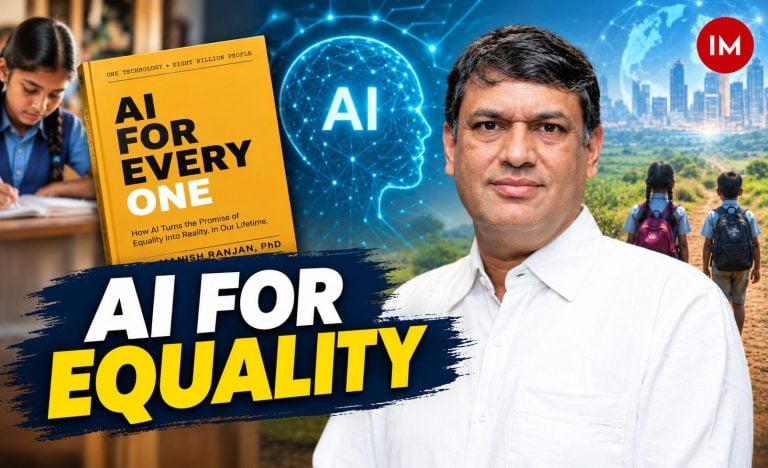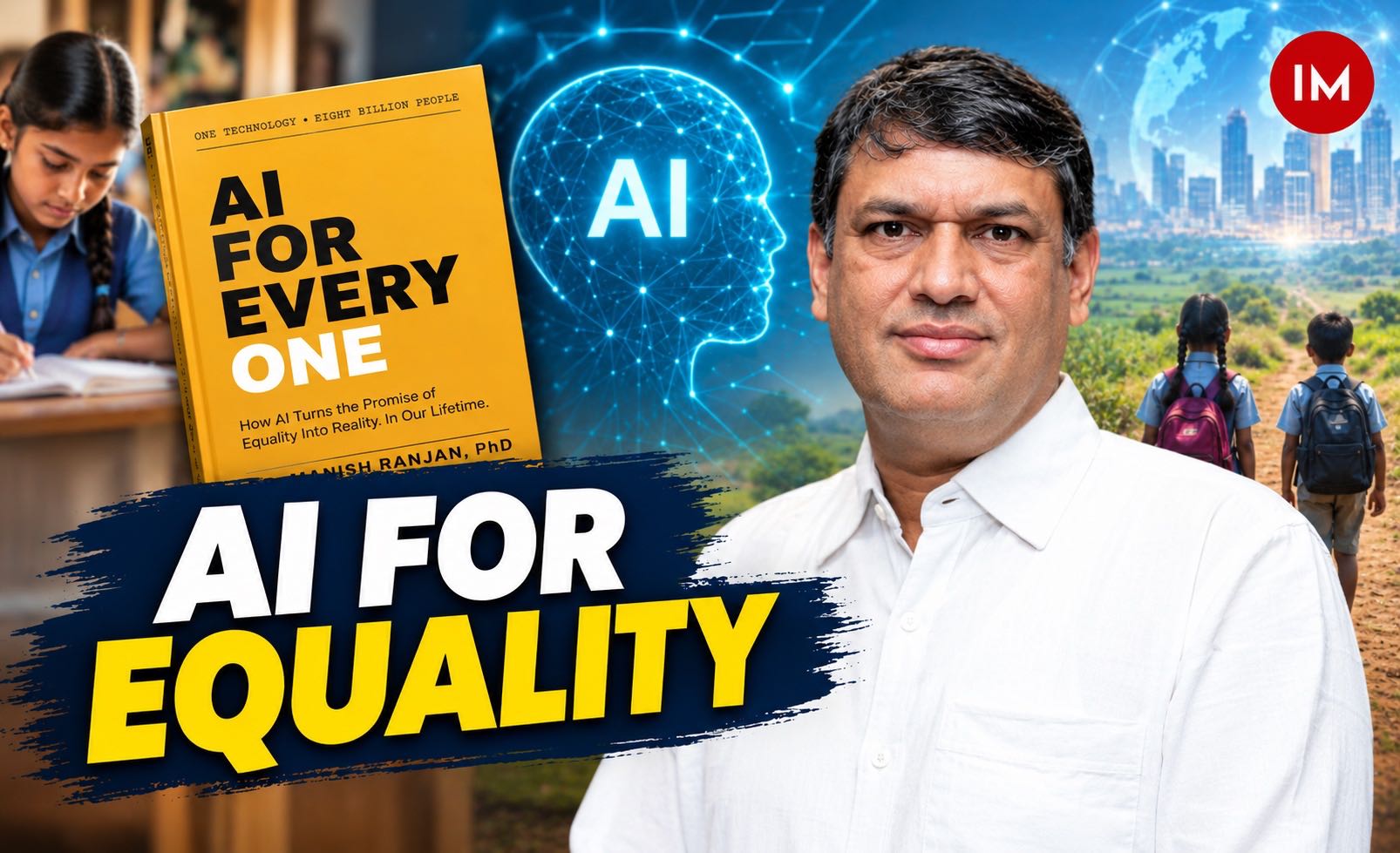
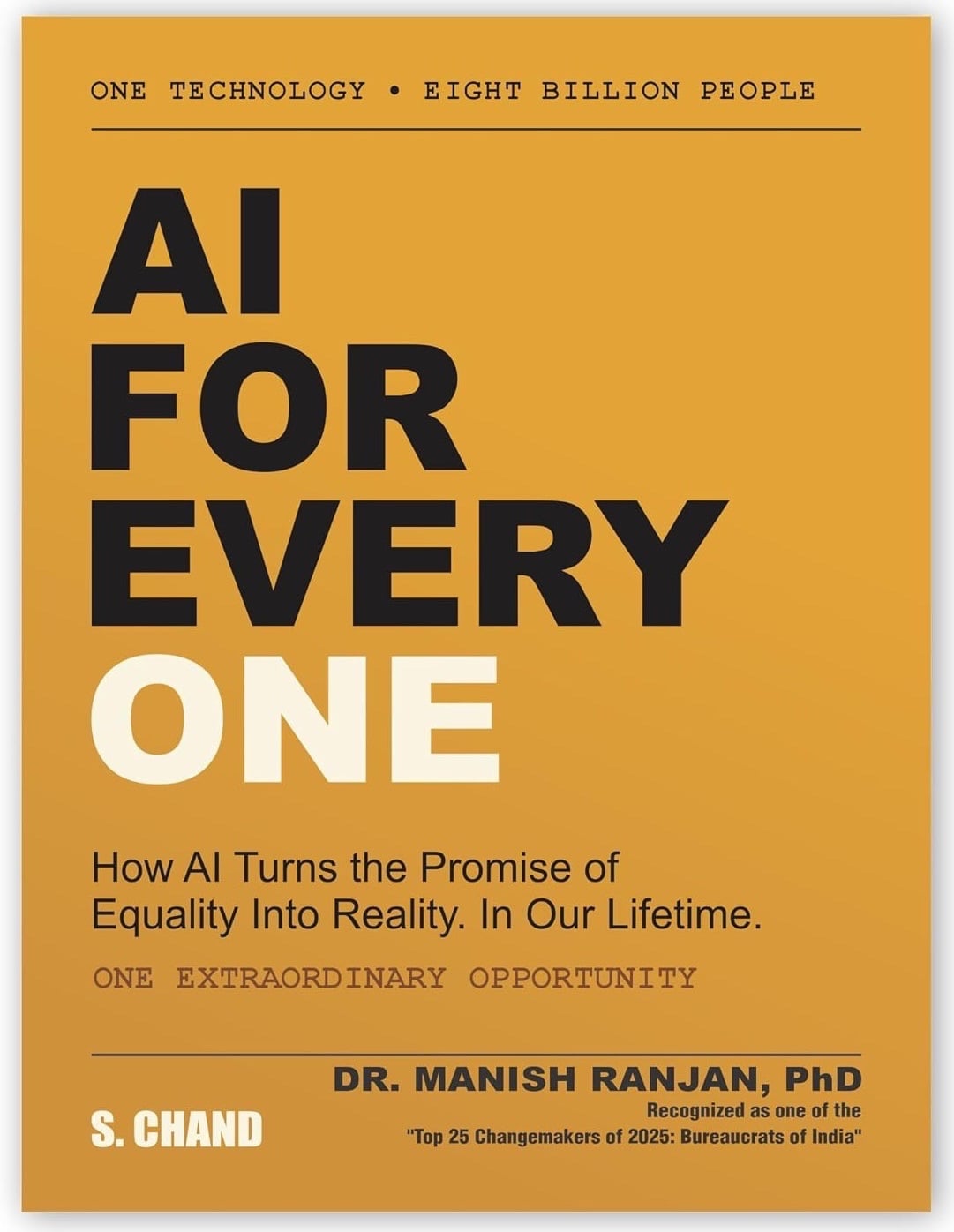
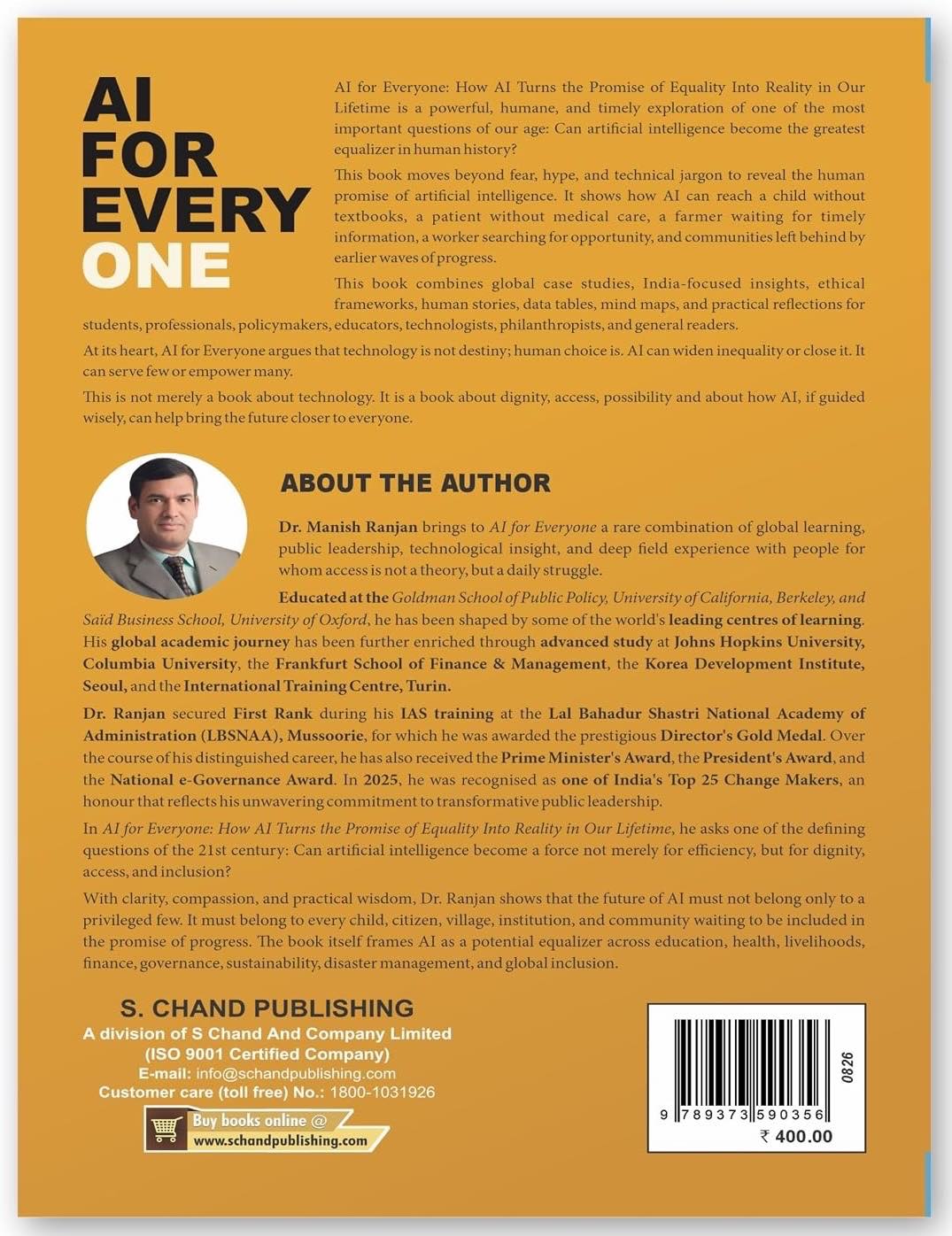
Two children, born into different worlds, may have the same dreams but vastly unequal opportunities. While one learns with the help of an AI tutor in a well-connected city, another struggles in a classroom where even internet access remains a distant possibility. This contrast lies at the heart of ‘AI for Everyone: How AI Turns the Promise of Equality into Reality in Our Lifetime’, a book by 2002 batch IAS officer from the Jharkhand cadre, Dr. Manish Ranjan that explores how artificial intelligence can bridge the divides in education, healthcare, livelihoods and access to opportunity.
Drawing on global case studies and ground realities, Dr. Ranjan examines how AI can bring quality education to remote classrooms, improve healthcare access, help farmers make informed decisions, overcome language barriers and extend financial services to underserved communities. The book also addresses the darker side of this technological revolution, including algorithmic bias, deepfakes, data theft and the risks of unequal access.
In an interaction with Indian Masterminds, Dr. Ranjan discusses the inspiration behind the book, AI’s implications for India’s governance and society, and the changes it could bring in the coming years. His central message is clear: technology alone cannot eliminate inequality; the real challenge is ensuring that AI serves everyone, not just those who already have access to opportunity.
Q. What inspired you to write AI for Everyone? Was there a particular experience during your administrative career that shaped this idea?
Ans – It began with a notebook.
Some years ago, I visited a small government school in Ulihatu, the village in Khunti where Dharti Aba Birsa Munda was born. A girl of about ten shyly showed me her notebook. She had drawn the solar system with great care. The sun in the middle. The planets around it. And beside the Earth, in her own handwriting, she had written: “This is our home.”
I kept looking at that page. The talent was there. The curiosity was there. What was missing was everything else. No internet. Too few books. One teacher for too many children.
In another village school, on a rainy monsoon day, I met a girl copying a whole chapter on the solar system by hand. I asked her why. She said there were only three books and sixteen children wanted to read it. She would study her copy at home, by candlelight.
Read Also: Project Cheetah’s Untold Story: The Negotiations, Challenges and Diplomacy Behind the Mission
I have sat through many policy meetings since then. I have never been able to forget her.
But the seed of this book was planted earlier, in Hazaribag. As district collector, I piloted Aadhaar enrolment in Churchu and Katkamsandi blocks before Aadhaar was formally rolled out in the country. We held camps in villages where many people had no paper at all to prove who they were. I remember an elderly man holding his enrolment slip with both hands, the way people hold a land record. For the first time in his life, the system could see him.
That taught me a lesson I carry to this day. Technology is never really about machines. It is about who gets seen and who gets missed.
When AI arrived, I asked the same question I had asked in those camps. Whom will it see? Whom will it miss? This book is my answer.
Q. Why did you open the book with Priya from rural Jharkhand and Leo from Helsinki, who have similar dreams but unequal access to technology?
Ans – Because the biggest things in a child’s life are decided before the child can choose anything.
Priya lives in Torpa, a village among the sal forests of Khunti. Leo lives in Helsinki. Both are ten. Both dream of the stars, of science, of making their parents proud. Priya walks three kilometres to a two-room school with no internet. Leo is greeted at breakfast by an AI tutor that remembers yesterday’s fractions.
Neither of them chose this. That is the whole point.
I did not want to open with numbers. A reader forgets “2.2 billion people offline” by the next page. A reader does not forget a ten-year-old tying her worn canvas shoes at six in the morning.
And Priya is not imaginary to me. I have met her many times. In school inspections in Garhwa, in Deoghar, in Hazaribag. Different names. The same bright eyes. The same patience that should never have been needed.
I chose Leo with equal care. He is not the villain. Finland is not the problem. Leo shows us what becomes possible when a society decides that every child deserves good teaching. So the question is simple. Why should Torpa wait fifty years for what Helsinki has today?
The book ends with the two of them reaching across the wall and shaking hands. That handshake is the whole idea of the book.
Q. Why do you view AI through the lens of equality and opportunity rather than just technological progress?
Ans – Because progress that reaches only a few is not progress. It is privilege moving faster.
Every district collector knows the public hearing day. People line up from early morning with their petitions. Over the years, I noticed something about that line. The poorest were often not in it. A widow whose pension had stopped could not afford a day’s lost wages and the bus fare to reach the district headquarters. The people who most needed the government were the ones least able to reach it.
Technology has the same habit. It serves the front of the queue first. Electricity, the telephone, the internet. Each reached the cities first, the villages later and the poorest last. If AI follows that old path, it will widen every gap that India has worked for seventy years to close.
But AI has one quality no earlier technology had. Once built, it can be copied a billion times at almost no cost. A good teacher is scarce. A good doctor is scarce. Good advice is scarce. AI can make these things plentiful. That is why I see it first as a question of equality.
In Hazaribag, I worked to promote the Sohrai and Khovar mural art of village women. Today, it carries a GI tag. Their talent was world-class. Their market was a middleman. Now imagine those same women using an AI tool that writes about their work in French and Japanese, prices it fairly and finds buyers abroad. Same talent. A much wider door.
So I judge AI by one old Indian test: Sarvajana Hitaya. For the benefit of all. Does this tool serve everyone, or only some?
Q. You argue that AI is not automatically the great equaliser. What does this mean for India in practical terms?
Ans – A tool has no conscience of its own. It carries the priorities of those who build it, fund it and deploy it.
In the book, I tell the story of a school in northern Ghana that received a crate of new tablets from a foreign charity. There was a ceremony and a photograph. Then the tablets were locked in a cupboard because there was no internet for forty kilometres. I have seen the Indian version of that story more than once. A computer room in a rural school, the machines still under plastic covers, because there was no power connection or no trained teacher. Equipment arrived. Opportunity did not.
For India, I see five practical tests.
First, language. AI must speak Santhali, Ho, Mundari and Kurukh, not only English and Hindi. A tribal woman should be able to speak to a government service in her own tongue and be understood. Bhashini is a strong start.
Second, the last mile. A fibre point at the panchayat office is not the same as a working classroom or a health centre that is online every day.
Third, women. In many rural homes, there is one phone, and it is in the man’s pocket. If we do not plan for this, AI will reach half the family.
Fourth, data. If the poor are missing from the data, they will be missing from the decisions. Indian data can quietly carry caste through surnames, addresses and occupations. We must test for that.
Fifth, a human who answers. No citizen should ever hear the words “the computer has rejected you” and have nowhere to go.
India has a real advantage. We have already built the rails: Aadhaar, Jan Dhan, UPI, DIKSHA. Now AI must run on those rails for everyone, not only for those already on the train.
Q. What is the one key message you want readers to take away from your book?
Ans – AI is not the great equaliser by itself. The great equaliser is the human decision to make AI serve everyone.
Think of a car. It can take a sick child to hospital. It can also run someone over. The car does not decide. The driver does. AI is the fastest car humanity has ever built. It needs brakes, rules and a driver who cares where it is going.
Technology is not destiny. Choice is.
In the book, I describe two possible mornings in 2030. In one, Priya is building her own AI tool to help farmers detect crop disease. In the other, she has left school to work in a factory because the AI tutor that could have helped her became a paid service she could not afford. The technology is the same in both futures. Only our choices are different.
So my message is for everyone who holds a small piece of that choice. The officer who designs a scheme. The teacher who tries a new tool. The parent who believes a village child deserves what a city child gets. The young person who builds something for their own community.
The girl in Jharkhand is waiting. She has been patient long enough.
Q. Can AI bridge India’s digital divide, or must we first address basic gaps in connectivity, electricity and digital literacy?
Ans – We have to do both, together. Not one after the other.
If we wait for perfect connectivity before bringing AI to villages, we will wait for decades. And it is always the poor who pay for waiting. If we push AI without the basics, we get tablets locked in cupboards. The only sensible path is to build the road and run the bus at the same time.
India has made real progress. Our mobile data is among the cheapest in the world. Rural internet subscribers rose from about 115 million in 2016 to more than 400 million by 2024. BharatNet has reached over two lakh gram panchayats. But a signal is not the same as a skill.
Here is the part that gives me hope. AI is the first technology that can come to people in their own language instead of asking them to learn its language. A woman who cannot read can now speak to a phone and be understood. In the book, Lakshmi, a Gondi-speaking woman from Bastar, speaks her request into an app and, for the first time, does not need her nephew to speak for her. Voice can jump over the literacy wall.
Electricity is no longer the barrier it once was. Solar power is cheap. Many AI tools can now run on a phone even without the internet.
Digital literacy needs people more than programmes. In Jharkhand, I learnt that the last mile is rarely a cable. It is a person. The ASHA worker. The anganwadi sevika. The young operator at the Common Service Centre. Train them well and they will carry AI into every home.
So yes, AI can help bridge the divide. But only if we lay the bridge from both banks.
Q. How can we address AI-related risks such as job losses, algorithmic bias, deepfakes and data privacy?
Ans – By keeping a human captain on the ship. Let me take each risk in turn.
Jobs. AI will remove some jobs, change most jobs and create new ones. The World Economic Forum expects about 170 million new jobs and about 92 million lost by 2030. The real danger is not mass unemployment. It is that retraining will reach the already skilled and skip everyone else. In the book, Ajay, a factory inspector near Pune, feared he would lose his job to an AI camera. Instead, his company retrained him to supervise it. That should be the rule, not the lucky exception. Skilling must reach the small town and the small trader, not only the metro engineer.
Bias. In government, a wrong entry in a register can keep a family out of a scheme for years. An algorithm can make that same mistake for a million families in a second. In India, bias can hide in a surname, a PIN code or a language. So every AI system used for public decisions must be tested for fairness before it is switched on, and every citizen must have a human to appeal to.
Deepfakes. As a district magistrate, I learnt that a rumour travels faster than any police jeep. During a big fair or a tense festival, one false message can gather an angry crowd in minutes. What worked was speed and trust. Put out the truth first, in the local language, from a face people know. Deepfakes make the rumour far more convincing, so we need clear labelling of AI content, quick takedowns, fact-checking in Indian languages and a habit every citizen can learn: pause before you forward.
Privacy. During the Aadhaar pilot in Hazaribag, poor families gave us their fingerprints and their trust. I never forgot how much that trust weighed. Data is a person’s treasure. The Digital Personal Data Protection Act now gives Indians legal rights over their data. Our job is to make those rights real for someone who has never read a privacy policy and never will.
In each case, the principle is the same. The machine may advise. A human must decide, and a human must answer.
Q. What major changes do you foresee AI bringing to our lives, society and governance in the coming years?
Ans – In our daily lives, AI will become as ordinary as electricity. Every child with a phone will have a tutor that never gets tired. Every ASHA worker will carry tools that can pick up early signs of illness. Every farmer will get weather and crop advice in her own language, about her own field. Help that was once rare will become common.
In society, the biggest change will be in work and in truth. Many jobs will be reshaped. Human judgement, empathy and creativity will become more valuable, not less. At the same time, seeing will no longer be believing. Every family will need the habit of checking before trusting.
In governance, I expect the deepest change of all.
When I joined the service, the citizen had to come to the government. He came with an application, a photocopy and a lot of patience. A file moved at the speed of its slowest table. In the coming decade, the government will increasingly go to the citizen. An old-age pension could begin without anyone applying for it. Crop loss could be assessed from satellite images before the farmer even files a claim. A grievance written in Santhali could be read, understood and sent to the right officer in seconds.
This will change the officer too. I have written that the steel frame must now learn silicon. I believe every training institute, including the one I lead, must make AI literacy as basic as drafting a note or reading a file.
But some things must never change. Compassion cannot be automated. Accountability cannot be outsourced. On the Hudson River in 2009, it was a human pilot, not an autopilot, who brought 155 people home safely. Governance will be the same.
The future will not be written by machines. It will be written by the hands that guide them.
About IAS Manish Ranjan
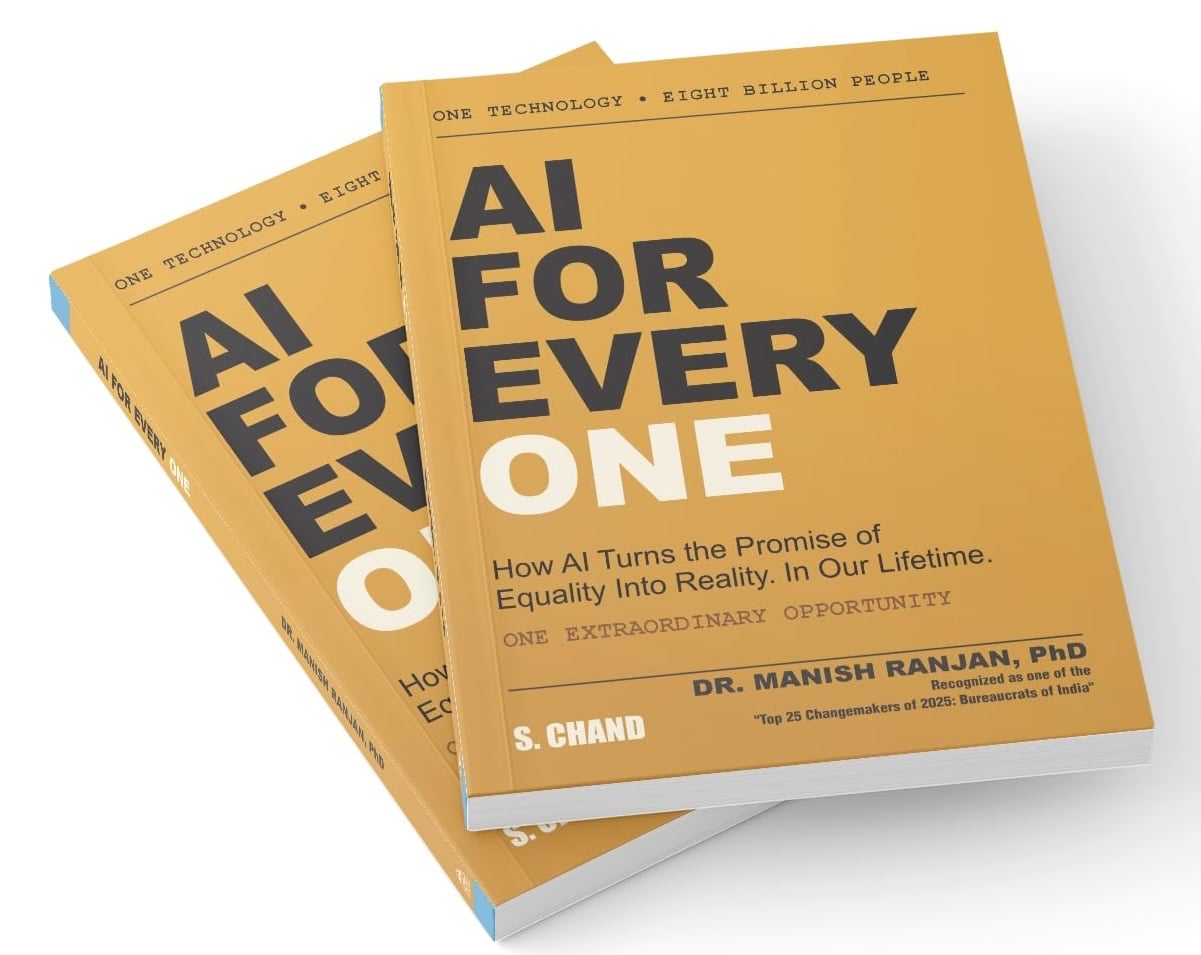
Dr. Manish Ranjan is an IAS officer and the author of eight books on Artificial Intelligence. A recipient of the Prime Minister’s Award and the National e-Governance Award, he studied at the Goldman School of Public Policy, UC Berkeley, and Saïd Business School, University of Oxford.
Recognised as one of India’s ‘Top 25 Changemakers of 2025’, he is currently serving as Director General of the State Administrative Training Institute in Ranchi, Jharkhand. He has previously served as District Magistrate, Divisional Commissioner and Secretary of various government departments. He writes frequently on technology, governance and Indian Knowledge Systems. Views are personal.