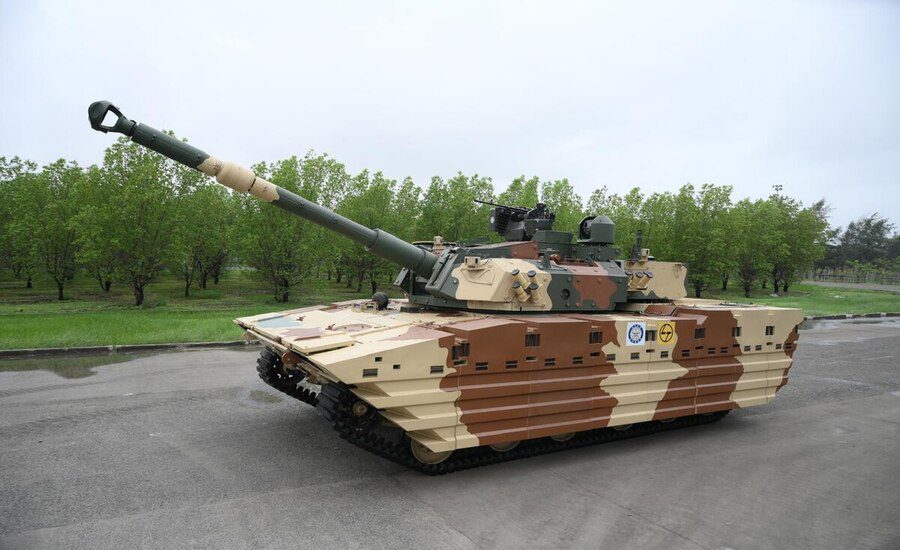
New Delhi: India’s Zorawar light tank programme faces a major challenge as the Indian Army seeks stronger armour to improve crew safety against modern battlefield threats. However, the additional protection could increase the tank’s weight, reduce its mobility in mountainous areas and require changes to its engine. These challenges may delay its induction into the Indian Army until 2028–29.
The tank is being developed by the Defence Research and Development Organisation (DRDO) in partnership with Larsen & Toubro (L&T) for operations in high-altitude regions along India’s northern borders.
Indian Army Wants Better Protection For Zorawar Tank
The Zorawar was designed as a lightweight armoured vehicle for mountain warfare. Its main purpose is to help Indian forces operate more effectively in areas such as eastern Ladakh, where steep slopes, narrow roads and thin air create serious challenges for military vehicles.
Read also: The Real Reason Behind Indian Army is Not Procuring This Lethal Tank
According to reports, the Army is seeking a higher level of armour protection than the tank’s original configuration. The proposed changes aim to improve its ability to protect the crew against powerful ammunition and other battlefield threats.
The challenge is to add stronger protection without making the tank too heavy for its intended role. Additional armour can improve survivability, but it can also affect speed, acceleration and the ability to climb steep mountain roads.
Zorawar Tank Weight Could Increase To 30–32 Tonnes
The Zorawar was initially designed around a combat weight of approximately 25 tonnes. This relatively low weight is important because the tank must operate in difficult Himalayan terrain and remain suitable for air transport.
Reports indicate that the Army is seeking protection corresponding to STANAG 4569 Level 6, compared with the reported Level 4 protection of the initial configuration.
Meeting the proposed requirement could involve additional armour and advanced protection systems. These changes could increase the tank’s combat weight to around 30–32 tonnes, although the final configuration has not been publicly confirmed.
The extra weight would create a difficult engineering problem for the developers. They must improve protection while preserving the mobility that makes the Zorawar different from India’s heavier main battle tanks.
Engine Upgrade Could Become Necessary
The Zorawar’s initial configuration uses a Cummins diesel engine rated at approximately 760 horsepower. At a weight of 25 tonnes, this gives the tank a power-to-weight ratio of about 30 horsepower per tonne.
The power-to-weight ratio measures how much engine power is available for each tonne of vehicle weight. A higher ratio generally helps a tank accelerate and climb slopes, although actual performance also depends on transmission, suspension, track design and other factors.
If the tank’s weight increases to 30–32 tonnes while retaining the same engine, its power-to-weight ratio would fall to approximately 24–25.3 horsepower per tonne.
This reduction could affect acceleration and hill-climbing performance, particularly in high-altitude areas where engines face additional operating challenges.
Developers may therefore need to examine a more powerful engine or other improvements to the powerpack. Any major change would require further integration work and testing before the modified tank could be accepted for service.
Why Mountain Mobility Is Important For The Indian Army
The Zorawar programme was accelerated after the 2020 India-China border confrontation in eastern Ladakh. The deployment of China’s Type 15 light tanks highlighted the need for an Indian armoured platform designed specifically for mountainous terrain.
India’s existing T-72 and T-90 tanks offer substantial firepower and protection. However, their greater weight can create logistical and mobility challenges in some high-altitude locations.
The Zorawar is intended to fill this capability gap by combining a relatively lightweight design with modern weapons, protection and surveillance systems.
Its mobility is especially important along the Line of Actual Control (LAC), where military forces must operate across difficult terrain and maintain the ability to move equipment quickly.
Adding armour is therefore not simply a matter of increasing protection. The Army and developers must ensure that the tank can still perform its intended role in the mountains.
Chinese Type 15 Light Tank Provides A Comparison
China’s Type 15 light tank provides a useful comparison for understanding the challenges facing the Zorawar. The Chinese tank is reported to weigh approximately 33–36 tonnes, depending on its configuration, and uses an engine rated at around 1,000 horsepower. It also carries a 105 mm main gun.
Its higher engine output helps compensate for its greater weight. However, India cannot simply copy the same design because the Zorawar must meet India’s own operational and transport requirements.
The Indian Army wants a tank that can operate in high-altitude regions while remaining practical to move and support. The Indian Air Force’s C-17 Globemaster III transport aircraft is an important part of this requirement.
The final design must therefore balance armour protection, engine power, battlefield performance and transportability.
DRDO And L&T Developing The Zorawar Tank
The Zorawar is being jointly developed by DRDO and Larsen & Toubro. DRDO is responsible for the indigenous defence development effort, while L&T is the industrial partner involved in building and integrating the platform.
The tank is equipped with a 105 mm main gun mounted in a Cockerill 3105 turret. Its design is intended to provide the Indian Army with a combination of firepower, mobility and protection for mountain operations.
The programme has progressed through prototype development and testing. The tank has also undergone high-altitude trials in Ladakh at elevations exceeding 4,200 metres, according to reported programme information.
These trials are important because the vehicle must demonstrate that its engine, weapons and other systems can operate reliably in challenging conditions. However, if the Army’s protection requirements lead to substantial design changes, the modified configuration may need additional trials before it can enter operational service.
Indian Army Plans To Procure 354 Light Tanks
The Indian Army’s planned requirement is for a total of 354 Zorawar light tanks. The programme is intended to strengthen India’s armoured capabilities in mountainous areas and reduce dependence on heavier vehicles for certain missions.
The first 59 tanks are being developed by DRDO and L&T. Reports indicate that Tata Advanced Systems has emerged as the lowest bidder for the remaining 295 tanks, with Mahindra Defence Systems also involved in the procurement competition.
The final procurement process, production arrangements and configuration decisions will be important in determining how quickly the Army receives the complete fleet.
One possible approach is phased induction. Under this approach, an initial batch could enter service with an earlier configuration, while later tanks receive additional protection and other improvements.
Such an approach could help the Army begin building its light-tank capability without waiting for every planned upgrade to be completed. However, the final implementation will depend on the government’s procurement decisions and the Army’s acceptance requirements.
Zorawar Tank Induction May Be Delayed Until 2028–29
The Zorawar was previously expected to be ready for induction earlier, but its development schedule has changed as testing and design requirements have evolved.
In June 2026, Army Chief General Upendra Dwivedi said that induction was likely during 2028–29, subject to the successful completion of trials, user evaluation and production readiness.
The reported demand for stronger armour adds another challenge because major changes can require fresh engineering work and validation.
An engine upgrade, if required, could add further time to the programme. Developers would need to ensure that the heavier tank can maintain acceptable performance under high-altitude conditions.
The final timeline will depend on the outcome of development work, the Army’s evaluation and the readiness of the production system.
Read also: Army Chief Confirms Zorawar Light Tank Delay: What It Means for India’s Border Security
FAQs
The induction timeline may be affected by the Army’s demand for stronger armour, possible weight increases, potential engine changes and additional testing. The Army Chief indicated in June 2026 that induction was likely in 2028–29, subject to successful trials and production readiness.
The Zorawar is an indigenous Indian light tank being developed by DRDO and Larsen & Toubro for the Indian Army. It is designed for high-altitude operations and mountainous terrain, particularly along India’s northern borders.
The Indian Army plans to procure 354 Zorawar light tanks. DRDO and Larsen & Toubro are developing the first 59 tanks, while the remaining 295 are subject to the procurement process.