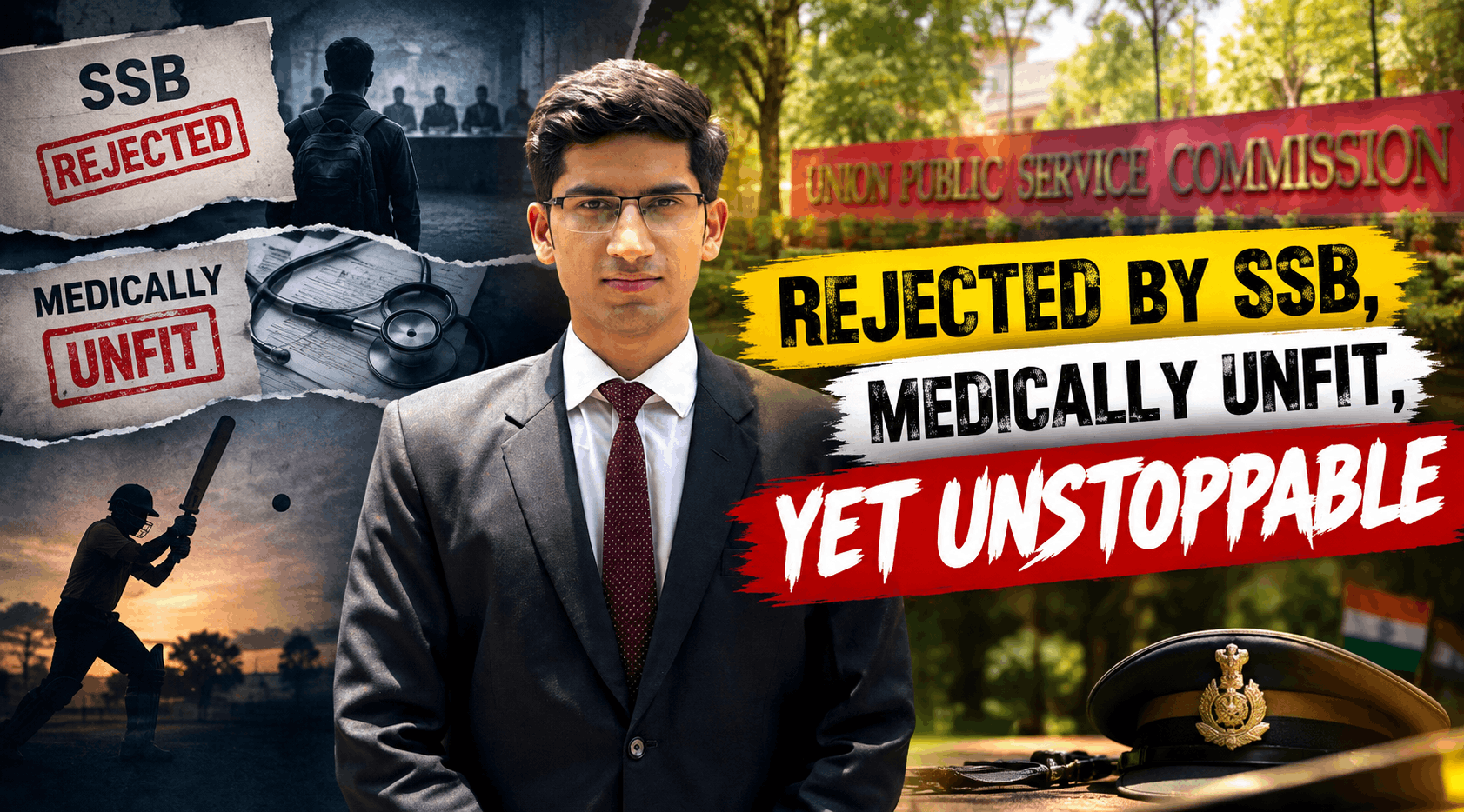
Aayush Sharma’s journey to becoming a CAPF Assistant Commandant was not built on one successful attempt. It was shaped by years of rejection, repeated examinations, medical setbacks, and the discipline he first learnt on the cricket field.
From Rait village in Kangra, Himachal Pradesh, Aayush secured All India Rank (AIR) 135 in the CAPF AC 2025 examination. What makes the achievement particularly remarkable is that he scored 125 marks in the interview—the highest interview score at the All India level in CAPF AC 2025.
For someone who had previously qualified CDS three times without clearing the SSB, appeared in AFCAT five times without making the final list, and was declared medically unfit for a Sub-Inspector post in the CAPFs, the result was more than a selection. It was the culmination of years spent learning how to turn failure into preparation.
FROM A VILLAGE IN KANGRA TO A DREAM IN UNIFORM
Aayush grew up in Rait village in Kangra in a simple and grounded environment. His father is a senior manager in a cooperative bank, while his mother is a government school teacher. Their lives taught him discipline, responsibility and the importance of remaining grounded while pursuing ambitious goals. But academics was not his only world.
Also Read – Father Died, Family Turned to Farming: How Pankaj Kamboj Fought His Way to CAPF
For around four years, Aayush pursued cricket seriously. He represented Kangra at district level in different age groups and was also part of a national camp at the Under-19 level. The sport became his first real training ground for competition, teamwork and setbacks. “I think my village and upbringing gave me a combination of humility and ambition. I wanted to dream big, but I also understood the value of hard work and the responsibility that comes with an opportunity,” he says.
He later pursued a B.A. Programme in History and Political Science from Sri Venkateswara College, University of Delhi. But even while studying, the desire to serve in uniform remained strong.
WHEN ONE FAILURE BECAME MANY
The difficult phase began when Aayush started attempting the competitive examinations for the armed forces. He qualified CDS three times, but could not clear the SSB. Then came AFCAT. He qualified the examination five times, but never reached the final selection. At another point, he was declared medically unfit for the post of Sub-Inspector in the CAPFs.
Each setback could have become a reason to stop. For Aayush, it became a reason to examine what needed to change. “The difficult part was not failing once; it was experiencing setbacks repeatedly after putting in a lot of effort,” he recalls. There were moments when disappointment was inevitable. But cricket had already taught him that one poor innings does not define a player.
“Cricket had already taught me that one innings or one match does not define a player. You have to analyse what went wrong, work on it and come back,” he says. His approach gradually changed. He realised that simply working harder was not always enough. He had to work smarter, understand his shortcomings and become more self-aware.
His earlier SSB experiences, which had once felt like failures, eventually became some of his most valuable learning experiences.
THE NEXT BALL
Aayush believes cricket influenced his preparation more deeply than he realised. Four years of serious cricket had taught him that improvement comes from consistency. It taught him to perform under pressure, understand his role within a team and, most importantly, accept failure without allowing it to define him.
“You can prepare perfectly and still get out on the first ball. What matters is whether you allow that dismissal to define you,” he says. One particular innings remains etched in his memory.
Aayush scored 145 not out despite having his fingernail torn off. He was initially in considerable pain, but gradually settled into the game and focused on each ball, each shot and what his team needed from him. His performance eventually helped his team win the match. That innings left him with lessons that went far beyond cricket.
“It taught me three lessons: discomfort does not define our capabilities, our mindset shapes how we respond to adversity, and individual success matters most when it contributes to the team,” he says.
The same philosophy accompanied him through his examination journey. Every unsuccessful attempt became the previous ball. The next attempt was the next one.
TURNING FAILURE INTO INTERVIEW PREPARATION
By the time Aayush appeared for the CAPF interview, he was no longer trying to create an impressive version of himself for the board. His previous experiences had taught him that a personality test was not about producing perfect answers. It was about being clear, honest, balanced and able to defend one’s views.
For his CAPF preparation, he studied the marks secured by candidates in the CAPF AC 2024 recommended list. He noticed that the highest interview score that year was 130. He wrote the number down and pasted it on the seat of his library. His target was clear: beat 130. He eventually scored 125. He did not beat the previous benchmark, but his score became the highest interview score in CAPF AC 2025.
“I wrote this score on one note and pasted it on my seat in the library, developing this mindset of beating this score. Although I couldn’t beat it, I got 125, which was the highest interview marks for this year,” he says. His preparation went beyond books. He worked extensively on his Detailed Application Form, current affairs, internal security, governance, international relations and the role of the CAPFs.
At the same time, he reflected deeply on his own journey—his village, family, cricket, failures and motivations. “I had studied so much for the interview, but I entered the room without any expectation,” he says. Rather than memorising prepared responses, he focused on communicating naturally and honestly. The interview itself was relatively short, but he remained composed and engaged with the board.
AIR 135 AND THE HIGHEST INTERVIEW SCORE
When the final CAPF AC 2025 result was released and Aayush saw his name with AIR 135, years of experiences came rushing back. There was relief, happiness and gratitude. He had begun with a dream of wearing the uniform. Along the way came three CDS qualifications without SSB success, five AFCAT qualifications without final selection, a medical rejection and several moments of doubt.
Then came the result that changed the meaning of those setbacks. Aayush had not only been selected as an Assistant Commandant; he had secured the highest interview marks in the country for CAPF AC 2025. His first reaction was almost disbelief.
“When I first saw the result, I thought it was a fake PDF. But when it got verified, I called my father and said, ‘135’,” he recalls. His parents had witnessed the journey from much closer than anyone else. His father and mother had seen the preparation, the disappointments and the repeated attempts. Their happiness, therefore, was not simply about a government job. It was about seeing years of persistence finally bear fruit.
THE BEGINNING, NOT THE END
For Aayush, the appointment as Assistant Commandant is not the conclusion of his journey. It is the beginning of a larger responsibility. Coming from Rait village, growing through cricket, facing repeated failures and finally securing AIR 135 with the highest interview marks, his journey is a reminder that success is often built quietly, attempt after attempt.
“I hope to justify the faith that my family and the people around me have placed in me,” he says. The uniform that Aayush once imagined from a village in Kangra now awaits him. And the lesson he carries from the cricket field remains unchanged: the previous ball cannot be played again. The only thing that matters is how you face the next one.
Also Read– After 15 Failures, Umar Janj Finally Heard the Words He Had Been Waiting For: ‘I have made it’