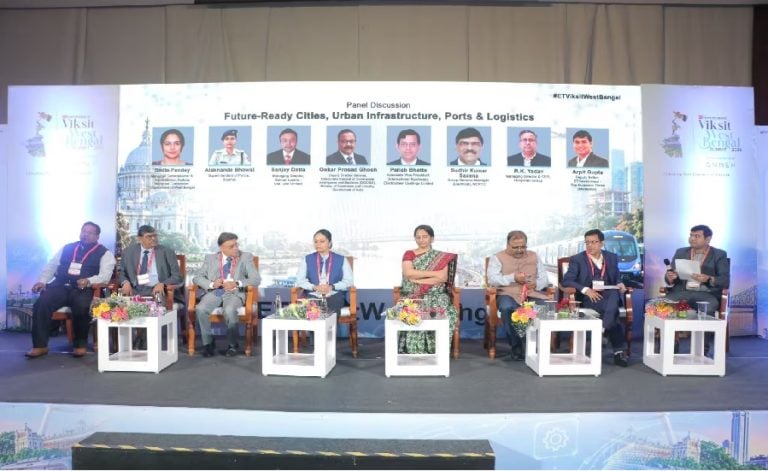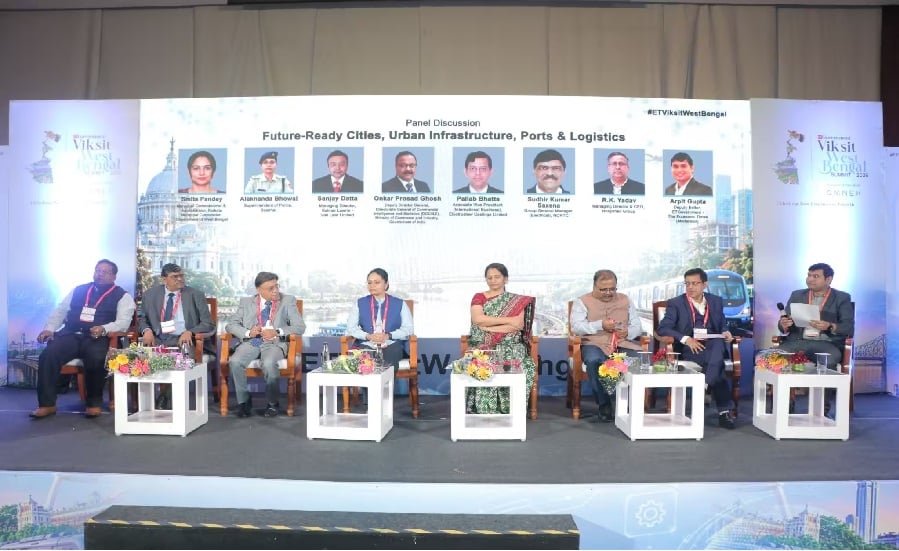
Kolkata: West Bengal‘s journey towards building future-ready cities will require more than physical infrastructure expansion, with integrated urban governance, regional connectivity, logistics, technology and citizen-centric services emerging as key priorities, policymakers and industry leaders said at the Viksit West Bengal Summit 2026 in Kolkata.
During a panel discussion titled ‘Future-Ready Cities, Urban Infrastructure, Ports & Logistics’, experts discussed the challenges and opportunities associated with modernising Kolkata and other emerging urban centres, improving public service delivery, strengthening connectivity and unlocking the state’s industrial and trade potential.
The discussion highlighted the importance of infrastructure development focused on efficiency, sustainability, accessibility and the everyday needs of citizens.
Kolkata’s Urban Transformation Requires Citizen Participation
Smita Pandey, Municipal Commissioner and Administrator, Kolkata Municipal Corporation (KMC), Government of West Bengal, emphasised that building a clean, accessible and sustainable city requires coordinated efforts between municipal authorities and residents.
She said considerable manpower and resources are deployed to maintain urban cleanliness, but the effectiveness of these efforts also depends on public participation.
Waste management, timely grievance redressal, pedestrian-friendly infrastructure and green spaces emerged as important priorities for improving Kolkata’s urban environment.
Pandey stressed that municipal services should respond promptly to civic problems before they affect residents’ overall experience of living in the city.
She also highlighted the need to develop urban spaces that encourage walking through well-maintained footpaths, landscaped streets and improved public spaces.
For Kolkata, which is known for its heritage, historic neighbourhoods and cultural identity, improved walkability could help residents and visitors rediscover the city’s urban landscape.
Read also: West Bengal Raises Monthly Remuneration of Contractual Panchayat Staff by Up to Rs 10,000
Green Cover and Digital Governance to Strengthen Urban Development
Environmental sustainability was another key focus of the discussion.
Pandey referred to an ongoing plantation initiative involving approximately one lakh trees, supported by municipal teams, the Forest Department, non-governmental organisations and other stakeholders.
The initiative is aimed at strengthening Kolkata’s green cover and improving environmental conditions for future generations.
She also highlighted the need to modernise municipal administration through digital technologies. While Kolkata Municipal Corporation has undertaken upgrades to internal systems and revenue-related processes, she said there is further scope for adopting technologies such as digital twins and data-driven urban management.
The corporation has also engaged with the Government of India regarding possibilities related to digital twin technologies.
Pandey further highlighted the role of user charges in supporting municipal services, stating that fair and transparent charges could encourage citizens to take greater responsibility for public infrastructure and its maintenance.
She said Kolkata’s historic lanes, architectural character and distinctive neighbourhoods could become important assets in creating a more attractive urban environment while preserving the city’s identity.
Technology-Enabled Policing Must Reflect Regional Needs
Alaknanda Bhowal, Superintendent of Police, Basirhat, highlighted the importance of adapting technology and administrative systems to local economic, geographical and social conditions.
She said Basirhat presents a distinctive administrative environment, combining semi-urban settlements, rural communities, coastal areas and international border-related challenges.
According to Bhowal, governance and technology solutions cannot follow a uniform approach across regions and must be designed according to local requirements.
She identified improved transportation connectivity, fisheries-related activities and better utilisation of regional resources as opportunities for economic development, while emphasising environmental sustainability.
Bhowal also highlighted digital birth and death registration as an example of how technology can improve public service delivery. Digital access to essential documents can reduce repeated visits to administrative offices and waiting periods for citizens in rural and semi-urban areas.
She pointed to opportunities to strengthen security through surveillance technologies, artificial intelligence-enabled analytics, integrated traffic management and real-time information sharing.
In border areas, she stressed the importance of coordination between police, civil administration, the Border Security Force, customs and immigration authorities.
She also highlighted disaster preparedness and inclusive access to public services as essential components of future-ready administration.
Regional Connectivity Can Support Balanced Urban Growth
Sudhir Kumar Saxena, Group General Manager (Electrical), NCRTC, highlighted the potential of high-speed regional rail systems to connect major cities with surrounding economic centres.
Drawing on NCRTC’s experience with the Delhi–Meerut Regional Rapid Transit corridor, Saxena explained how faster transport networks can reduce travel time and make longer-distance commuting more practical.
He referred to the approximately 82-kilometre Delhi–Meerut corridor and the importance of developing transport systems that efficiently connect population centres.
For West Bengal, he said improved regional connectivity could support more balanced economic development beyond Kolkata’s metropolitan boundaries.
Connecting cities and urban centres such as Kharagpur, Krishnanagar and other surrounding locations through efficient transport networks could expand opportunities for employment and residential development.
Saxena also emphasised multimodal integration, highlighting the importance of connecting regional rail services with metro systems, conventional railways, buses and last-mile transport facilities.
Integrated transport hubs can reduce transfer-related inconvenience and improve the commuter experience, while electric vehicle charging facilities and coordination with local transport operators can further strengthen modern mobility infrastructure.
Such approaches could help reduce pressure on concentrated urban centres while improving accessibility between residential, commercial and industrial locations.
West Bengal’s Logistics Infrastructure Needs Better Integration
Sanjay Datta, Managing Director, Balmer Lawrie – Van Leer, highlighted West Bengal’s historical role as an industrial centre and its existing road, rail and waterway infrastructure.
He said the state has significant potential for industrial and logistics development, with the opportunity lying in improving the utilisation and integration of its existing transportation resources.
Better coordination between manufacturing centres, transport networks and logistics facilities could improve supply-chain efficiency, reduce operational uncertainty and strengthen businesses’ access to domestic and international markets.
The discussion underscored the importance of treating infrastructure systems as interconnected networks rather than developing them in isolation.
Port Modernisation Critical for Trade and Export Competitiveness
Pallab Bhatta, Associate Vice-President – International Business, Electrosteel Castings, highlighted operational challenges faced by exporters and importers using Kolkata’s port infrastructure.
He explained that Kolkata’s position as a riverine and city-based port creates logistical constraints involving river conditions, sedimentation, vessel navigation requirements and dredging costs, which can affect port operations and vessel turnaround times.
The port’s location within a densely populated urban environment also presents challenges related to heavy-vehicle movement, road access, environmental concerns and traffic restrictions.
For exporters and importers, predictable cargo movement and adherence to shipping schedules are essential to maintaining competitiveness.
Bhatta cited improved coordination between Kolkata Municipal Corporation and port authorities, particularly in road maintenance and cargo vehicle movement, as an example of how administrative cooperation can help address operational challenges.
Deep-Sea Ports and Infrastructure Expansion Could Boost Industrial Growth
Bhatta highlighted the potential of new deep-sea port infrastructure to strengthen West Bengal’s maritime capabilities and support industrial development.
He said modern port facilities, supported by specialised terminals for different cargo categories, could attract industries and improve export-import operations.
He also recommended strengthening existing facilities at the Haldia Dock Complex and Kolkata’s port system.
Drawing comparisons with industrial regions in Tamil Nadu and Odisha, he observed that major port investments can stimulate manufacturing units, logistics providers and ancillary industries.
He also referred to the possibility of a tunnel beneath the Hooghly River as a potential solution to improve cargo connectivity and reduce the movement of heavy commercial vehicles through congested urban roads.
Such infrastructure could improve goods movement between industrial areas and port facilities, strengthening the relationship between maritime infrastructure, industrial investment and regional transport networks.
Trade Intelligence and Freight Corridors to Improve Logistics Efficiency
Onkar Prosad Ghosh, Deputy Director General, Directorate General of Commercial Intelligence and Statistics, Ministry of Commerce and Industry, Government of India, highlighted the role of trade intelligence and logistics planning in strengthening West Bengal’s participation in domestic and international commerce.
He observed that global trade patterns have evolved considerably, requiring regions to continuously reassess their infrastructure and commercial strategies.
Ghosh highlighted the diversity of products exported from West Bengal while noting that the state’s overall share in national exports remains relatively modest.
He said improving trade performance would require more effective utilisation of commercial intelligence, stronger engagement between industry and research institutions, and better coordination across infrastructure systems.
He also stressed the need for dedicated freight corridors connecting industrial locations with ports.
Efficient cargo movement requires transport routes that are protected from avoidable disruptions and monitored in real time, he said.
Technology-enabled freight corridor monitoring could help logistics operators anticipate disruptions, improve shipment planning and enhance supply-chain efficiency.
He further emphasised balancing the requirements of historic cities with modern industrial and commercial infrastructure.
Medical Infrastructure Essential for Future-Ready Cities
R K Yadav, Managing Director and CEO, Hospimed Group, highlighted the importance of medical infrastructure in building future-ready cities and regions.
He drew attention to disparities in access to quality medical facilities between urban centres and smaller towns and rural areas.
While Kolkata has an established network of hospitals and specialised medical services, several other parts of West Bengal continue to face limitations in medical equipment, advanced treatment capabilities and access to specialised healthcare.
Yadav emphasised the need to expand affordable and quality treatment beyond metropolitan centres.
He also highlighted the role of modern medical technology, including advanced diagnostic and surgical systems, in improving treatment capabilities.
According to him, investment in healthcare infrastructure should form part of broader regional development planning to ensure economic growth is accompanied by improved access to essential services.
People and Technology Must Work Together
Towards the conclusion of the panel discussion, experts discussed whether people or technology would play the defining role in shaping future-ready cities.
The responses highlighted the importance of combining technological innovation with human participation, institutional capacity and effective implementation.
Bhowal stressed that urban development must remain inclusive, bringing together people, machines and human judgement.
Other panellists also emphasised that technology should be deployed responsibly, supported by appropriate skills and an understanding of local requirements.
The discussion additionally highlighted vertical development and efficient land utilisation as important considerations as urban expansion places increasing pressure on available space.
The experts agreed that infrastructure alone cannot make a city future-ready. Modern transport systems require integration, digital governance needs accessibility, logistics networks require coordination, and sustainable urban development depends on active citizen participation.
For West Bengal, the opportunity lies in bringing these elements together through long-term planning, institutional collaboration and targeted investment.
As the state looks towards its future development ambitions, the effectiveness of its urban transformation will depend on how successfully it connects established cities with emerging economic centres, modernises trade infrastructure and ensures that technological progress improves everyday life.
The defining measure of a future-ready city, the discussion highlighted, will be how seamlessly its people, services, businesses and institutions work together to create a connected, inclusive and sustainable urban future.