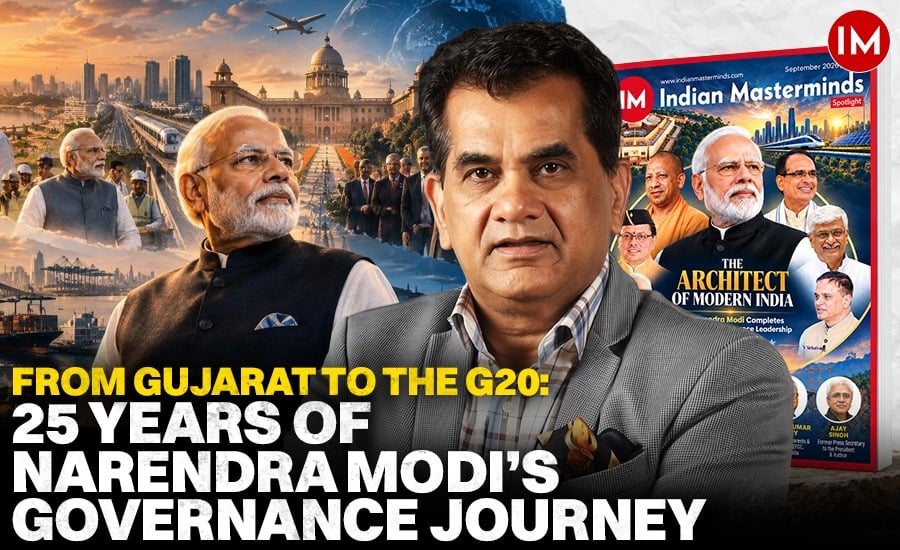
Twenty five years ago, when Mr. Narendra Modi first took charge as chief minister of Gujarat, few could have imagined the scale of change that his journey as chief minister and prime minister would unleash across India. I have had the privilege of watching that journey from unusually close quarters, first as a civil servant working with him on Gujarat’s growth story and later as CEO of NITI Aayog and as India’s G20 Sherpa reporting directly to him on some of the most complex negotiations in recent history.
This vantage point has given me a ringside view of how he has created a new India through a relentless focus on outcomes, technology, inclusion and last mile governance.
First meeting
My first substantive interaction with PM Modi was in Gandhinagar when he was chief minister of Gujarat and I was exploring the idea of developing a new, greenfield city. I went to several chief ministers with the concept and asked if their state could make available around 150 square kilometres of land. Most of them said this was far too difficult and complex. When I met Mr Modi, he heard me out and said that 150 square kilometres was too small, and that Gujarat could give me 750 square kilometres for the project.
That single response told me I was dealing with a leader who not only thought big, but was willing to put the full weight of his state machinery behind ambitious ideas. It was followed by an invitation to Vibrant Gujarat, where I found a chief minister who saw global engagement and investment as central to Gujarat’s transformation and was ready to break conventional silos to make that happen.
Outcome and delivery driven
Over the last decade, working with him in Government of India, I have seen that same instinct expressed through a very clear working style. The Prime Minister is deeply outcome driven and extremely delivery oriented. He sets the broad vision and stretch targets with great clarity, then expects his team to deliver against those benchmarks. Once the policy is announced, he gives you both freedom and responsibility to execute, and he watches the results very closely.
During the early push for digital transformation, he summoned me and asked us to organise one hundred digital melas in one hundred days across the country. I thought this was an excessively demanding task, yet he remained insistent. In retrospect, that intense hundred day period helped drive awareness and adoption of digital services among ordinary citizens, and laid the ground for the extraordinary expansion of India’s digital public infrastructure.
Instruments of change
Mr Modi is, in my experience, a big picture leader who is also a genuine techie at heart. He has an intuitive understanding that technology, when combined with data and good governance, can leapfrog constraints that held India back for decades. In our conversations, he has consistently pushed for the opening up of sectors like geospatial services, space, and drones, because he sees them as future growth drivers for the Indian economy.
The transformation of India’s digital landscape over the last ten years shows this mindset. Between 2015 and 2017, we opened over 550 million new bank accounts and linked Aadhaar and mobile numbers to these accounts, which in turn enabled the growth of fast digital payments and the broader fintech ecosystem.
The Bank for International Settlements observed that India achieved in nine years what would otherwise have taken five decades in terms of digital payments penetration, a feat made possible by the Prime Minister’s insistence that we build robust, inclusive digital public infrastructure. As UPI completes its first decade, annual transactions have risen from 1.78 crore in 2016–17 to more than 24,162 crore in 2025–26, with total value of about ₹314 lakh crore. In July 2026 alone, UPI processed a record 2,366 crore transactions worth ₹29.88 lakh crore, and India now accounts for nearly half of all real time digital payments globally, making UPI the most used instant payment system in the world.
Reimagining Governance
His approach to governance has always been anchored in the lives of ordinary citizens. When we were conceptualising the programme for India’s most underdeveloped districts, his first instruction was that we must never call them backward districts. He insisted we call them aspirational districts, because language shapes expectations and morale. He wanted the focus to be on transforming the lives of citizens through competition, data and good governance rather than merely increasing allocations.
Under his guidance, NITI Aayog created real time dashboards that ranked districts on health, education, nutrition and other indicators, and collectors began to compete with each other to climb the rankings. He met these district collectors during his tours, encouraged them personally, and stressed the importance of using data to drive improvements.
Breaking Silos
In the design of Startup India, I saw another hallmark of his governance style. We made several presentations before the policy was finally announced. At each stage, he challenged us to move beyond the narrow confines of any single department. He asked us to look at incubators, IITs and IIMs, engineering colleges, regulatory frameworks and venture capital simultaneously, and to design a comprehensive ecosystem rather than a departmental scheme. He breaks silos by default and insists on multidisciplinary thinking as the basis of policy design.
Once he is satisfied that the architecture is sound, he steps back and expects delivery. Startup India started with just over a hundred early stage ventures. Today India has tens of thousands of startups and over a hundred unicorns, supported by a policy ecosystem that is far more enabling than the licence raj environment I saw when I joined government service in 1980. That journey from a controlled, quota based economy to a dynamic, entrepreneurial one is inseparable from his push for ease of doing business, the scrapping of over 1600 obsolete laws, and a constant drive to simplify rules and procedures.
India’s Global Voice
The clearest test of his leadership that I have experienced was during India’s G20 presidency. When I was appointed as India’s G20 Sherpa, his brief was unambiguous. The presidency had to be inclusive, decisive, ambitious and action oriented, with a special emphasis on the concerns of the Global South. He wanted India to use the G20 to champion women led development, human centric progress, financial inclusion and climate justice while demonstrating that multilateralism could still deliver concrete outcomes.
On the morning of the New Delhi summit, as world leaders assembled at Bharat Mandapam and the fate of the Leaders’ Declaration hung in the balance, I met him to update him on the deadlock between major powers. He listened carefully, reflected for a moment on why bilateral issues were being injected into a multilateral forum, then told me that he did not wish to delve into procedures. He wanted to see the result, meaning consensus, very soon, and expected me to navigate and secure the agreement.
Throughout the months of difficult negotiations, he demanded urgent situation reports every two hours, which forced us to analyse developments quickly and stay ahead of emerging challenges. At one stage, as ministerial meetings failed repeatedly because of differences over the Russia Ukraine conflict, he instructed me to convey very clearly that India would not preside over a divided G20 and that if global institutions like the United Nations and its Security Council were paralysed, the G20 had to function or India would prefer to work with alternative groupings. That clarity of mandate allowed us to be firm yet constructive in our diplomacy. Eventually, India secured unanimous consensus on the New Delhi Leaders’ Declaration, including language on geopolitics that both the West and Russia could accept.
His Traits
Behind these episodes lie certain characteristic traits that define PM Narendra Modi as an administrator. He has an enormous capacity for hard work and detail, but he never loses sight of the larger story he wants India to tell the world. He respects professionals and gives them space, yet he holds them accountable against very precise expectations. In meetings, he listens carefully, asks searching questions, and distils discussions into a small set of clear directives that everyone can understand.
He is also remarkably comfortable with disruption and new technologies. From artificial intelligence and quantum computing to green hydrogen and electric mobility, he has pushed India to embrace frontier areas rather than remain trapped in incrementalism. His ambition that by 2047 India should shift from importing fossil fuels worth roughly 180 billion dollars to exporting clean energy encapsulates both his sense of scale and his belief that technological missions can change India’s structural constraints.
A New India
When I joined the civil service, India was trapped in shortages and quotas. To get a fixed telephone connection or a gas cylinder often required political influence and patience. Today, a citizen can open a bank account, buy insurance, or transact in the stock market in seconds on a smartphone, and India accounts for nearly half of the world’s real time digital payments. The journey from God’s own country tourism campaigns and Maruti 800 aspirations to world class airports, highways, startups and electric vehicles has been rapid and radical.
As someone who has worked with Mr Modi as chief minister and as prime minister, I have seen that this journey has not been about isolated schemes. It has been about a consistent governance philosophy. Think big, set audacious yet clear goals, use technology and data to drive implementation, reimagine the relationship between the state and citizen from control to empowerment, and insist that India’s voice is heard on the global stage. That is how a new India has been built over these twenty five years, and that is the India whose contours I have tried to capture in my work and in my book, The Elephant Moves.
In the decades ahead, India will need to grow at nine to ten percent a year for a long period and bring many more states and companies into the league of global champions. From my experience, PM Narendra Modi’s administrative instincts are aligned with that requirement. He is a leader who sets the destination, equips his team with tools, and then demands delivery. That is why, when I look back at the last twenty five years, I see not just the story of one individual’s political journey, but the story of a country learning to believe that it can leap like a tiger rather than ambling like an elephant.
(The author is former G20 Sherpa, India, and former CEO, NITI Aayog)