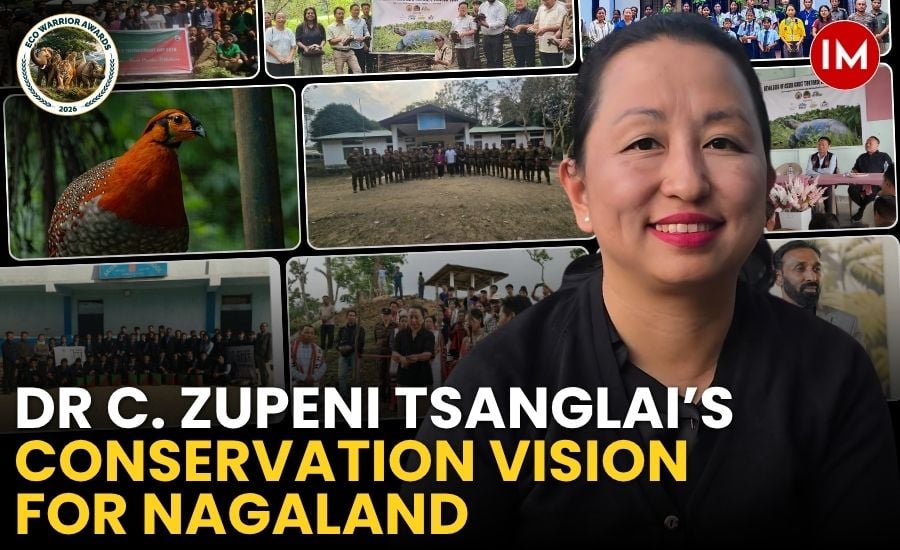
For Dr. C. Zupeni Tsanglai, conservation is not limited to protecting forests or maintaining animals in captivity. It is about creating systems in which forests can regenerate, wildlife can return to natural habitats, and communities can become long-term partners in protecting their environment.
A 2013-batch Indian Forest Service officer of the Nagaland cadre, Dr. Tsanglai has worked across several aspects of wildlife and forest management, including forest restoration, species recovery, conservation breeding, and zoological park management.
Among these areas, she considers ex-situ wildlife management — the conservation of animals outside their natural habitats, such as in zoological parks — particularly challenging. She is a veterinarian with a Master’s degree in Veterinary Science and, before joining the IFS, worked as a Scientist in Animal Science under the Indian Council of Agricultural Research (ICAR).
“The challenge is not just keeping the animals alive in captivity; we also have to maintain their physical health, psychological well-being, and natural behaviour,” Dr C Zupeni Tsanglai shared in an exclusive interview with Indian Masterminds.
For her, this makes wildlife management far more complex than simply providing food, shelter and veterinary care. The objective is to understand animals as living species with specific behavioural and ecological requirements, while ensuring that captive populations can contribute to wider conservation goals.
Restoring Forests by Working With Communities
During her work in Tuensang, one of the biggest challenges Dr Tsanglai encountered was restoring degraded forests while ensuring that local communities remained part of the process.
In Nagaland, forests have traditionally supported communities in several ways, while jhum cultivation remains an important part of rural livelihoods. This makes forest restoration different from a conventional plantation exercise where trees are planted without considering the relationship between people and the landscape.
For Dr Tsanglai, gaining the confidence of local communities was therefore an essential first step.
“Restoration cannot simply be imposed as a departmental plantation programme. We need to approach the communities properly.”
Her approach focused on community-led restoration and the creation of alternative livelihood opportunities through convergence with other government departments.
She believes that the success of a restoration programme should not be measured only by the number of saplings planted. Instead, the larger question is whether the forest can eventually regenerate naturally and whether communities are willing to protect it over the long term.
This requires sustained engagement with villagers and an understanding of the traditional relationship they share with forests.
Combining Science With Traditional Knowledge
Community participation, according to Dr Tsanglai, begins with understanding the knowledge that already exists within villages.
Forest officials conduct awareness programmes and involve communities in departmental activities. Villagers are also invited to participate in events such as World Environment Day and Wildlife Week.
When a particular village is identified for conservation work, the process often begins through the village council. This is because local communities possess detailed knowledge of their forests — knowledge built through generations of interaction with the landscape.
“They know their forest very well — every corner of it,” she explains.
This traditional knowledge can complement scientific approaches to afforestation and ecological restoration. Rather than treating the two systems as separate, Dr Tsanglai believes that conservation becomes more effective when scientific methods and local understanding are brought together.
“We need to combine our scientific knowledge of afforestation and plantation with their traditional knowledge. When both are applied together, the results and impact are much better.”
Such an approach can help restoration programmes become more suited to local ecological conditions while also giving communities a greater stake in protecting the landscape.
Conservation Breeding Must Lead Back to the Wild
Dr Tsanglai’s work in species recovery and conservation breeding has also shaped her understanding of wildlife management.
For her, breeding threatened species in captivity is only the beginning. Maintaining animals in enclosures and producing offspring does not automatically amount to species recovery.
The real objective is to eventually create viable, self-sustaining wild populations.
This requires careful planning at every stage. Conservation breeding programmes must maintain genetic diversity and ensure the health of founder animals. Their behaviour must also be studied so that individuals selected for release have the best possible chance of adapting to natural environments.
Once a captive population becomes sufficiently large, suitable release sites must be identified. These sites need to be assessed for habitat quality, predators and other ecological factors, as well as human pressures.
Local communities also have an important role to play after animals are released. Long-term monitoring and protection are essential if reintroduction programmes are to succeed.
For Dr Tsanglai, therefore, conservation breeding is ultimately about reconnecting captive populations with functioning natural landscapes.
A Regional Conservation Centre in Nagaland
Her vision extends to Nagaland Zoological Park, which she sees as having the potential to play a much larger role in conservation across Northeast India.
The Northeast is among India’s richest regions in terms of biodiversity, and Dr Tsanglai believes the zoological park can serve as a regional conservation centre while continuing to function as a modern scientific zoo.
“I want Nagaland Zoological Park to be more than just a place where people come for recreation and to see wildlife.”
Her vision is for the park to become a space where conservation programmes are scientifically planned, demonstrated and eventually connected with conservation work in natural landscapes.
This could include supporting species recovery and conservation breeding programmes whose ultimate objective is to return animals to suitable wild habitats.
Nagaland’s Conservation Future
Looking towards the next decade, Dr Tsanglai’s vision for Nagaland goes beyond simply increasing forest cover or wildlife populations.
She wants the state to emerge as a model of community-led and scientifically managed landscape conservation.
That would mean restoring degraded forests with native species, maintaining functional wildlife corridors and ensuring that habitats remain connected so animals can move between landscapes.
Human-wildlife conflict is another major concern. Addressing it requires conservation strategies that recognise the needs of both wildlife and communities living alongside forests.
At the same time, threatened species need targeted recovery programmes, supported by habitat protection and long-term monitoring.
For Dr Tsanglai, conservation cannot succeed if it focuses only on forests and animals while ignoring the people who have depended on these landscapes for generations.
Her broader vision is therefore one where ecological protection and sustainable livelihoods develop together.
The future of Nagaland’s forests, she believes, will depend on building a relationship in which communities are not merely participants in conservation programmes but become their long-term custodians.
That approach brings together three elements — science, traditional knowledge and community ownership. For a state as ecologically diverse as Nagaland, Dr Tsanglai believes this combination can provide the foundation for restoring landscapes, protecting wildlife and ensuring that conservation continues beyond individual projects and administrative programmes.