At the Government Sawmill, Chatham, in the Andaman & Nicobar Islands, timber governance once depended heavily on paper records. From the moment a round log arrived at the mill to the time its sawn timber and by-products were sold, information was recorded manually at multiple stages.
For a department operating across geographically isolated islands, this created a familiar set of problems: repeated paperwork, delays, difficulty in tracking individual logs and limited scope for real-time monitoring.
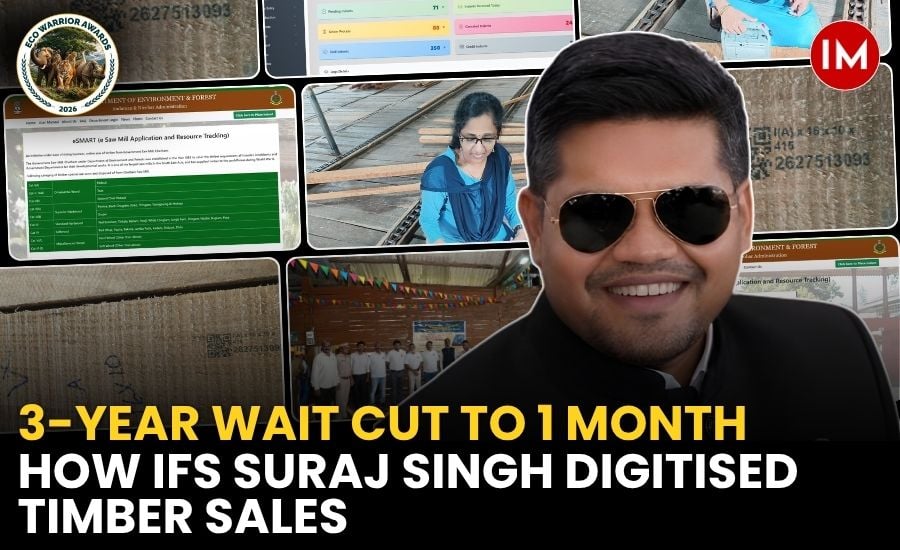
IFS officer Suraj Singh, a 2017-batch AGMUT cadre officer, saw an opportunity to change this system. His answer was the e-SMART Platform — E-Saw Mill Application Resource Management and Tracking System — an end-to-end digital platform designed to bring almost every major operation of the Government Sawmill onto a single system.
The basic version of the initiative was started in 2019. However, the disruption caused by the COVID-19 pandemic meant that the project could not progress as intended. In 2023, Mr Singh and his team revived the initiative and began developing it as a more comprehensive digital ecosystem.
“Basically, it’s an online platform which has been developed to include all the processes right from the acceptance of logs till the sale is done of all the timber and its by-products,” IFS Suraj Singh told Indian Masterminds.
Moving from Paper to Real-Time Tracking
The biggest change brought by e-SMART was replacing multiple layers of manual entries with a digital workflow.
Earlier, when a round log was received, its details were entered on paper. Further entries were made when the log moved through different stages of processing. This made it difficult to know the exact status of a particular log without manually checking records.
The digital system changed that.
The platform allows officials to track where a log is in the production process and assess how much timber is being recovered from it. This also provides data on conversion efficiency and manpower utilisation.
For example, officials can monitor how much conversion has taken place during a particular day and assess operational performance through data rather than depending entirely on physical records.
“The digitisation also helped reduce the lead time between the acceptance of a log and the eventual sale of timber. With information available through a single system, processing became faster, and the mill was able to handle more indents.”
Giving Every Piece of Timber a Digital Identity
One of the distinctive features of e-SMART is its QR-based timber tracking system.
Each sawn timber piece is assigned a unique QR code. Once the tag is attached, its information can be accessed whenever required by simply scanning the code.
This eliminates the need to repeatedly measure and manually record the same piece of timber during subsequent processes. For inventory management or sale, officials can scan the QR code and retrieve the relevant information from the system.
The approach provides a digital trail for timber moving through the mill while also making stock management easier.
For a government sawmill dealing with large quantities of timber, such traceability can improve accountability at different stages — from production and inventory to eventual sale.
From a Three-Year Wait to One Month
Perhaps the most visible impact of the platform has been on the public-facing side of timber distribution.
Andaman Padauk, a prominent timber species available through the Government Sawmill, had a waiting period of more than three years when the system was initially being streamlined.
The administration introduced a quota-based online system to make the process more predictable. For Padauk, a fixed number of indents are opened every month, and applications are accepted online on a first-come, first-served basis.
The process is somewhat similar to booking a railway ticket: applicants no longer need to repeatedly visit the mill or remain uncertain about where their application stands.
According to Mr Singh, the waiting period has now come down dramatically.
“The pendency of three years has been reduced to one month.”
The platform also covers other timber products and sawmill by-products, including sawdust, souvenirs and carpentry products. Citizens can apply online, track their requests and receive notifications when their orders are ready for collection.
This is particularly significant in the Andaman & Nicobar Islands because the government is the primary supplier of timber and its by-products, making the sawmill an important public service provider for the islands.
Digitisation in a Remote Island Setting
Building the system was not without its own logistical challenges.
Equipment required for the project, including scanners, was not readily available locally. The team had to search across India to identify suitable vendors, and some of the required machines had to be sourced from Germany.
There was also a technical challenge: developing and maintaining a specialised digital system with limited in-house technical resources.
The initiative therefore became a joint effort involving the forest department and the National Informatics Centre (NIC). While NIC provided technical supervision, particularly for the technology-related aspects, web development was taken up in-house.
But technology was only one part of the transition.
The mill is a British-era establishment, and many employees had spent years following traditional working methods. For some older employees, moving from paper-based processes to digital workflows was a significant change.
Instead of imposing an immediate switch, the team adopted a hybrid approach.
For three to four months, employees were asked to maintain both paper records and digital entries. This allowed them to gradually understand the new system and its advantages. Tablets were also provided to make digital entry easier on the shop floor.
Over time, many employees became comfortable with the online system and moved towards using it independently.
More Than Just an Online Application System
The impact of e-SMART is reflected not only in the technology but also in the operational numbers.
Monthly service delivery, which was earlier around 100 transactions, has increased to approximately 150–200 transactions. At the same time, there is no longer a three-year backlog for timber indents.
The platform has also improved predictability for citizens. Even when an application cannot be accommodated in a particular month’s quota, applicants know when they can try again rather than remaining uncertain for years.
Feedback collected through the platform, along with informal interactions with Panchayati Raj Institution representatives and members of the public, has largely been positive.
For citizens, the biggest benefits are straightforward: fewer physical visits, online applications, faster processing and a clearer idea of when they can expect their timber.
Building a System That Can Last
For IFS Suraj Singh, however, the success of e-SMART cannot be measured only by its launch or initial results. The larger challenge is keeping a digital public-service system functional over the long term.
The platform has been developed with sustainability in mind, including in-house web development and continued staff training. This is particularly important in a remote location where technical support and equipment can take time to procure.
“The biggest challenge with any online platform is the sustainability of it, because for one year then, if it is not managed well, it just goes down. So the first thing we focus on is the sustainability. It should run continuously, because it is a matter of public service delivery.”
The e-SMART initiative therefore represents more than the digitisation of a sawmill. It brings production management, timber traceability, inventory, citizen applications and public-service delivery onto a common digital framework.
In an island ecosystem where logistics are inherently complicated, the system has shown how technology can reduce administrative delays while improving transparency and predictability.
What began as an attempt to replace paper entries has evolved into a comprehensive digital model for forest-based industrial governance — one that could potentially be adapted by other government sawmills and forest departments facing similar challenges.