For an officer working in the forest department, conservation is not limited to protecting trees, patrolling wildlife habitats or enforcing laws. It also involves understanding why people interact with nature in certain ways and finding alternatives that make conservation meaningful to communities.
IFS officer Sandeep Divyajyoti Behera, a 2018-batch officer of the AGMUT cadre, has explored this approach through several field initiatives. Currently posted as DFO Udhampur. Forest Division in Jammu and Kashmir, Mr Behera’s earlier work in the Andaman and Nicobar Islands offers an insight into how administration, citizen participation and scientific documentation can come together to address environmental challenges.
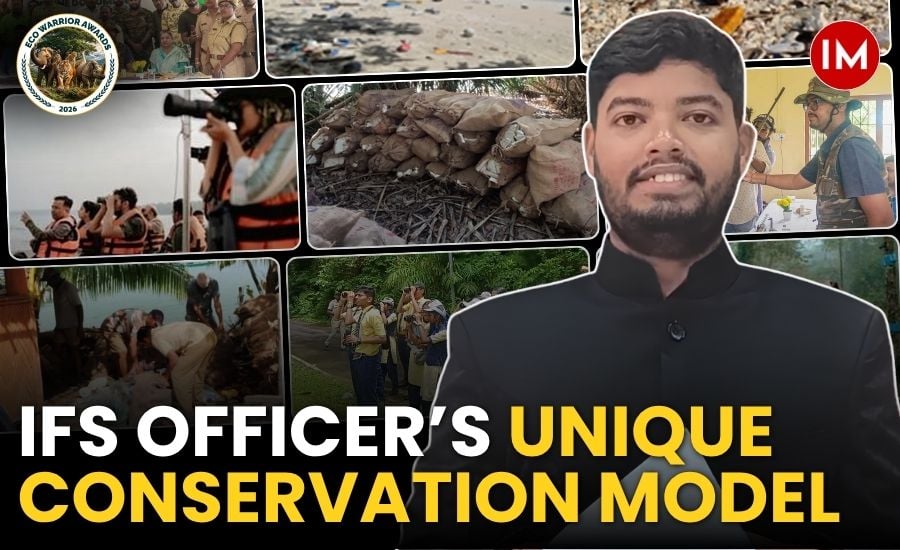
Two initiatives stand out from his tenure there: ‘Udne Do Hamein – Gun Choro, Camera Pakado’, which sought to move people away from bird hunting towards birdwatching, and Mission 1 Lakh, an ambitious effort to document and remove marine litter from remote forest beaches.
From air guns to cameras: Building ‘Udne Do Hamein’
During his posting as DFO Middle Andaman, Mr Behera encountered a recurring conservation challenge: the use of air guns for hunting birds.
While air guns themselves are not illegal, hunting protected forest species is. The difficulty, he explains, was that people could often justify their actions by claiming they were hunting non-scheduled birds for food outside forest areas.
But the deeper reasons behind hunting were more complex.
Andaman has abundant and affordable fish, which provides an important source of protein. Mr Behera therefore found that hunting certain birds was often driven by their perceived exotic value or by traditional beliefs surrounding their meat.
As he explains, “I feel hunting is happening for the exoticness of that world.”
Some birds were also associated with superstitions, including beliefs that eating certain species could help with health conditions. This made conventional enforcement alone an insufficient solution.
The forest department instead began looking at how people could be given another way to engage with birds.
That led to ‘Udne Do Hamein’, accompanied by the message ‘Gun Choro, Camera Pakado.’
The idea was simple: replace the gun with the camera and turn birds from targets into subjects of observation.
Turning Andaman into a birding destination
The campaign was not designed as a standalone awareness drive. It was supported by a broader effort to build interest in birding across the islands.
During the COVID-19 period, many people were confined to their homes and looking for new ways to spend their time. Earlier ornithology workshops conducted by the department helped some residents develop an interest in birdwatching.
People began visiting different locations with cameras, photographing endemic birds and sharing their observations on social media.
The opportunity was significant. Although the Andaman and Nicobar Islands account for only about 2% of India’s geographical area, Mr Behera points out that the islands have around 30 endemic bird species, making them an important destination for bird enthusiasts.
As interest grew, bird tourism also began creating economic opportunities for local communities.
The department worked with local birding clubs and groups such as the Andaman Events Club to develop a citizen-science model. Residents and visitors contributed observations that helped build a better understanding of where different bird species could be found.
“A very successful citizen science model in which we came to know which bird is where,” Mr Behera told Indian Masterminds.
The approach also helped the department obtain information about activities such as air-gun use.
The conservation strategy gradually expanded to include endemic bird centres, rallies, birding events and interventions around forest management. As awareness about birds increased, so did public interest in protecting their habitats.
For Mr Behera, this created an important chain reaction: protect the birds, and communities begin demanding protection for the forests and wetlands that sustain them.
“If birds are to be protected, when people themselves come saying ‘We have to protect the birds,’ automatically they protect the forest,” he says.
Mission 1 Lakh: Following plastic back to its source
The second major initiative emerged from a very different problem: marine litter.
While serving as DCF Wildlife, IFS Sandeep Behera was involved with protected areas, including the Mahatma Gandhi Marine National Park. During a patrolling visit to the remote Tarmugli Island circuit, the team encountered a two-kilometre beach covered with plastic waste.
The location raised an obvious question: if no one lived there, where had all the plastic come from?
The answer was the sea.
“Whatever plastic we are putting into the ocean, the ocean is giving it back to us,” Mr Behera explains.
The waste also revealed that marine pollution does not stop at national boundaries. During the clean-up, bottles carrying labels from countries including China, Myanmar and Thailand were found. Subsequent documentation identified waste originating from several countries.
This observation led to Mission 1 Lakh, launched during Wildlife Week 2024–25.
The objective was not merely to clean beaches but to understand the origin and composition of marine litter.
Over the following year, the initiative covered around 100 forest beaches and involved more than 30–35 clean-ups, including locations without road connectivity. Teams travelled by boat, spent the day collecting waste and transported it back to the main island.
In 2024–25, the initiative collected 1,19,000 kg of marine litter.
A portion of the waste was separated for detailed study. Around 15% of the collected waste was brought together from different parts of the islands, from Diglipur in the north to Nicobar in the south. Researchers then examined the material to identify its possible origins.
The exercise documented waste from around 19–20 countries apart from India, with 32.4% of the identifiable waste found to be from outside India.
The work also extended below the waterline. Divers participated in reef-scraper activities to remove plastic from underwater areas, recognising the risks that marine waste poses to coral reefs and coastal species.
Conservation as data, participation and policy
For IFS Sandeep Behera, Mission 1 Lakh was as much about generating evidence as it was about cleaning beaches.
The collected waste offered a record of how marine litter reaches isolated islands and highlighted the need for greater research into ocean pollution.
“The most important idea was to understand where the plastic is coming from,” he says.
The project was carried out with community participation and support from the Kachre Wale Foundation. This collaboration reflected another important aspect of the approach: environmental problems on this scale cannot be addressed by government departments alone.
Mr Behera also stresses the importance of creating records that can inform future environmental discussions.
That emphasis on documentation connects both of his major conservation efforts. Whether it was recording bird sightings through citizen science or analysing plastic collected from remote beaches, the initiatives attempted to convert field-level observations into usable environmental information.
Taking field lessons forward
The experience from the Andaman and Nicobar Islands offers a larger lesson for forest administration: conservation becomes stronger when people are made participants rather than treated only as subjects of regulation.
‘Udne Do Hamein’ attempted to change the relationship between communities and birds by creating interest in birdwatching. Mission 1 Lakh combined field action with scientific documentation to understand marine pollution.
Both initiatives also demonstrate the value of partnerships—with birding clubs, citizens, volunteers, researchers and private organisations.
The larger idea is straightforward. A forest department can patrol a habitat, but lasting conservation also depends on whether people understand what the habitat gives them—and whether they see themselves as part of its protection.