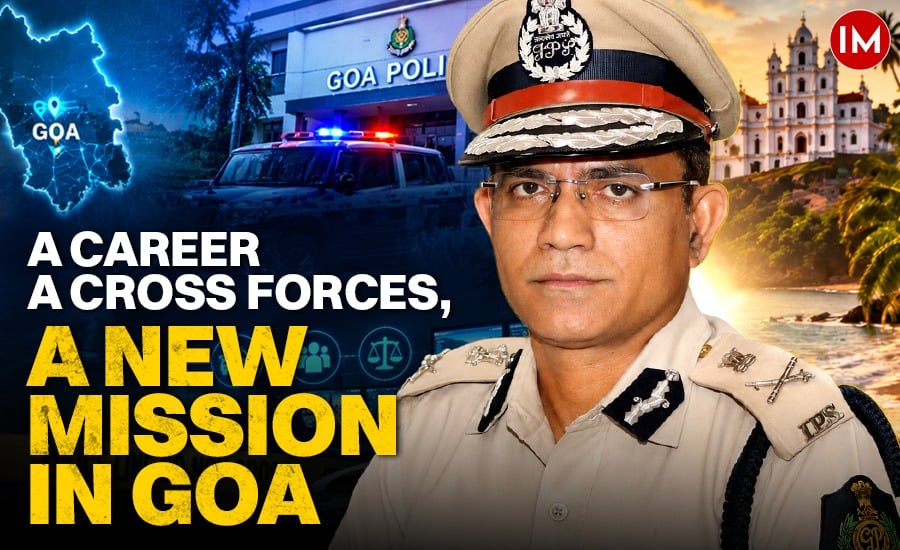
Some police careers are built in one city. Others are shaped by movement, changing challenges and lessons gathered across different policing environments. For Alok Kumar, IPS, nearly three decades in uniform have taken him from the Delhi Police to the NSG, BSF and CISF, before bringing him to Goa as its Director General of Police.
When Kumar joined the Indian Police Service in 1996, India’s policing landscape was still largely defined by physical crime, paper records and face-to-face investigation. Nearly three decades later, he leads the police force of a state where a crime can begin in a nightclub and end in a digital wallet, a drug network can stretch across borders, and a traffic violation can involve a tourist from another state.
A 1996-batch IPS officer of the AGMUT cadre, Kumar has therefore witnessed the changing nature of policing from close quarters. His assignments across different forces and specialised organisations have exposed him to crime investigation, security operations, organised networks and evolving technology.
Today, as DGP of Goa, he is bringing that experience to a state with its own unique policing challenges — tourism, drugs, cybercrime, road safety, large public events and the constant need to maintain public trust. Kumar took charge in July 2024.
His approach is increasingly centred on one idea: policing should not merely respond to crime after it happens; it should use intelligence, technology and stronger field systems to identify threats early and prevent them from becoming larger crises.
FROM DELHI POLICE TO SPECIALISED SECURITY FORCES
When Kumar entered the IPS in 1996, policing was still largely physical. Records were predominantly on paper, investigations depended heavily on face-to-face interactions, and most crimes had identifiable physical locations.
His career has allowed him to witness that transformation first-hand.
In the Delhi Police, he served as Joint Commissioner of Crime and later as Special Commissioner, dealing with complex investigations and organised criminal networks.
His career subsequently expanded beyond conventional policing. Assignments with the NSG, BSF and CISF exposed him to counter-terrorism, border security, critical infrastructure protection and specialised security operations.
Also Read – The Bridge That Rose From the Ruins: How IFS Gurharsh Singh United a Village After the Samej Disaster
Before coming to Goa, he served as an Inspector General in the CISF.
His service has also been recognised with the Police Medal for Meritorious Service in 2013.
These varied assignments have shaped his belief that modern policing cannot simply be about responding to incidents. It must involve understanding patterns, identifying networks and anticipating threats.
In an conversation with Indian Masterminds Mr. Kumar Says, ““The responsibility of the police remains the same, but the nature of the challenge changes.”
Watch the video here :
GOA NEEDS ITS OWN POLICING MODEL
Goa may be one of India’s smallest states, but its policing burden cannot be measured by its resident population alone.
Millions of domestic and international tourists arrive every year. During peak season, the floating population can rival the resident population. Music festivals, nightlife and large public events bring enormous crowds into concentrated areas, while drugs, traffic congestion and cyber fraud add their own layers of complexity.
Kumar therefore believes that policing models cannot simply be transplanted from one state to another.
“We cannot compare one place directly with another because the challenges are different. The responsibility of the police remains the same, but the nature of the challenge changes.”
His strategy has consequently focused on identifying Goa’s specific vulnerabilities and developing solutions within the police force wherever possible.
FROM CATCHING SELLERS TO BREAKING DRUG NETWORKS
Drug trafficking is one of Kumar’s major priorities. Goa’s international tourism profile and nightlife economy can create opportunities for criminal networks. But the DGP’s focus is not limited to catching individual users or small-time sellers. The larger question, he argues, is who is supplying the drugs, how the network operates and where distribution takes place.
The numbers indicate this shift. In 2024, Goa Police registered 162 NDPS cases and seized narcotics worth ₹9.91 crore. In 2025, the number of cases remained almost unchanged at 163, but the value of seizures increased dramatically to ₹78.48 crore.
A total of 212 people were arrested, including 32 foreign nationals. For Kumar, however, seizure and arrest are not the final indicators of success. The real test is whether investigations survive in court.
In 2025, Goa Police secured convictions in 35 NDPS cases involving 37 accused, with sentences extending up to 10 years of rigorous imprisonment. The philosophy is clear: follow the money, understand the structure and dismantle the organisation behind the visible crime.
CYBERCRIME: FROM COMPLAINT REGISTER TO RAPID RESPONSE
If drugs represent a traditional organised-crime challenge, cybercrime represents the opposite — a form of crime that can cross borders without a physical presence.
Kumar puts the priority bluntly: “Best way to deal with cyber-crime is to eliminate factors that lead to cyber-crime, next best is to have laser fast response.” Goa has consequently strengthened the 1930 cybercrime helpline, treating it as a frontline emergency-response mechanism.
A dedicated cloud-telephony-based 1930 centre was established at the Cyber Crime Police Station, Ribandar, in October 2025, when Union Home Minister Amit Shah launched it along with the Goa Police mobile application.
Calls are recorded, supervised, transcribed and audited, while missed calls are returned.
The impact has been significant. Between January and July 2026, the lien amount percentage increased by 76 per cent compared with the corresponding period of the previous year, while the overall cyber-fraud amount fell by almost 35 per cent. Goa has consistently ranked among the leading states in the percentage of fraud amount placed under lien.
The next step is AI.
Goa Police is integrating an AI-based call agent in co-pilot mode with the 1930 system. It will be capable of handling calls in 12 Indian languages and capturing information from callers, potentially reducing response time further.
Goa was also among the first states to operationalise e-Zero FIR, under which cyber-fraud complaints involving more than ₹1 lakh automatically convert into an FIR without requiring the victim to visit a police station.
A Lok Sabha reply in July 2026 recorded 446 such FIRs in Goa within months of the system becoming operational.
The investigative response has also extended beyond Goa. An investigation into the trafficking of Indians into cyber-slavery compounds in Cambodia expanded into an international probe, resulting in the arrest of a Chinese-origin accused and the dismantling of a SIM-box operation in Bengaluru used to route scam calls.
Prevention is being built alongside enforcement. Under Cyber Surakshit Goem, around 450 school computer teachers were trained as cyber-awareness multipliers. The initiative was subsequently extended to sarpanchas, college volunteers, temple committees and parish priests.
In February 2025, Goa also launched a network of 120 civilian Cyber Yoddhas, taking cyber-awareness efforts into communities and the last mile.
TURNING THE POLICE FORCE INTO A TECHNOLOGY LAB
One of the most distinctive elements of Kumar’s tenure has been the attempt to develop technology inside the police force rather than simply purchase it from outside.
Goa Police conducts an annual hackathon with engineering colleges in the state. Eight policing problem statements are identified, students develop solutions, and three are eventually selected for full-scale rollout with support from the police’s in-house AI-ML Lab.
Established at Crime Branch, Ribandar, in February 2025, the lab is designed to convert policing challenges into practical technological products.
Among the tools emerging from this ecosystem is DeepTrace, launched in May 2025, which generates investigative leads from publicly available digital footprints associated with mobile numbers, PANs, email addresses and vehicle registrations.
SpotTheScam identifies fraudulent websites and APK files; more than 70 fake websites were flagged for blocking during testing. A Radical Content Analyzer examines video content for extremist material.
In February 2026, Goa Police launched PRISM — the Proactive Risk Identification and Surveillance Mechanism — an intelligence fusion centre providing analytical and technical intelligence to police stations and investigation units.
PRISM has also supported proactive intelligence on narcotics and property offenders, allowing field units to take preventive action.
MAKING ROAD SAFETY A DAILY PRIORITY
Road safety is another area where Kumar has adopted a data-driven approach. Goa records roughly 25–30 murders a year, but its road fatalities have historically been far higher. Over two decades, the state has averaged more than 350 road deaths annually. Kumar has therefore directed the traffic cell to study accident patterns and develop corresponding strategies and engineering proposals.
One of his simplest instructions has become symbolic: every day on which someone dies on a Goa road is marked on the traffic cell’s calendar.
The objective is to ensure that the next mark becomes increasingly difficult to make.
Traffic enforcement, he believes, should also target behaviours that cause accidents — particularly overspeeding and drunk driving — rather than treating challans as an end in themselves.
Goa’s TRACK Centre — Traffic Response and Congestion Control — was inaugurated at Traffic Headquarters, Altinho, in August 2024, just weeks after Kumar assumed charge.
Using mapping data and social-media inputs, it monitors congestion and communicates actionable information to field units. By May 2026, it had generated remedial action in 4,592 congestion incidents.
Road safety indicators have subsequently improved. Road accidents in 2025 declined by more than 11 per cent compared with 2024, while fatal accidents and road deaths both fell by more than 5 per cent.
Under Project TRUST, thousands of traffic violators are being put through road-safety training rather than receiving only penalties.
QuickPass, launched in February 2025, allows motorists whose documents have already been verified to carry QR-based proof and avoid repeated stops at successive checkpoints.
Body-worn cameras have also been introduced for traffic enforcement, providing an objective record of roadside interactions.
Goa has now begun rolling out AI-based traffic challan cameras at more than 30 locations, with plans to cover around 100 locations. The cameras incorporate facial recognition, fake-number-plate detection and anomalous-behaviour detection.
The larger objective is to use technology not merely to penalise violations, but to change commuter behaviour and reduce accidents.
BUILDING A SMARTER, MORE CAPABLE FORCE
Technology, however, cannot replace trained personnel.
Around 1,000 Goa Police personnel had completed cyber-investigation training by the end of 2025, compared with a cyber cell strength of only 26 personnel in mid-2024.
The force has also signed an MoU with Rashtriya Raksha University and collaborates with BITS Pilani Goa and the Indian Cyber Crime Coordination Centre.
Citizen services are being digitised as well. Tenant verification, for example, can now be completed online through the Goa Police app rather than requiring a visit to a police station.
At the ground level, service delivery remains equally important. Bicholim Police Station was ranked fifth among India’s best police stations for 2025.
PREPARING FOR THE TOURIST SEASON BEFORE IT BEGINS
Goa’s tourist season presents an annual operational test, and the tragedy at Birch by Romeo Lane nightclub in Arpora in December 2025 demonstrated its potential severity.
A fire killed 25 people, including 20 staff members. The establishment’s owners fled abroad, but Goa Police, working with central agencies and through diplomatic channels, secured their detention in Thailand and their deportation to India within days.
The subsequent investigation was built for judicial scrutiny, with more than 300 witnesses examined and a chargesheet exceeding 4,000 pages against 13 accused.
In August 2026, the High Court of Bombay at Goa set aside the bail granted to the owners and their partner and directed them to surrender.
Kumar’s broader philosophy is to prepare before crowds arrive rather than react after problems emerge.
District police, traffic units and specialised wings are directed to coordinate in advance. Patrolling is strengthened, drones are used for traffic monitoring and technology is incorporated into operational planning.
During the New Year period, nakabandis were conducted at more than 100 locations.
Goa Police is also exploring computer-based simulation to predict congestion and identify bottlenecks before they develop.
“The preparation is continuous. The emphasis is on ensuring that every unit performs its responsibility effectively and that the entire system works together.”
A CAREER THAT REFLECTS THE CHANGING FACE OF POLICING
From Delhi Police to the NSG, BSF and CISF, and now Goa Police headquarters, Alok Kumar’s career has tracked the transformation of Indian policing.
The external assessments are beginning to reflect the change. In the Bureau of Police Research and Development’s national review for 2025–26, Goa ranked first among all states and Union Territories in implementation of the Nyaya Samhitas, retaining the top position for eight months.
An even bigger institutional recognition is on the way.
Goa Police has been awarded the President’s Police Colour, the highest institutional honour conferred on a police force. Goa becomes only the fifth state police force in the country to receive it, with the ceremonial presentation scheduled for 7 September 2026.
For Kumar, however, the fundamentals remain unchanged despite the changing tools. Intelligence. Discipline. Professionalism. Public trust. What has changed is how those fundamentals are applied.
A modern police force must identify a criminal network before it expands, stop cyber-fraud money before it disappears, understand accident patterns before another life is lost and prepare for crowds before they arrive.
After nearly three decades in uniform, Kumar’s Goa chapter reflects a clear philosophy: less reaction, more prevention; less routine, more intelligence; and technology that makes policing smarter, faster and more accountable.
For a state where the resident population is only part of the policing equation, that may be the most important shift of all.
Also Read – The Bridge That Rose From the Ruins: How IFS Gurharsh Singh United a Village After the Samej Disaster